

Petrochelys is one of the early known softshell turtles. Its fossils come from Albian deposits in southeastern Fergana. The best-studied specimens are an isolated bone of the lower shell and a separate fragment from the back of the skull.
Quick facts
| Group | Turtles, softshell lineage (Pan-Trionychidae) |
|---|---|
| Age | Early Cretaceous (Albian) |
| Region | Asia (Kyrgyzstan, Osh Region) |
| Type species | Petrochelys kyrgyzensis |
| Holotype | CCMGE 186/12458, plastron fragment |
| Locality | Kylodzhun I, southeastern Fergana |
| Formation | Alamyshik |
| Referred material | Shell, cranial and other skeletal fragments |
| Scientific name | Petrochelys |
| Diet | Exact diet unknown |
What can the fossils tell us?
CCMGE 186/12458 is part of the left xiphiplastron, a bone at the rear of the lower shell. It came from Kylodzhun I.
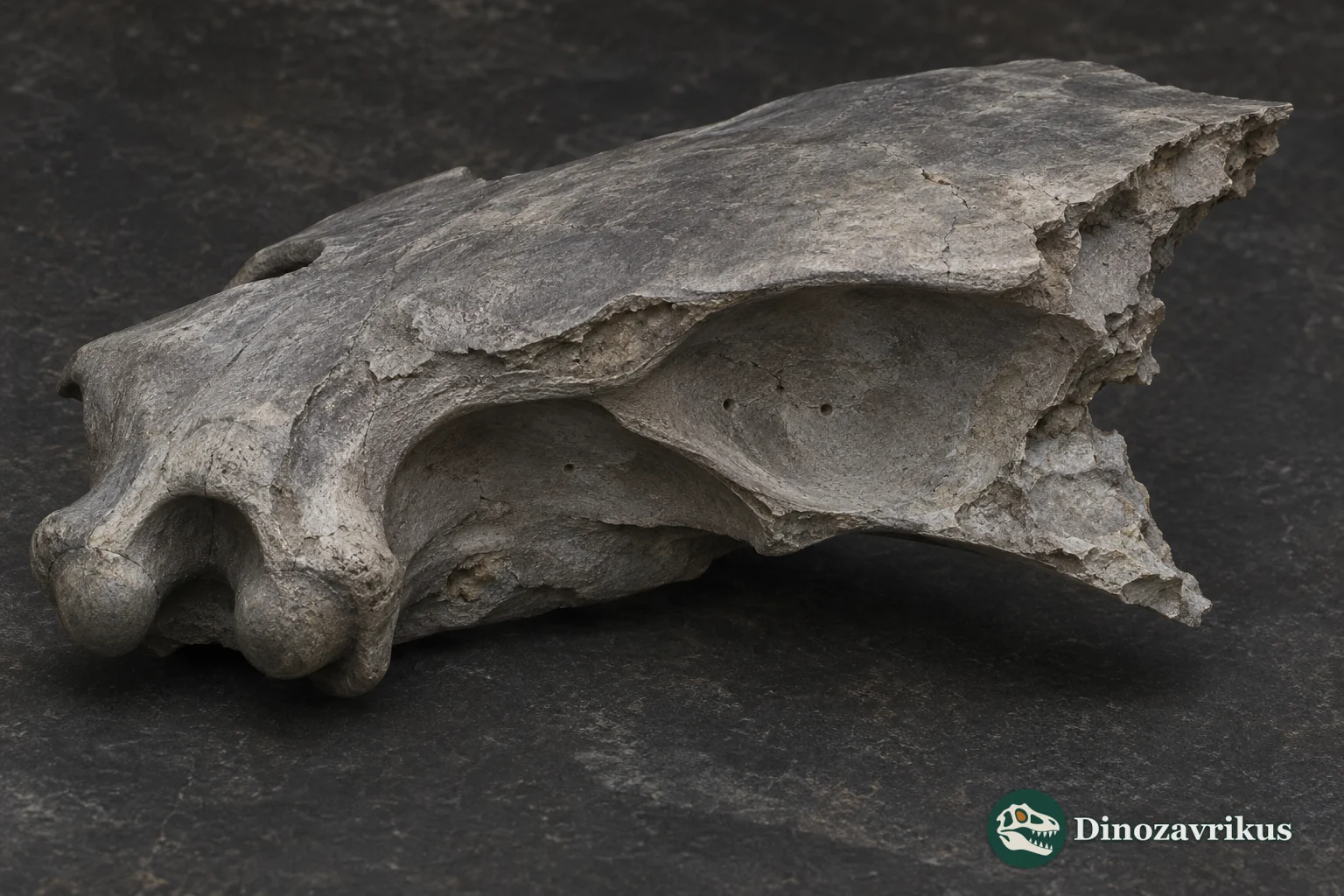
Researchers scanned the rear skull fragment ZIN PH T/F67-218. Its three-dimensional model allowed them to trace spaces and passages inside the bones.
Petrochelys belongs to the softshell lineage. Its exact position varies with the characters and analytical method used.
The first Fergana finds
Lev Nessov named the species Trionyx kyrgyzensis in 1995. The holotype, CCMGE 186/12458, is an incomplete left xiphiplastron from the Albian Alamyshik Formation at Kylodzhun I. Isolated pieces of shell, skull, jaw, vertebrae and limb girdles from the same locality have also been referred to the species.
The genus name Petrochelys was introduced in 2017. The locality yielded enough material to compare features of both the shell and the skull. Those features come from separate specimens, so their association rests on the locality and comparative anatomy.
Inside the skull fragment
Natasha Vitek and colleagues used micro-CT to examine ZIN PH T/F67-218, a fragment from the back of the skull. The scans yielded a three-dimensional model showing spaces and passages hidden beneath the fossil's surface.
The specimen has a single opening for the hypoglossal nerve. The rear jugular opening merges with a neighbouring opening in the back of the skull. Combined with shell features, these details help distinguish Petrochelys from other early softshells.
An early branch of the softshell lineage
Several analyses place Petrochelys in the same part of the tree as the later Khunnuchelys. Its position relative to the living lineages varies between analyses. The fossils record an Albian member of the softshell lineage, but Petrochelys alone cannot provide a secure date for the divergence of modern groups.
The isolated shell bones and partial skull provide anatomical details. They give no reliable estimate of full shell length or evidence identifying its precise diet.
Frequently asked questions
Where was Petrochelys found?
At Kylodzhun I in southeastern Fergana, in what is now Kyrgyzstan.
How old are the fossils?
They come from Albian beds of the Alamyshik Formation. The Albian is the final stage of the Early Cretaceous.
Is the skull the type specimen?
The type is CCMGE 186/12458, a fragment of the lower shell. The skull fragment was found separately at the same locality.
What did the scan reveal?
It revealed passages and openings inside the rear of the skull, including the exit for the hypoglossal nerve.