

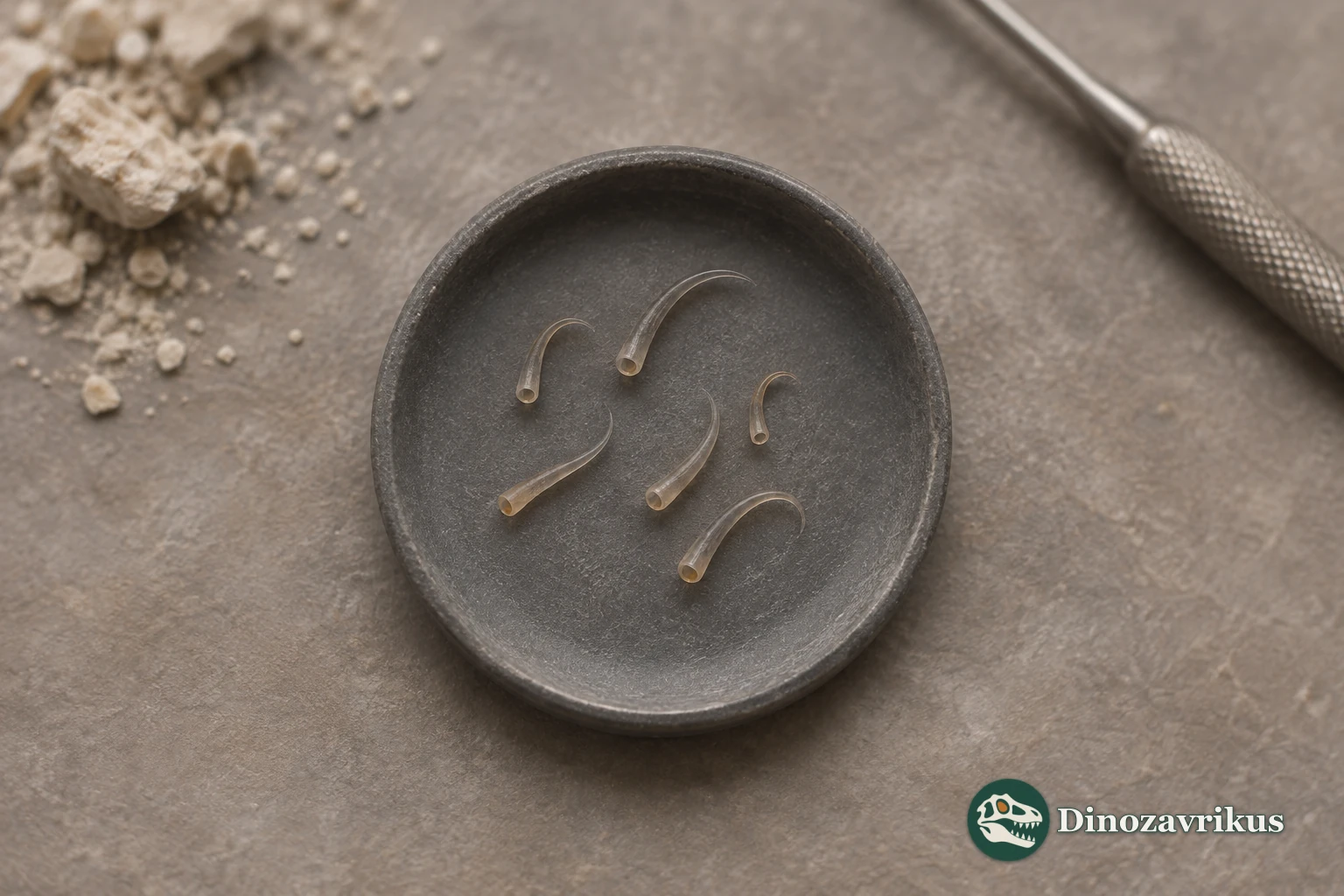
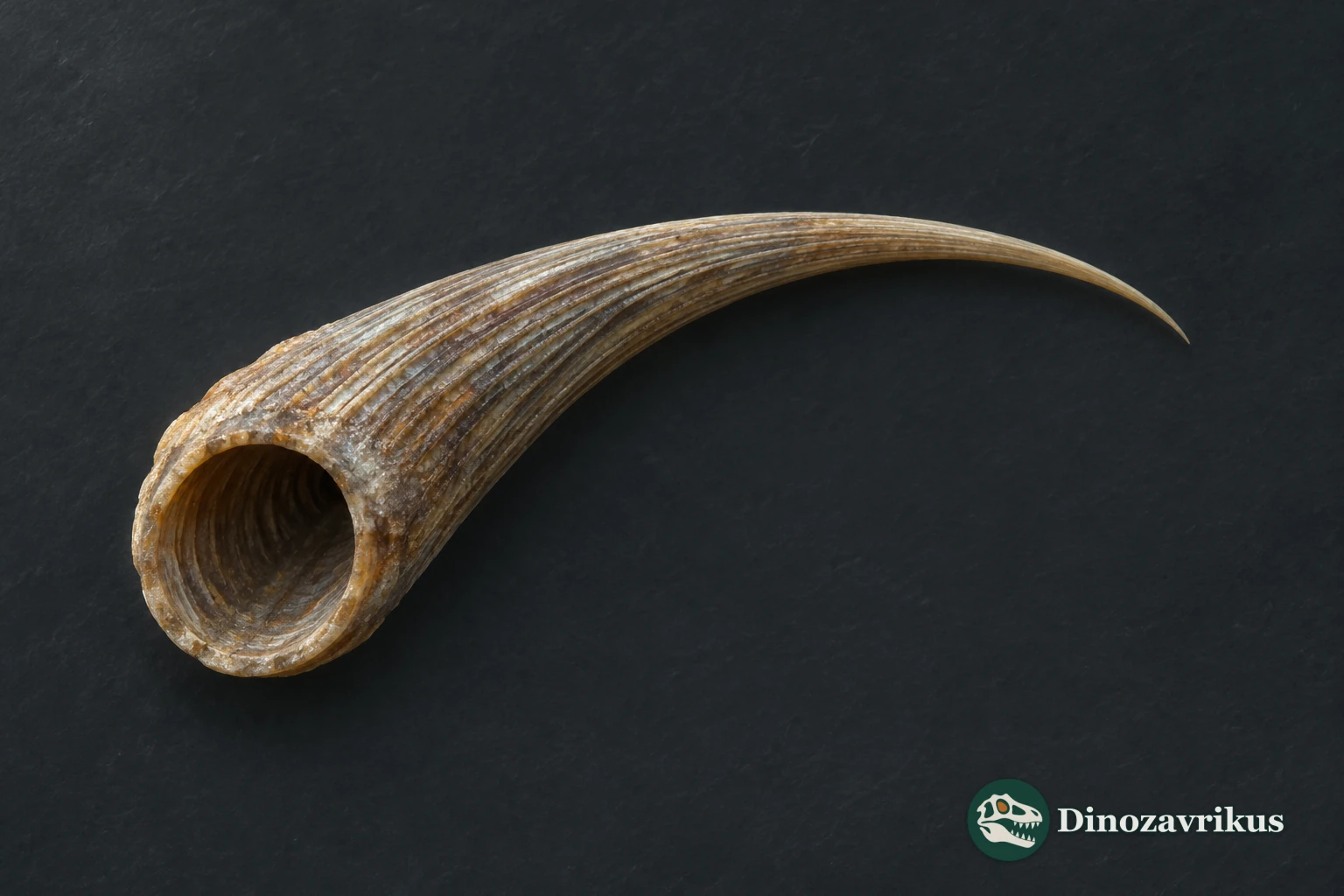
Phakelodus is known from slender curved fossil spines with a hollow at the base. The spines often occur on their own, but some are preserved together as curved rows. Their arrangement and internal structure support identification as the grasping armature of an early chaetognath, or arrow worm.
Quick facts
| Group | Chaetognaths, inferred from spines |
|---|---|
| Age | Cambrian to Early Ordovician |
| Genus established | James Miller, 1984 |
| Type species | Phakelodus tenuis |
| Known remains | Isolated spines and clusters |
| Example apparatus | ZPAL C.IV/6.2, Poland |
What can the fossils tell us?
The curved elements are arranged in rows, allowing comparison with the grasping apparatus of living chaetognaths.
Modern chaetognath spines are organic. The phosphate in the fossils is plausibly a result of mineralisation after burial.
The rows show how grasping elements were arranged. They provide no reliable estimate of the animal's total length or body outline.
From an isolated spine to an apparatus
James Miller established Phakelodus in 1984. Its type species, P. tenuis, had been described by Klaus Müller in 1959 as Oneotodus tenuis. A single element resembles a curved conical tooth, which helps explain why these fossils were long studied alongside conodonts.
The Upper Cambrian specimen ZPAL C.IV/6.2, recovered from the subsurface in northern Poland, preserves a nearly complete grasping apparatus. A different P. tenuis cluster, GMPKU2771, comes from the Chefu Formation at Wangcun in Hunan, China. Natural clusters show how neighbouring spines fitted together before the animal decayed.
Why compare the spines with arrow worms?
Hubert Szaniawski compared the paired rows with the grasping spines of living chaetognaths. Both fossil and living spines have a deep basal cavity. At sufficient magnification the wall of each also shows three layers. The resemblance extends from the shape of the whole apparatus to the microstructure of a single spine.
Fossil spines contain calcium phosphate, while living arrow worm spines are built from organic material. Szaniawski attributed the phosphate to mineralisation after burial. The true conodont Teridontus also had conical elements, but a similar outline alone does not establish a close relationship.
What can be inferred about the animal?
Phakelodus occurs in marine rocks of Cambrian and Early Ordovician age. Some fossils are compressed against shale, while others retain their three-dimensional shape. The armature is consistent with grasping prey. The fossils considered here do not resolve the body outline or document what any one individual ate.
Frequently asked questions
Why was Phakelodus once studied with conodonts?
Its scattered curved spines resemble conical conodont elements. Natural arrangements and the layers of the spine walls revealed different evidence about their origin.
What did the specimen from Poland preserve?
ZPAL C.IV/6.2 preserves a nearly complete grasping apparatus of P. tenuis from Upper Cambrian rocks in northern Poland.
How old are Phakelodus fossils?
They are known from Cambrian and Early Ordovician marine rocks, including the Tremadocian.
Can the spines reveal the animal's total length?
The clusters primarily document the grasping armature. Without the soft body they do not provide a reliable total length.