

Planohybodus was an extinct hybodont shark described from a combination of teeth and skeletal remains. Its type species is better represented than sharks known only from loose teeth, and one Late Jurassic fossil records a tooth associated with a robust ammonite shell. Even so, no complete skeleton or secure whole-body length estimate is available.
Quick facts
| Type species | Planohybodus peterboroughensis Rees & Underwood, 2008 |
|---|---|
| Genus established | Jan Rees and Charlie Underwood, 2008 |
| Placement | Hybodontiform sharks |
| Type locality | Fletton, Peterborough, England |
| Type horizon | Oxford Clay, Callovian |
| Preserved material | Teeth, jaws, fin spines and parts of the skull |
| Accepted species | Three; the Brazilian P. marki is treated as a nomen dubium |
| Species range | Bathonian to Barremian; one separate Late Jurassic tooth association |
What can the fossils tell us?
Teeth have a high, wide central cusp flattened from side to side, strong cutting edges and short simple folds. Shape differs among species and jaw positions, so isolated worn teeth may not be identifiable to species.
The holotype P.8386 associates jaw remains, teeth and fin spines. A paratype preserves a mineralised male skull with cephalic spines and dermal denticles. These finds do not amount to a complete skeleton or establish total length.
A Late Jurassic ammonite impression bears a tooth identified as Planohybodus and possible punctures. It documents contact but does not show whether the shark attacked a live ammonite or scavenged it.
How Planohybodus was named
Jan Rees and Charlie Underwood established Planohybodus in 2008 while revising dental and skeletal material from the Middle Jurassic of England. The type species, P. peterboroughensis, comes from the Peterborough area. The name combines Latin planus, “flat,” with Hybodus, referring to its flattened tooth crown and hybodont affinities.
Holotype P.8386 comprises associated jaw remains with teeth and fin spines from the Oxford Clay at Fletton. Paratype P.62254 is a pyritised male skull displaying cephalic spines, dermal denticles and broken teeth. The exact horizon within the clay was not established; Rees and Underwood gave a Middle or Upper Callovian age. That locality evidence should not automatically be applied to every species in the genus.
Teeth, jaws and spines
The teeth are characterised by a high, wide central cusp flattened labiolingually, prominent cutting edges and short, simple enamel folds. The porous root projects lingually. Tooth details vary between upper and lower jaws; lateral cusplets and crown folds help diagnose species. A worn or incomplete crown may not support identification beyond Planohybodus sp.
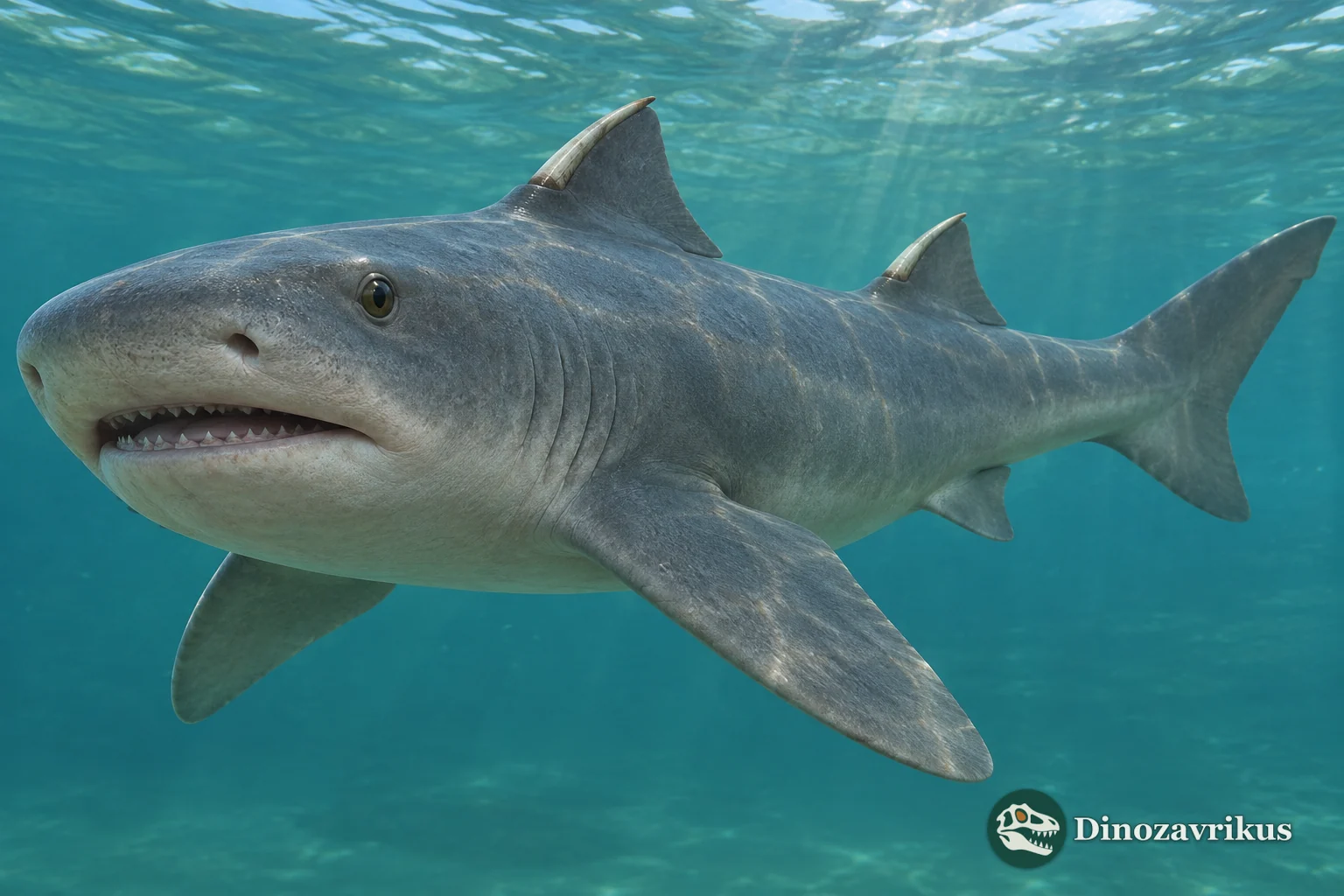
Cephalic and fin spines add anatomical evidence unavailable from teeth alone. The described fin spines carry longitudinal ribs that turn backwards, and several pairs of head spines are known. Still, a collection of individual elements is not a complete articulated skeleton. Published remains do not establish total length or every body proportion.
Three established species and a changing range
The 2008 revision included P. peterboroughensis, Bathonian P. grossiconus and P. ensis, recorded from the Berriasian to Barremian. Later studies continue to recognise those three species, while fragmentary teeth from some localities are left as Planohybodus sp. In 2022, researchers judged the fragmentary Brazilian teeth named P. marki too incomplete to diagnose confidently or to support their placement in this genus.
The Bathonian-to-Barremian interval describes the three established species, not every uncertain tooth referred to the genus. A separate Late Jurassic French find records a tooth associated with an ammonite. It should be discussed as a distinct interaction record, not silently used to expand every species' range.
What an ammonite can tell us
In 2011, Romain Vullo described an internal mould of a Late Jurassic Orthaspidoceras ammonite from western France. A tooth identified as Planohybodus remained associated with it, alongside possible punctures. This unusual fossil documents contact with a robust-shelled ammonite despite the shark's tearing-type teeth.
A single association does not reveal the entire event. It cannot distinguish an attack on a living ammonite from feeding on a dead animal, and it does not make ammonites the shark's specialised prey. Comparisons with other hybodonts, including Egertonodus and the fish known in Russian as Hybodus, are useful for anatomy, not proof of identical diets.
Frequently asked questions
What fossils are known for Planohybodus?
The type species is represented by teeth, jaw remains, fin spines and parts of a skull. No complete skeleton establishes the shark's full proportions.
What is distinctive about its teeth?
They have a high, broad central cusp flattened from side to side, strong cutting edges and short enamel folds. Wear or breakage can prevent a species-level identification.
What does the ammonite find show?
A Late Jurassic ammonite mould from France carries a tooth identified as Planohybodus and possible punctures. It documents an interaction but not the sequence of events or the shark's usual prey.
When did Planohybodus live?
The three accepted species range from the Bathonian to the Barremian. A separate Late Jurassic tooth-on-ammonite association is discussed apart from that species range.