

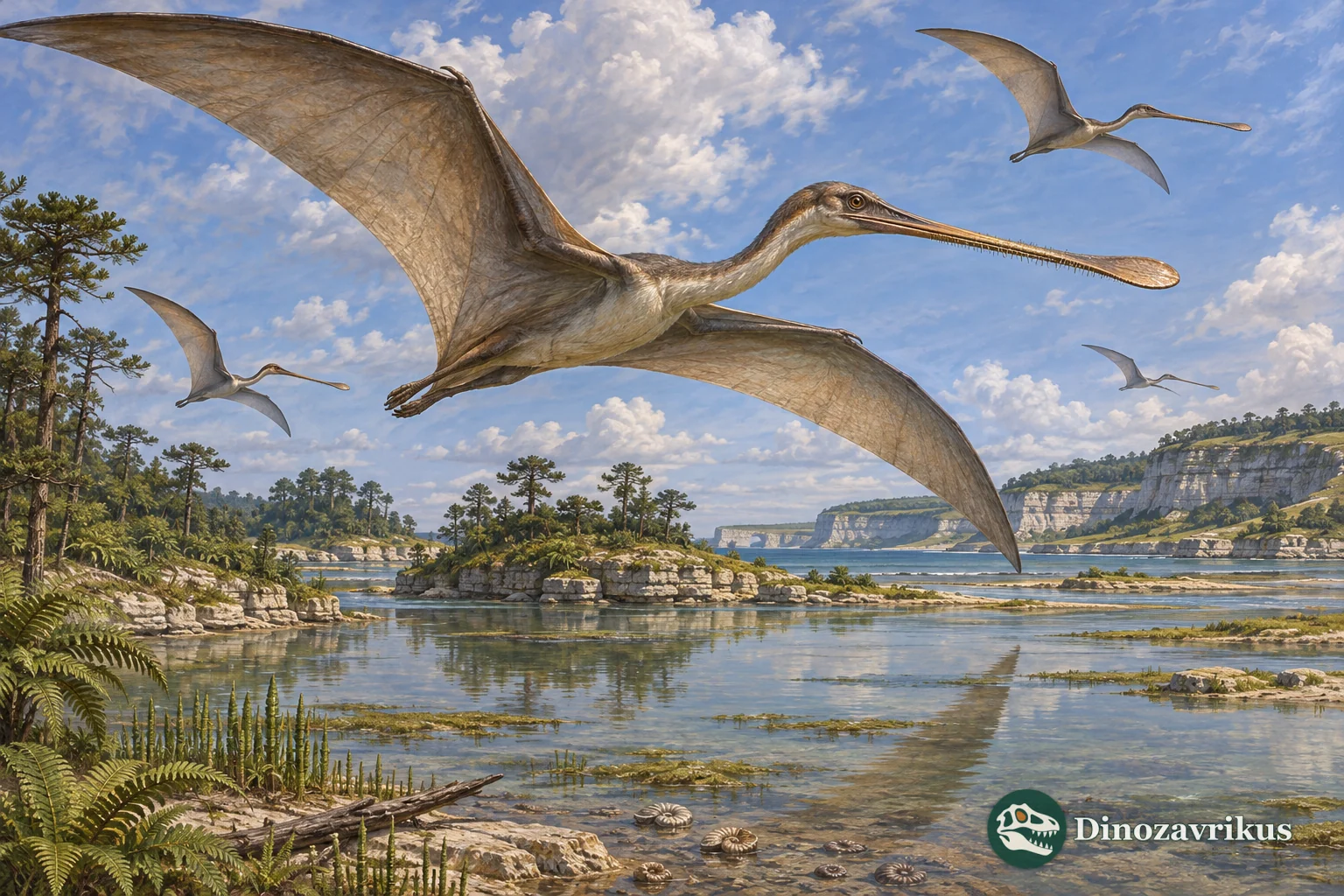
Plataleorhynchus streptophorodon is known from the front of an upper jaw found in Dorset, England. Its narrow snout broadens towards a spoon-like tip lined with teeth. This fossil distinguishes the animal from several relatives, but it does not show its complete head, wings or body. The flying pterosaur in the cover art is a reconstruction.
Quick facts
| Named species | Plataleorhynchus streptophorodon, Howse and Milner, 1995 |
|---|---|
| Holotype | NHMUK PV R 11957, incomplete anterior upper jaw |
| Locality | Purbeck rocks of Dorset, England |
| Geological age | Near the Jurassic–Cretaceous boundary; precise placement depends on stratigraphy |
| Diagnostic feature | Laterally expanded, spatulate snout tip with teeth |
| Wingspan | Not securely established from the fossil |
| Relationships | Ctenochasmatid related to Gnathosaurus |
What can the fossils tell us?
NHMUK PV R 11957 preserves the front of the snout. It provides neither a complete skull nor a wing skeleton.
The anterior jaw widens sideways. The head, neck and living tissues beyond that bone require comparative reconstruction.
Teeth and sockets permit anatomical comparisons, but no gut contents or prey remains identify its actual food.
Without wings or a trunk, the holotype cannot yield a secure wingspan or whole-body outline.
Discovery in the Purbeck rocks
Stephen Howse and Angela Milner named the genus and species in 1995 in a study of pterodactyloid fossils from Dorset's Purbeck Limestone Formation. Their type specimen, NHMUK PV R 11957, is part of the anterior rostrum. The study also considered other Purbeck pterosaurs, but those separate finds do not make up a skeleton of Plataleorhynchus.
Purbeck strata span an interval close to the Jurassic–Cretaceous boundary. Different stratigraphic schemes place individual beds differently. A single jaw cannot provide a precise date for the life or death of the animal. Geological age here refers to the rock record, not a direct date for the specimen itself.
What the jaw reveals
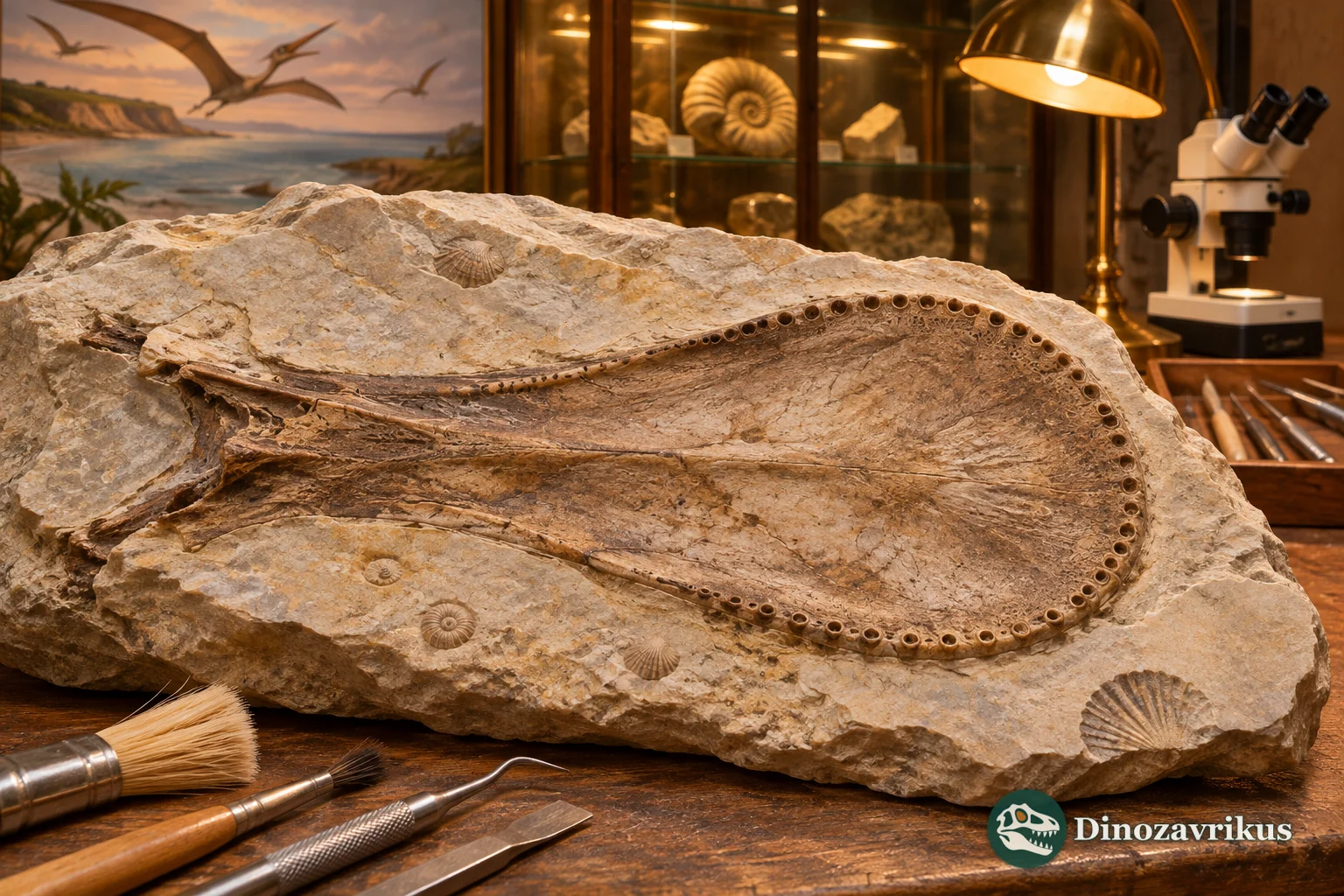
The front of the rostrum expands laterally to form a broad rounded outline. Teeth and sockets along its margin were central to the original comparison with other pterosaurs. Later researchers compared the type jaw with other ctenochasmatids, especially Gnathosaurus. Shared features are useful in assessing kinship but do not make the two named animals identical.
The back of the skull is missing, so a complete head length, crest or neck proportion cannot be measured. Nor does the specimen preserve wing elements. A flight portrait imports broad features of related pterosaurs and cannot be used to calculate this genus's wingspan.
Relationships and feeding possibilities
Plataleorhynchus is usually treated as a ctenochasmatid. Ctenochasma shows a much denser tooth row, whereas Petrodactyle is known from far more of its skeleton. Those comparisons illuminate the diversity of jaws in the group, while leaving the missing Plataleorhynchus anatomy unknown.
The widened tip and teeth have prompted suggestions that this pterosaur handled small aquatic prey near shorelines. That is an anatomical inference. There are no identified stomach contents, feeding traces or direct prey remains for the named specimen. Water depth, exact capture method and daily movements remain unknown.
What the pictures can show
The illustrated research slab is fictional and is not a photograph of NHMUK PV R 11957. A Purbeck coastal scene evokes a possible environment, but group flight, skin colour and posture are artistic choices. They should be read alongside the much narrower evidence preserved in the jaw.
Frequently asked questions
What fossil defines Plataleorhynchus?
NHMUK PV R 11957, an incomplete anterior upper jaw from Dorset's Purbeck rocks. A complete skeleton is unknown.
Why is the snout called spatulate?
Its preserved front broadens sideways into a rounded, spoon-like tip. That shape alone does not prove one feeding method.
Is its wingspan known?
No secure wingspan can be calculated from the type jaw because no wing bones belong to the specimen.
What did it eat?
The teeth invite comparisons with other pterosaurs, but no direct food remains identify its exact diet.