

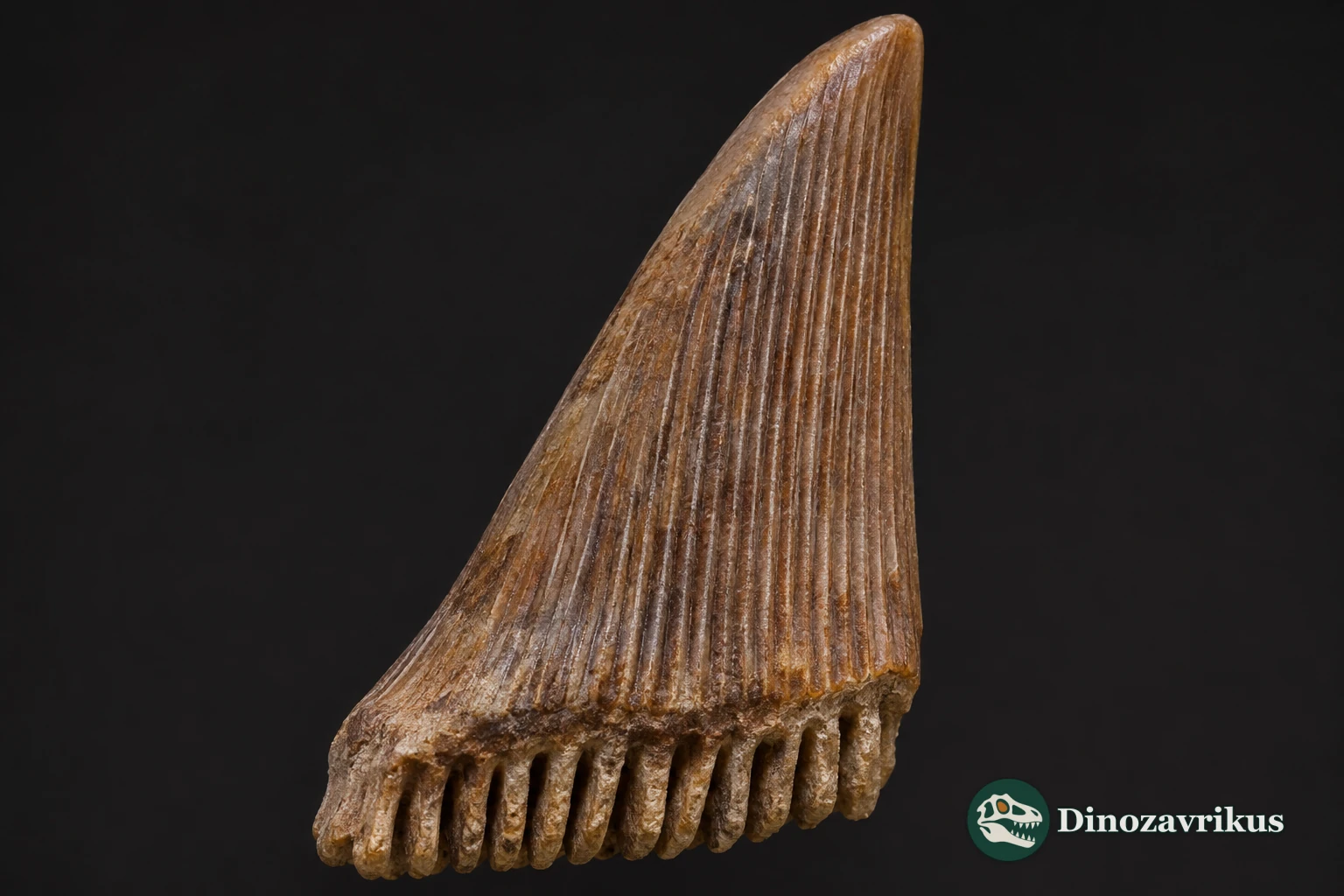
The teeth of Plinthicus stand high above their roots, narrow from front to back and marked by vertical ridges. Loose teeth identify this ray in Oligocene and Miocene marine deposits. They also led to different ideas about its relatives. Some researchers emphasised crown shape, while others asked how the teeth could have fitted together in a jaw.
Quick facts
| Order | Myliobatiformes |
|---|---|
| Type species | Plinthicus stenodon |
| Fossils | Isolated teeth |
| Age of records | Oligocene and Miocene |
| Key localities | Belgium, eastern United States and southern France |
| Affinities | Cownose rays and devil rays have both been proposed |
What can the fossils tell us?
Its working surface is flat and the ridges branch. A preserved tooth row is still unknown for this species.
Loose teeth from the Pungo River Formation support a proposed arrangement. They were recovered separately from their jaws.
Their thin shape contrasts with the heavy crushing teeth of many rays. No preserved gill apparatus establishes whether Plinthicus filtered food.
From Miocene teeth to an older record
Edward Drinker Cope named Plinthicus stenodon from North American material in 1869. Teeth attributed to the same species were later described from Miocene deposits in southern France. David Cicimurri and James Knight referred specimens from the Chandler Bridge Formation of South Carolina to this species, extending its record back into the late Oligocene.
In 1990, Taco Bor named Plinthicus kruibekensis from a single tooth, RGM 177500, from Kruibeke in Belgium. Bor collected it in a clay pit in 1984, and it is housed in the museum collection in Leiden. The tooth came from the Putte Member of the Boom Clay Formation, of Rupelian age. Its flat working face and branching ridges contrast with the concave surface and more nearly parallel ornament of the younger North American form.
Three tooth types in the Pungo River sample
Robert Purdy and colleagues examined several hundred isolated teeth from the Miocene Pungo River Formation of North Carolina. They identified three forms with differences in symmetry and breadth. The roots are divided into thin plates, another feature that can be compared across the sample. Loose teeth can differ because they sat in different parts of a jaw, so the full range of shapes matters.
The older Eocene ray Eoplinthicus is also identified from the shape of individual crowns and roots. Plinthicus is distinctive for its tall crown, compressed from front to back. A tooth can preserve those details much more readily than the original arrangement of a row.
A debated place among the rays
Some authors allied Plinthicus with devil rays on the basis of crown features. Purdy and colleagues compared their inferred tooth arrangement with that of cownose rays. Some lateral teeth from Chandler Bridge are lower at one end than the other, another feature shared with cownose rays. These comparisons remain dependent on how the separate teeth are interpreted.
The high, narrow crowns have informed hypotheses about feeding on small or soft organisms. No associated gill apparatus or prey remains confirm a feeding mechanism. The artwork uses a general ray silhouette because the teeth do not establish the exact head and fin shapes of Plinthicus.
Frequently asked questions
Which species was named first?
Edward Drinker Cope named Plinthicus stenodon in 1869.
What is the Belgian species based on?
One tooth from the early Oligocene Boom Clay at Kruibeke.
Were all the teeth alike?
The Pungo River sample contains three forms that differ in breadth and symmetry.
Can we estimate the span of the fins?
The known teeth do not provide a reliable fin span.