

Plotopterum joaquinensis is the seabird that gave the extinct Plotopteridae their name. It is known from part of a bone that braced the shoulder against the chest. More complete relatives later supplied the direct evidence that plotopterids swam with their wings.
Quick facts
| Type species | Plotopterum joaquinensis |
|---|---|
| Family | Plotopteridae |
| Age of the type | Near the Oligocene–Miocene boundary |
| Type locality | Pyramid Hill, Kern County, California |
| Holotype | LACM 8927 |
| Type material | Shoulder end of a left coracoid |
What can the fossils tell us?
The surface for the scapula is flat, and the humeral facet does not project beyond it. These details allow a comparison with other plotopterids.
Early accounts called the deposit Miocene. Later work put the Pyramid Hill sands at 24–25 million years old, on the Oligocene side of the boundary.
The femur from Mizunami resembles plotopterid femora. A corresponding thigh bone is not preserved in the Californian type, so the referral remains provisional.
A fragment from Pyramid Hill
Hildegarde Howard described Plotopterum joaquinensis in 1969. Its type, LACM 8927, is held by the Natural History Museum of Los Angeles County. It preserves the shoulder end of a left coracoid, a bone which connected the shoulder to the breastbone.
Howard treated the marine sands at Pyramid Hill as early Miocene. A later estimate places the Pyramid Hill Sand Member of the Jewett Sand Formation at about 24–25 million years old, in the late Oligocene. Recent comparisons describe the Californian record as close to the Oligocene–Miocene boundary.
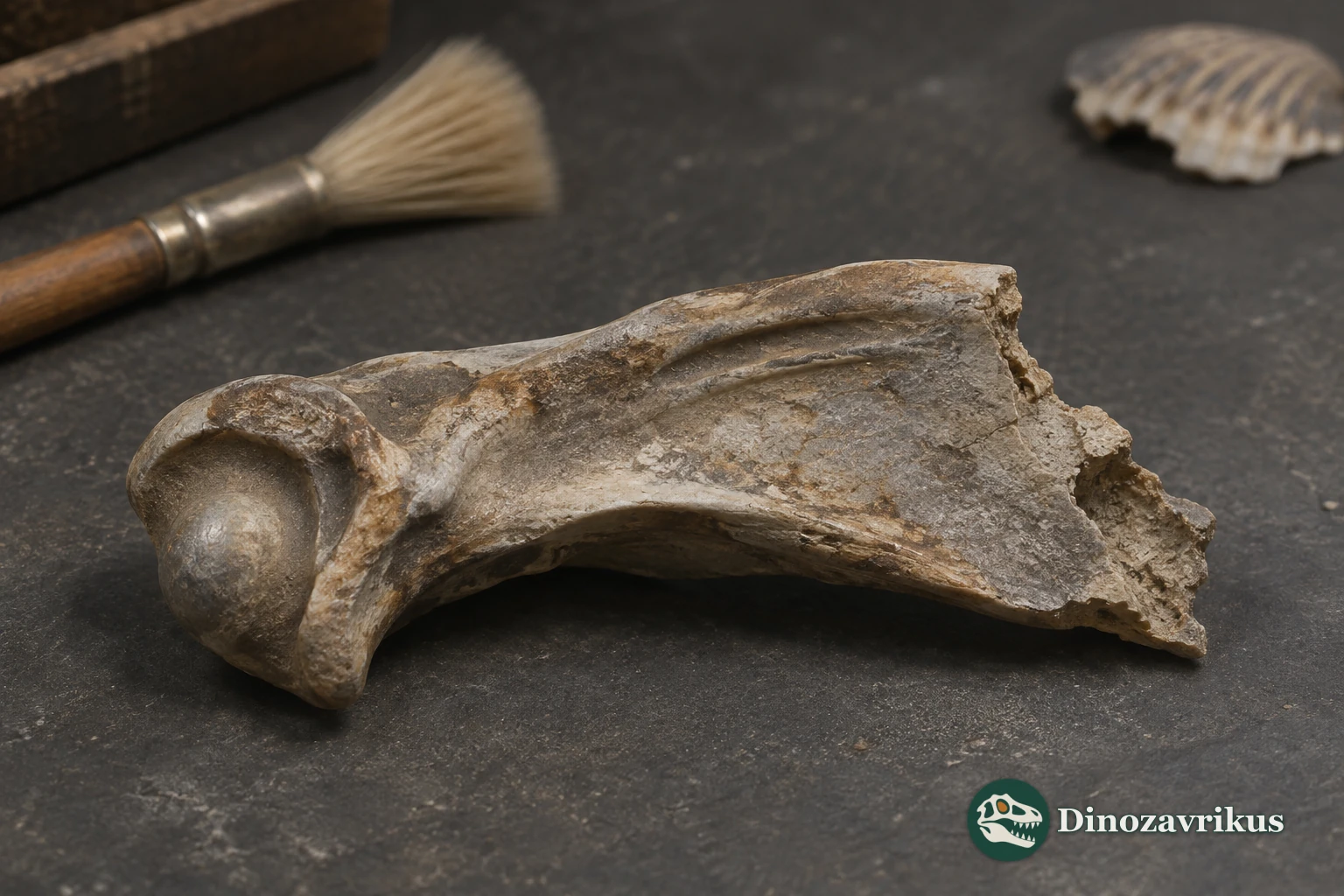
What the shoulder tells us
Howard inferred a diving bird from the coracoid. Later finds of relatives such as Tonsala preserved more of the skeleton, including wings shaped for underwater propulsion. Plotopterum itself preserves a much narrower window on that anatomy. Its flat scapular facet differs from the corresponding surface in several geologically older plotopterids.
In 1976 Tatsuya Kaede found a nearly complete left femur near Mizunami on Honshu. Storrs Olson and Yoshikazu Hasegawa referred it to Plotopterum sp. in 1985. Revised dating places the Japanese deposits at roughly 16–17 million years old. The original Californian fossil preserves no femur, so a direct test of the generic referral is still lacking.
Frequently asked questions
Which part of the skeleton is the type?
The shoulder end of a left coracoid. It retains joint surfaces but says little about the complete wing or skull.
Was it a kind of penguin?
It was a plotopterid. That family independently evolved a way of swimming similar to the wing strokes of penguins.
Why do published ages for the type differ?
The sand was originally described as early Miocene. Later work revised the age to close to the boundary with the Oligocene.
Is the Japanese bone the same species?
The authors named no species for the Japanese femur. It was provisionally referred to the genus.