

Fossils from Fuente Amarga near Préjano in Spain include partial jaws and other separated bones of several pterosaurs. Three adjoining snout fragments, catalogued as FA 112, define Prejanopterus curvirostris. They document the front of the head but cannot reveal the entire living animal. The cover is an artistic interpretation, not a fossil photograph.
Quick facts
| Named species | Prejanopterus curvirostris, Fuentes Vidarte and Meijide Calvo, 2010 |
|---|---|
| Holotype | FA 112, three adjoining rostrum fragments |
| Additional snout | FA 185; six preserved teeth |
| Locality | Fuente Amarga near Préjano, La Rioja, Spain |
| Rock unit and age | Leza Formation, Early Cretaceous; exact age debated |
| Estimated wingspan | About 1.5–2 m in an adult, by comparison |
| Key feature | Long toothed rostrum with a short toothless tip |
What can the fossils tell us?
FA 112 preserves around 140 mm of rostrum. The back of the skull and soft tissues are not known from it.
At least 19 pairs of sockets were described on FA 112; FA 185 retains six teeth. Neither specimen preserves a meal.
The initial description took a lateral bend as anatomical. Reassessment attributed that appearance to post-burial deformation.
The Leza Formation has been assigned to different Early Cretaceous intervals. The fossils alone cannot settle that stratigraphy.
Discovery and collection
The Fuente Amarga fossil locality was discovered in 1980 by Blaschke, Palacios and Pérez-Lorente, and excavated systematically in 1993–1994. The 2010 description named a pterosaur from the long snout FA 112 and associated other scattered material from the site. Fossils preserved apart cannot simply be assembled into a complete individual.
A later reassessment recognised at least five individuals from overlapping jaw elements. That is a minimum count of animals, not the number of inventoried fragments. The material is held at the palaeontological centre in Enciso. Multiple jaws and separate limb bones explain why a single complete body cannot be reconstructed directly.
Snout, teeth and corrected name
FA 112 preserves about 140 mm of anterior rostrum with at least 19 pairs of tooth sockets and a short toothless tip. A second snout, FA 185, retains six teeth. These are direct dental observations, not proof of a particular prey item or feeding behaviour.
The original account treated a sideways bend in the snout as natural and used the epithet curvirostra. A 2012 reassessment concluded that the lateral bend resulted from fossil deformation, and corrected the species spelling to curvirostris. A slight upward curve in profile and a distorted sideways bend are distinct points.
Age, size and relationships
The fossils come from the Leza Formation of La Rioja. One stratigraphic interpretation assigns it to the late Barremian–early Aptian, while another places it in the Berriasian–Valanginian. Stating a narrow age without acknowledging that conflict would suggest a certainty the rocks do not provide.
The 2012 authors estimated an adult wingspan of roughly 1.5–2 m by comparing incomplete elements. This is not a measurement of a spread fossil wing, and parts from the locality may represent different individuals. Prejanopterus has been discussed among early pterodactyloids. Petrodactyle and Cycnorhamphus offer anatomical comparisons, not missing pieces of this Spanish fossil.

Illustration and evidence
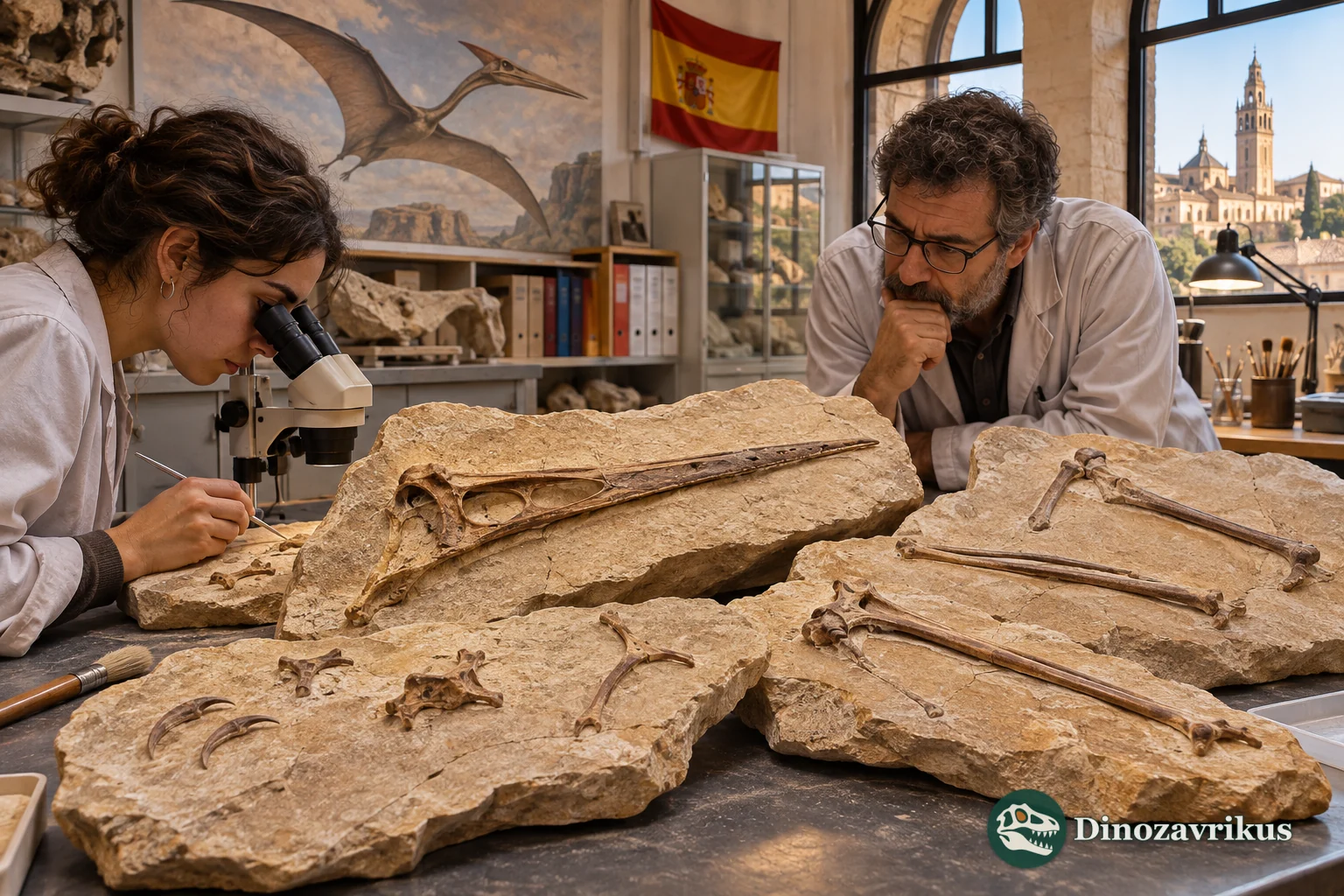
A reconstructed animal beside a coastal lake evokes one plausible setting, while the laboratory scene explains why researchers must compare disarticulated pieces. Neither illustration depicts FA 112, FA 185, actual scientists or an observed flight. They cannot establish the animal's colour, precise prey or behaviour.
Frequently asked questions
How many individuals were found at Fuente Amarga?
At least five were distinguished in the reassessment from overlapping jaw elements. The number of separate bones is much larger.
Was the snout naturally bent sideways?
The later study attributed the conspicuous lateral bend to post-burial distortion, not the usual living form.
Why is the fossil's age uncertain?
The Leza Formation has been placed in different Early Cretaceous intervals in competing stratigraphic schemes.
Is the 1.5–2 m wingspan measured directly?
No. It is a comparative adult estimate from incomplete bones, not a preserved fully extended wing.