

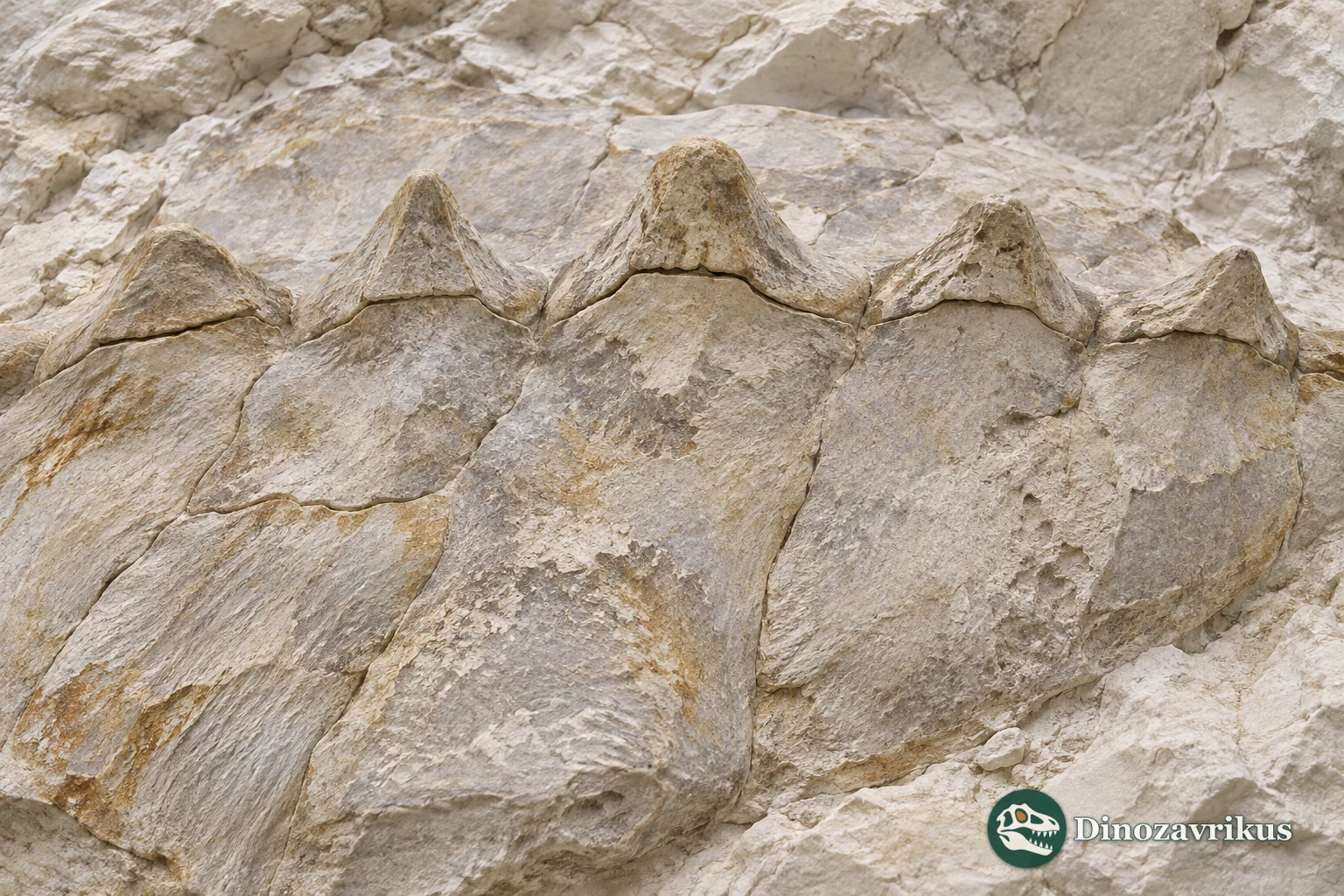
Prionochelys swam in the seas of Late Cretaceous North America. Its serrated shell was topped by an uneven ridge. Specimens from Alabama preserve part of that ridge in place, including small, separate bones that sat above the usual midline plates.
Quick facts
| Group | Turtles, marine turtles (Ctenochelyidae) |
|---|---|
| Age | Late Cretaceous |
| Region | North America: Alabama, Arkansas and Kansas, USA |
| Type species | Prionochelys matutina |
| Holotype | FMNH P27561, shell material |
| Scientific name | Prionochelys |
| Diet | No direct evidence |
What can the fossils tell us?
The epineurals sit above the midline row of carapace bones. The contacts show that they are distinct elements.
The front face of the rearmost midline bone is broader in larger specimens. Some differences between shells reflect growth.
Comparison with better Alabama shells led to P. galeotergum being assigned to P. matutina.
The Alabama fossils
Rainer Zangerl named the genus in 1953. The holotype of P. matutina, FMNH P27561, came from the Mooreville Chalk in Dallas County, Alabama. Andrew Gentry’s redescription included more complete specimens from the Mooreville Chalk and Eutaw Formation. Small and large shells preserved overlapping parts and made it possible to track changes over an individual’s growth.
How the ridge was built
Small bones called epineurals capped some of the midline bones of the shell. Together these elements made the keel rise and fall in a series of peaks. The outer bones at the back had deep notches, and the carapace retained openings between plates. Ctenochelys also had bones above its carapace. Some of the peaks in Prionochelys projected farther above the shell.
These bones provide a test of how sea turtle shells evolved. A phylogenetic analysis favoured independent origins of extra shell ossifications in ctenochelyids and the leatherback lineage. Comparison of the microscopic tissues could help determine how similar the structures were.
Which species are recognised?
Zangerl named P. nauta from the Marlbrook Marl of Arkansas and P. galeotergum from the Niobrara Formation of Kansas. On re-examination, the Kansas shell’s extra bone near the tail fit the same pattern as P. matutina. The adjacent bone also becomes broader as the turtle grows, so its narrowness was likely an age difference. Gentry recognised the Kansas specimen as P. matutina and retained P. nauta as a separate species.
Frequently asked questions
Why is it called a saw-toothed turtle?
The edge of its carapace was serrated and a row of peaks rose along its back.
What is an epineural?
It is a small extra bone that sits above a bone of the shell’s midline row.
Why was the Kansas species reassigned?
Its supposed distinguishing features either matched P. matutina or could be explained by growth.
Where was the type of P. nauta found?
It came from the Marlbrook Marl in Howard County, Arkansas.