

Procolpochelys was a sea turtle of the western Atlantic. Fossils from Oligocene South Carolina and Miocene deposits farther north represent two species. Both preserve enough anatomy to compare turtles that lived in the same coastal region at different times.
Quick facts
| Group | Turtles, marine turtles (Pan-Cheloniidae) |
|---|---|
| Age | Oligocene and Miocene |
| Region | North America (Atlantic coast of the United States) |
| Type species | Procolpochelys grandaeva |
| Type material | ANSP 9210–9212, three midline carapace bones |
| Scientific name | Procolpochelys |
| Carapace length | Up to an estimated 1.5 m for P. grandaeva |
| Diet | Exact diet unknown |
What can the fossils tell us?
The type bones record details of the carapace midline. Their common locality cannot establish that they came from one animal.
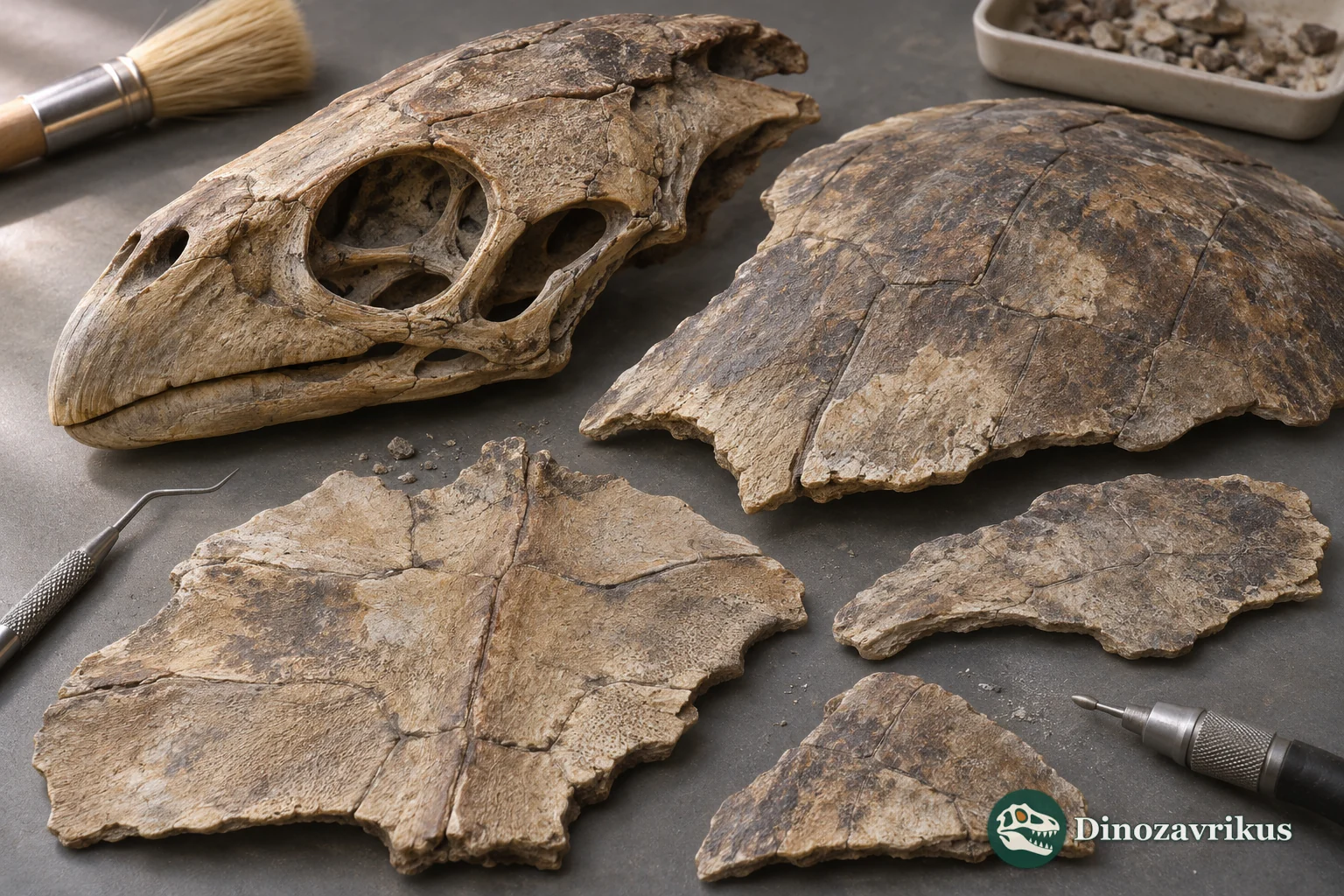
Specimen CCNHM 893 preserves the skull with its lower jaw. It fills gaps left by the shell-dominated type material of the Oligocene species.
A shallow oval scar resembles the footprint of a barnacle. The animal responsible for the mark is unknown.
The Miocene type species
Joseph Leidy named the type species in 1851. Oliver Hay erected Procolpochelys for it in 1908. Three midline shell bones, ANSP 9210–9212, from Miocene marl in Salem County, New Jersey, anchor P. grandaeva. They were collected at the same locality, although their association with one individual remains uncertain.
More complete carapaces from Atlantic coastal deposits show how large the species could grow. In large individuals the upper shell reached an estimated 1.5 metres. The costal plates thickened substantially during growth. Gaps between some costal and peripheral bones remained open even in large individuals.
What the Charleston fossils added
Robert Weems and Albert Sanders named P. charlestonensis in 2014. The type, ChM PV6056, preserves much of the carapace with other bones from the Chandler Bridge Formation. Material attributed to the same species also occurs in the older Ashley Formation.
A later study described an associated skull and jaws, CCNHM 893. They show a broad snout and a well-developed secondary palate. Features at the base of the skull and in the humerus have been compared with those of the lineage that includes the living loggerhead.
A mark left on the shell
A Miocene carapace from the Calvert Formation bears a shallow oval scar about 25 mm across. Its shape is consistent with a barnacle attachment, a hypothesis based on the mark remaining in the bone. Other shells from the same deposits record a different marine turtle, Trachyaspis.
Frequently asked questions
What was the type species named from?
Three bones from the midline of the upper shell, catalogued as ANSP 9210–9212.
What did the Charleston skull add?
It preserves the snout and the secondary palate with its associated lower jaw.
What part could reach 1.5 metres?
The estimated length of the upper shell in large P. grandaeva.
What may have left the oval scar?
A barnacle could have attached to the shell and left the mark.