

Proconodontus was an early euconodont. Its fossils are small curved cones with a thin outer crown and a deep cavity inside the base. Their shape, growth layers and position in the rocks each reveal something different about the animal.
Quick facts
| Group | Conodonts (euconodonts) |
|---|---|
| Age | Late Cambrian and Early Ordovician |
| Region | North America, Europe, Asia, South America, Australia |
| Diet | Unknown |
| Type species | Proconodontus muelleri |
| Genus named by | James Miller, 1969 |
What can the fossils tell us?
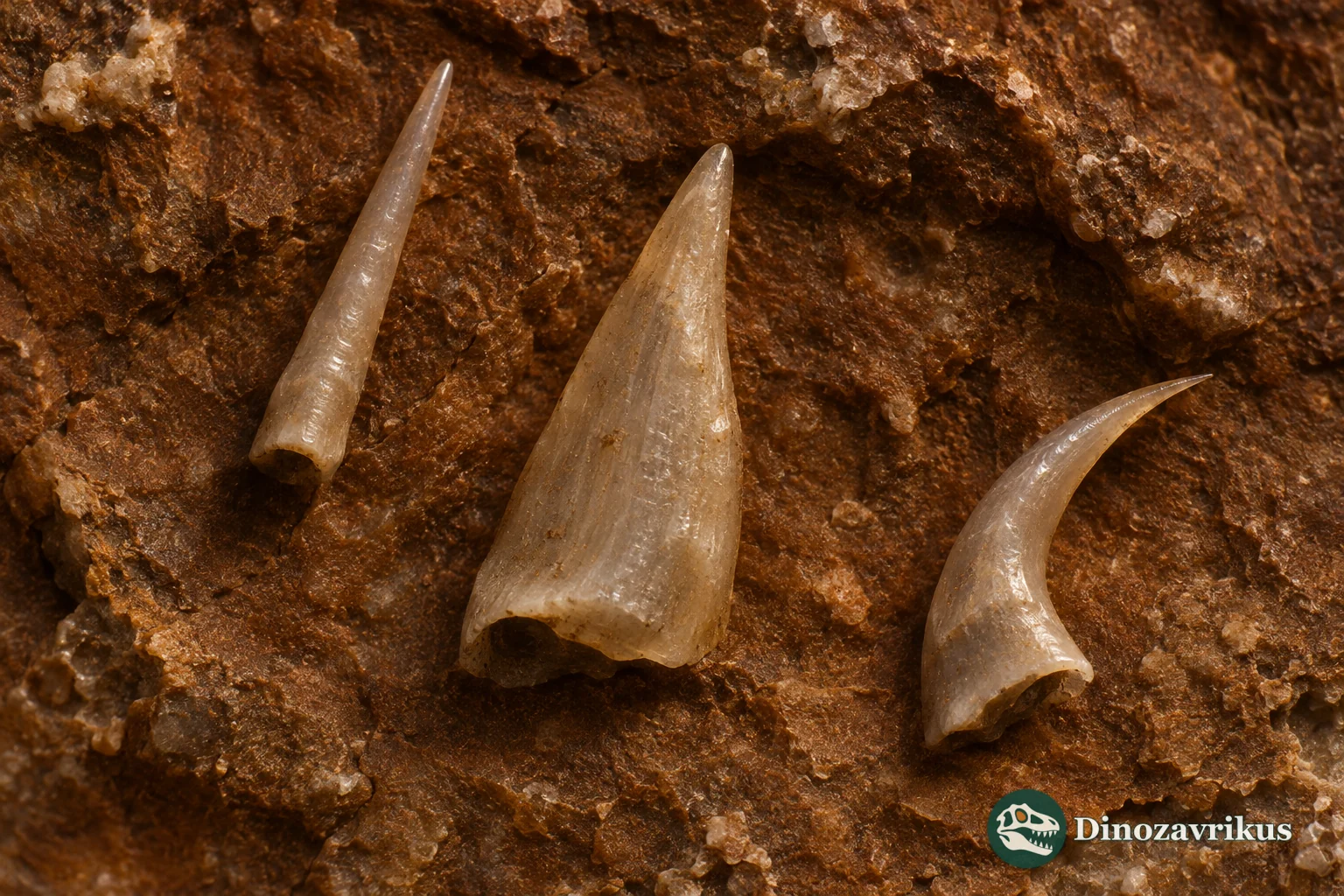
About 900 elements of P. muelleri include rounded, laterally compressed and more abruptly bent cones.
Layers of different thickness record the successive addition of tissue. Their number alone does not give an age in days or years.
The Proconodontus Zone in western Hunan begins with the appearance of P. muelleri and ends at the first occurrence of Eoconodontus notchpeakensis.
The original material and the shape of the cones
James Miller named the genus in 1969 from the Notch Peak Limestone of the House Range, Utah. In Proconodontus muelleri, the cavity extends almost to the tip. Narrow keels occur along the margins of many elements. In the similar Eoconodontus, the cavity usually stops short of the tip, and the tissue above the cavity has a pale core.
Hubert Szaniawski and Stefan Bengtson recognised three main forms in the Swedish collection: slender cones with rounded sections, wider laterally compressed cones, and sharply bent ones. The shapes may represent different positions in the apparatus. Isolated fossils give limited evidence of the arrangement.
Growth increments and rock sequences
Isabella Leonhard and colleagues counted 58 growth increments in one P. muelleri element. They found no microwear in the specimen, and its strontium-to-calcium ratio changed little. That result pertains to the element examined and leaves the diet unresolved.
The sequence of Proconodontus species helps correlate Late Cambrian beds in Hunan. Material is also known from Queensland. Three compressed cones of the type species came from the Early Ordovician Santa Rosita Formation in northwestern Argentina. The rounded and sharply bent forms represented in Sweden were absent from that small sample.
Frequently asked questions
Where was the type species described from?
The Notch Peak Limestone of the House Range in western Utah.
How deep is the cavity in P. muelleri?
It extends through most of the element and ends near the tip.
Is the diet of Proconodontus known?
It remains unresolved. One studied element records growth but showed no detectable microwear.
Does Proconodontus occur after the Cambrian?
Yes. Elements of P. muelleri are documented from the Early Ordovician Santa Rosita Formation of Argentina.