

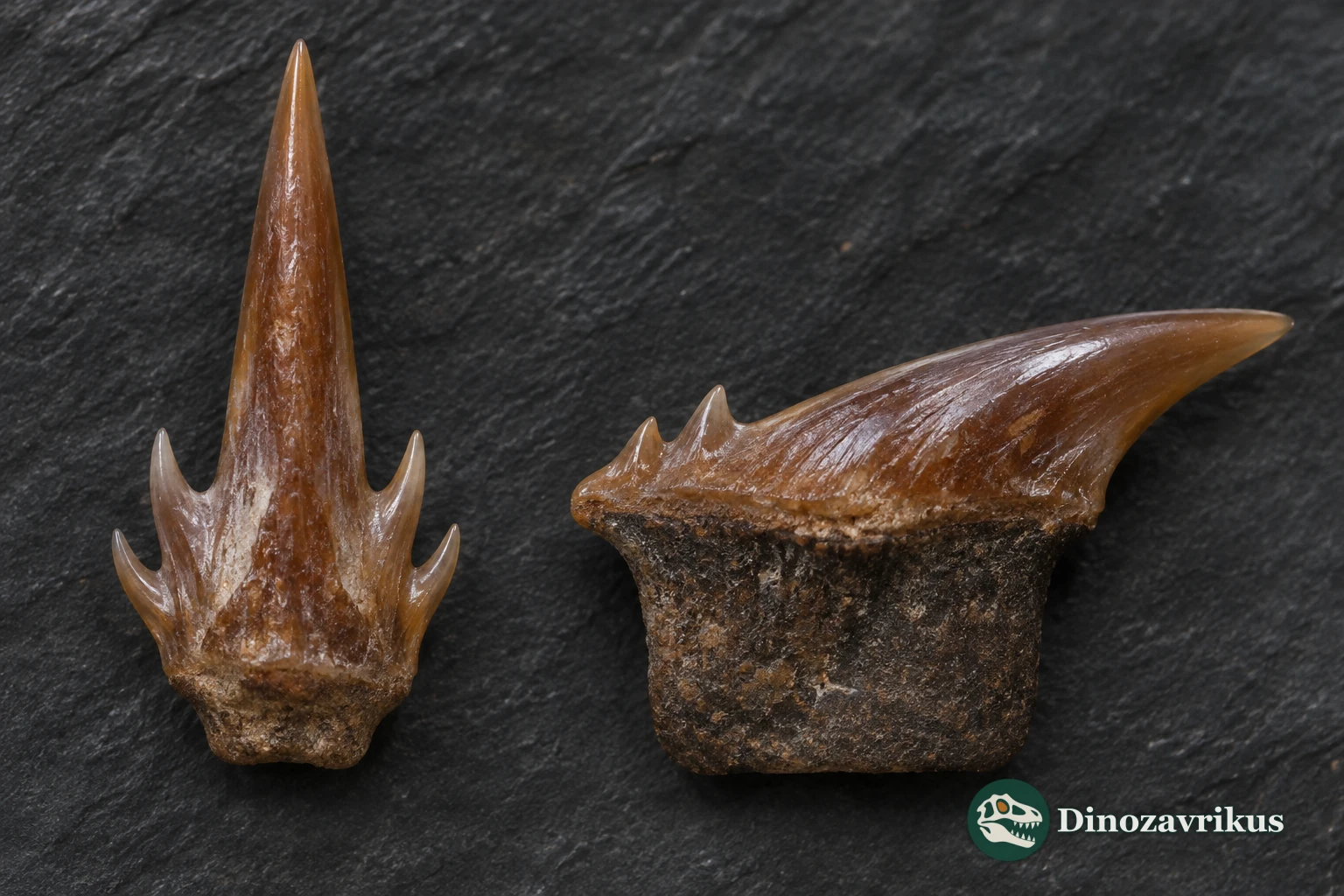
Proetmopterus was a Late Cretaceous dogfish shark with strikingly different upper and lower teeth. Upper teeth carried a tall point and smaller side points. In the lower jaw the main point was inclined, making a low cutting edge. Comparing loose teeth from European deposits helped palaeontologists recognise members of the genus.
Quick facts
| Order | Squaliformes |
|---|---|
| Type species | Proetmopterus hemmooriensis |
| Age of key records | Maastrichtian, Late Cretaceous |
| Fossils | Isolated upper and lower teeth |
| Localities | Germany, Sweden, Denmark and Austria |
| Family in the descriptions | Lantern sharks |
What can the fossils tell us?
The German material was initially named as Etmopterus. The Swedish study justified recognising it in a genus of its own.
Each crown has two pairs of side points. No lower teeth were confidently assigned to this species in that sample.
The same assemblage yielded an upper tooth with needle-like points. The teeth were recovered loose from sediment.
From Hemmoor to southern Sweden
Jacques Herman described Etmopterus hemmooriensis in 1982 from Maastrichtian material at Hemmoor in northern Germany. The type specimen is kma 257. In 1993, Mikael Siversson established Proetmopterus while studying fossil dogfish sharks from southern Sweden. His comparison also showed that some teeth listed in the type series of other Cretaceous sharks belonged to Proetmopterus.
Individual dogfish teeth can be misleading. The sleeper shark Palaeocentroscymnus also combined tall upper teeth with blade-like lower teeth. Small features such as the contour of the root and the positions of its openings help distinguish similar specimens.
Two upper teeth from Stevns Klint
The Maastrichtian chalk of the Højerup Member yielded two well-preserved upper teeth, MGUH 29914 and MGUH 29915. They were described as 1.2 millimetres high and 0.8 millimetres wide. Each had a triangular main point that leaned slightly towards the corner of the jaw, with two pairs of progressively smaller cusplets. A central groove divided the base of the root.
The Danish authors could not identify lower teeth in the material they examined. They suggested the missing form might be rare, fragile, or easily confused with the lower teeth of another species.
A second species from Austria
Iris Feichtinger and colleagues described Proetmopterus lukasi from the latest Maastrichtian at Waidach, north of Salzburg. Their paper appeared online in 2022 and in a 2023 journal issue. The holotype, lower tooth NHMW 2022/0152/0002, came from horizon 4 of the Gerhartsreit Formation and is housed in the Natural History Museum Vienna.
The lower teeth resemble those of the type species. On the inner face of the Austrian roots, one of the marginal openings is distinctly larger than the other. The two openings are usually similar in size in the type species. The clearest differences occur in the single upper tooth identified by the authors, with straighter, slender needle-like points and a more angular root. The dental evidence has led researchers to classify the genus with lantern sharks. Whether Proetmopterus itself could produce light remains unknown.
Frequently asked questions
Why was Proetmopterus separated from Etmopterus?
Siversson compared teeth from Sweden with the German type material and established a separate genus.
Which jaw did the Danish teeth come from?
Both were identified as upper teeth.
Where is the type of the Austrian species housed?
The Natural History Museum Vienna holds tooth NHMW 2022/0152/0002.
Can we infer body length from a millimetre-high tooth?
There is no reliable species-specific body-length estimate from those isolated teeth.