

Prohegetotherium is a hegetotheriid whose type name rests on two museum fragments of upper jaw. Their teeth preserve a small but testable set of diagnostic features. Many other fossils once assigned to the genus have since received qualified identifications or been excluded from its secure record.
The profile belongs in the ancient mammal catalogue. Within Hegetotheriidae, it is often compared with Hegetotherium. That comparison helps discuss anatomy and changing combinations, but it does not show that one genus was the direct ancestor of the other.
Quick facts
| Scientific name | Prohegetotherium Ameghino, 1897; type species P. sculptum |
|---|---|
| Group | Notoungulata; Hegetotheriidae |
| Type species age | Late Oligocene; Deseadan South American land-mammal age |
| Type locality | Cabeza Blanca, Sarmiento Formation, Chubut, Argentina |
| Type material | Two fragments of left maxillae with teeth |
| Diagnostic evidence | Upper canine position, P1 shape and premolar sulci |
| Taxonomic caution | A 2017 revision accepted the type pair as the only secure P. sculptum material |
What can the type teeth of Prohegetotherium show?
Lectotype MACN A 52-443 preserves the canine alveolus and P1–P3; paralectotype MACN A 52-444 preserves an incomplete P3–M3 row and part of the nasal and frontal region. They are two specimens, not one articulated skull.
The upper canine is unreduced and lies anterolabial to P1; P1 is triangular with a pronounced parastylar projection, and P1–P2 have a strong parastylar sulcus. These are features of the type jaws, not direct evidence of diet.
Records from Quebrada Fiera and other formations have been labelled P. cf. sculptum or Prohegetotherium sp. Revisions note uncertainty and reject some proposed synonymies. These specimens provide a broader hypothesis, not a secure range for P. sculptum.
The cheek teeth are described as prismatic and hypselodont, meaning high-crowned and continuously growing. This does not directly establish food, body growth rates or locomotion.
Name and the narrow basis of the type species
Florentino Ameghino named Prohegetotherium in 1897. Its type species, P. sculptum, is based on material from Cabeza Blanca in Chubut, Argentina. The name resembles Hegetotherium, but systematic relationships are tested from anatomy, not from similar names.
Kramarz and Bond’s 2017 revision re-examined the type series and accepted two left maxillary fragments as the only secure material of P. sculptum. Lectotype MACN A 52-443 preserves an upper canine alveolus and premolars P1–P3. Paralectotype MACN A 52-444 preserves an incomplete series from P3 to M3 and part of the nasal and frontal bones. These are two specimens; they should not be joined into one complete skull or skeleton.
The available revision does not establish enough about the original collector and field circumstances to reconstruct a reliable collection history. The profile therefore identifies the museum numbers and type locality without assigning the discovery to a person not documented by the evidence.
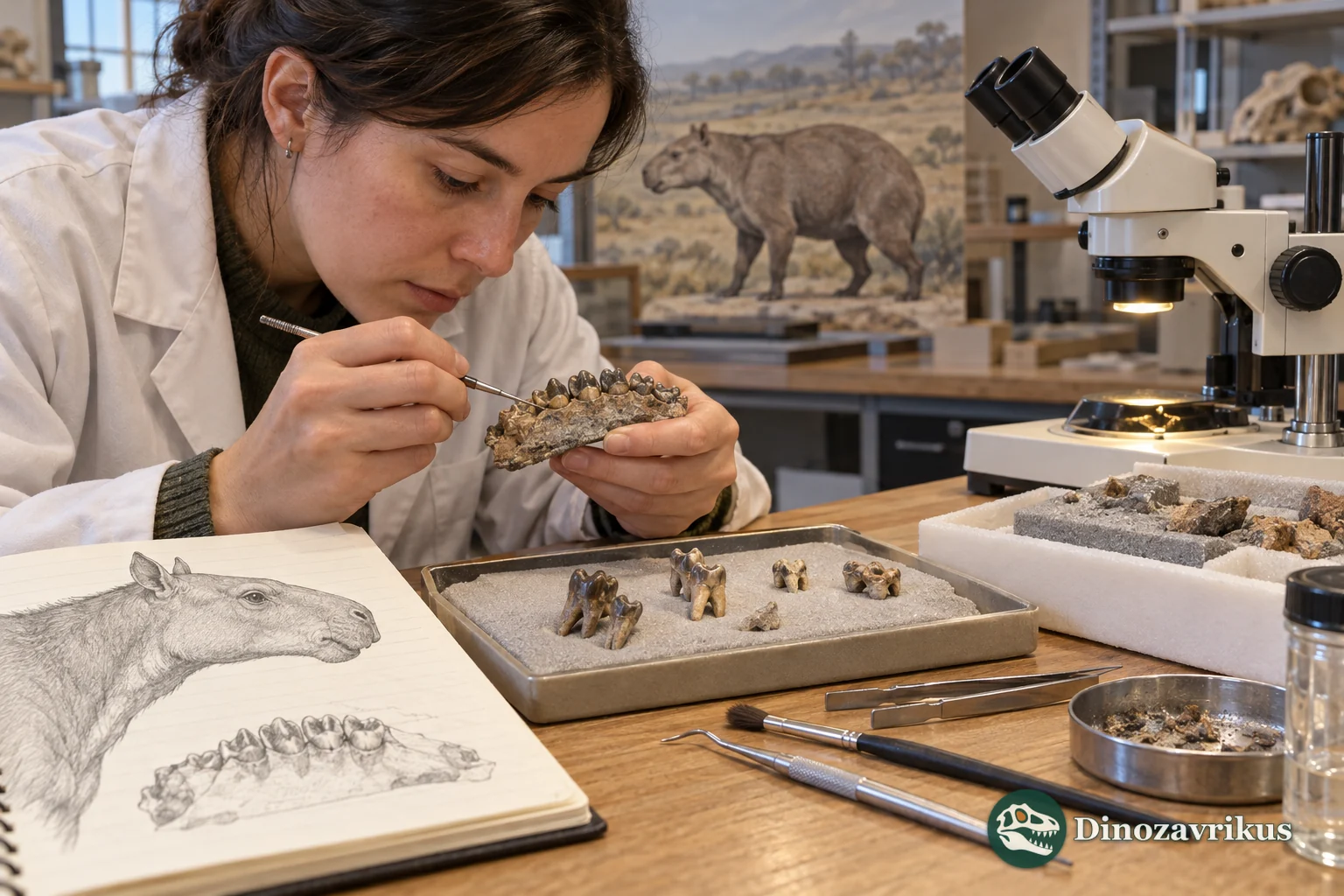
Maxilla and diagnostic teeth
The upper canine is unreduced and lies in front of P1, offset toward the outer side of the tooth row. P1 is triangular in outline with a marked parastylar projection; a pronounced parastylar sulcus occurs on P1 and P2. The cheek teeth are described as prismatic and hypselodont, with high crowns that continue growing through life.
These traits help distinguish the type material from other hegetotheriids. They do not directly reveal what the animal ate, how fast it moved, or the soft tissues of its muzzle. Functional explanations need independent comparison of wear and other evidence; high crowns alone do not prove a particular diet.
The type maxillae also provide no reliable body-mass estimate or limb proportions. Numerical size claims without a stated method would go beyond the material.
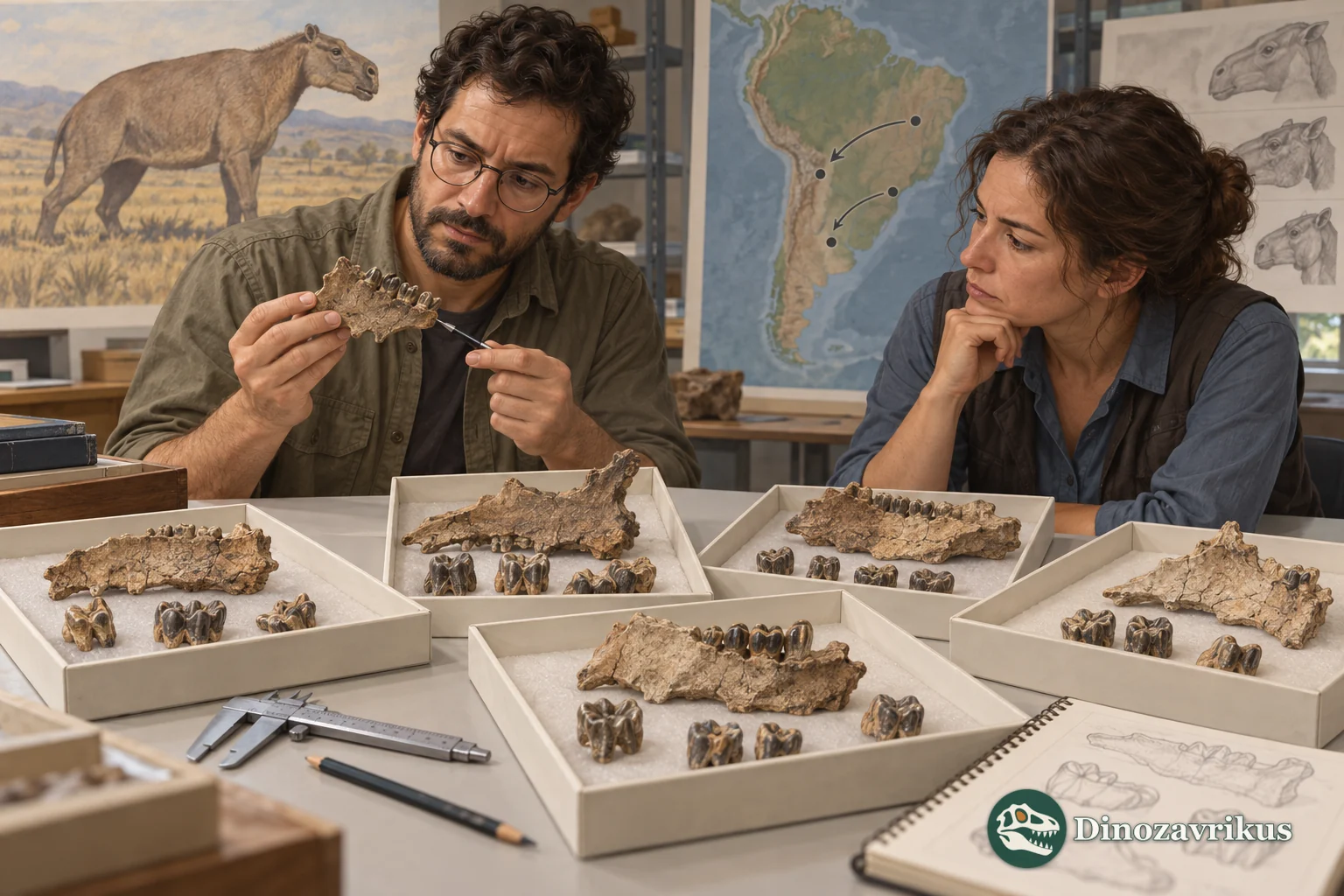
Age and geological setting
The type material comes from Cabeza Blanca in the Sarmiento Formation. It is associated with the late Oligocene Deseadan interval. This age follows the stratigraphic and faunal context; the maxillae themselves are not directly dated to a precise year or millennium.
Other proposed records are linked with Quebrada Fiera in Mendoza and neighbouring South American faunas. Researchers have used cautious labels such as P. cf. sculptum and Prohegetotherium sp. These mark resemblance and uncertainty rather than confirmation that the specimen belongs to the type species.
Why the genus boundaries are disputed
Older lists assigned several species and synonyms to Prohegetotherium. In 2017, Kramarz and Bond rejected the proposed synonymy of P. sculptum with P. shumwayi and Propachyrucos crassus. They also found that the genus as then composed was not monophyletic and questioned the placement of names including P. schiaffinoi and P. malalhuense.
Later work described a nearly complete skull from Quebrada Fiera under the provisional label “Prohegetotherium schiaffinoi.” The 2022 authors emphasized uncertainty around that assignment and the instability of the genus. The name P. schiaffinoi is also tied to type material from Uruguay’s Fray Bentos Formation, not to the P. sculptum jaws from Cabeza Blanca. These records cannot be combined into one uncontroversial sample.
For the type species, the narrow set of jaw characters and the type pair remain the firmest basis. Wider geography and a longer species list depend on debated referrals. Comparison with the later hegetotheriid Hegetotherium is useful, but changes in combinations do not turn one into a direct ancestor of the other.
What remains unknown
There is no direct evidence for reproduction, individual growth, social groups, exact food or diagnosed life injuries in P. sculptum. The upper jaws cannot recover a complete skeleton, gait or coloration. The cover artwork suggests only a possible general appearance for a small terrestrial notoungulate; it is not a documented portrait.
The main open questions concern which additional jaws genuinely belong to the type species, how regional South American faunas relate, and whether a new phylogenetic analysis will recover the genus as a coherent evolutionary group.
Frequently asked questions
When did Prohegetotherium live?
The type species P. sculptum is associated with the late Oligocene Deseadan interval. Earlier or younger records are based on referrals that remain debated.
Is a complete skeleton known?
No. The type series consists of two upper-jaw fragments with different parts of the tooth row. A nearly complete skull from Quebrada Fiera has a provisional species assignment.
How is P. sculptum diagnosed?
Features include an unreduced upper canine ahead of P1, a triangular P1 with a projection, and sulci on P1–P2.
Are all species assigned to Prohegetotherium securely one genus?
No. Revisions have questioned the genus’s monophyly and the placement of several names. Its composition depends on comparisons with the type material.