

Propraopus was a large extinct South American armadillo. Its armor combined two main shields with movable transverse bands. Most finds are bony plates from that shell, which survive better than the animal's skin or habits. A nearly complete carapace gives unusually direct evidence for its construction.
This profile belongs in the ice-age animal catalogue. Pampatherium also had movable armor bands but belonged to another armored lineage; the rigid dome of Glyptodon offers a different comparison.
Quick facts
| Group | Armadillos, Dasypodini |
|---|---|
| Time | Pleistocene, with possible early Holocene records |
| Type species | P. grandis Ameghino, 1881; later synonymized with P. sulcatus |
| Key carapace | MLP 69-IX-9-9 |
| Movable bands | Seven in that carapace |
| Carapace length | About 85 cm along the back of that specimen |
What can the fossils tell us?
Specimen MLP 69-IX-9-9 preserves shoulder and pelvic shields joined by seven movable bands. Its approximate 85 cm dorsal length applies to this individual, not every animal assigned to the genus.
Grooves, openings and the plate's position in the shell help distinguish fossils. Isolated cave osteoderms cannot be assembled into one individual without supporting evidence.
Comparison of many osteoderms found no consistent separation between P. grandis and the earlier P. sulcatus. Other historical names require more complete material.
Ameghino's name and a lost type
Florentino Ameghino named Propraopus grandis in 1881 from several osteoderms reported near Luján in Argentina. The original type material was subsequently lost. Its old description can be compared with later fossils, but those first plates cannot be remeasured or examined with modern imaging.
A later review compared the historical descriptions with a broader series of plates. It regarded P. grandis as a junior synonym of P. sulcatus, a name introduced by Peter Wilhelm Lund in 1842. This is a taxonomic conclusion based on comparative anatomy, not a direct observation of the missing type. The status of P. magnus remains more uncertain; material once called P. punctatus was reassigned to Dasypus in the same review.
What an associated carapace shows
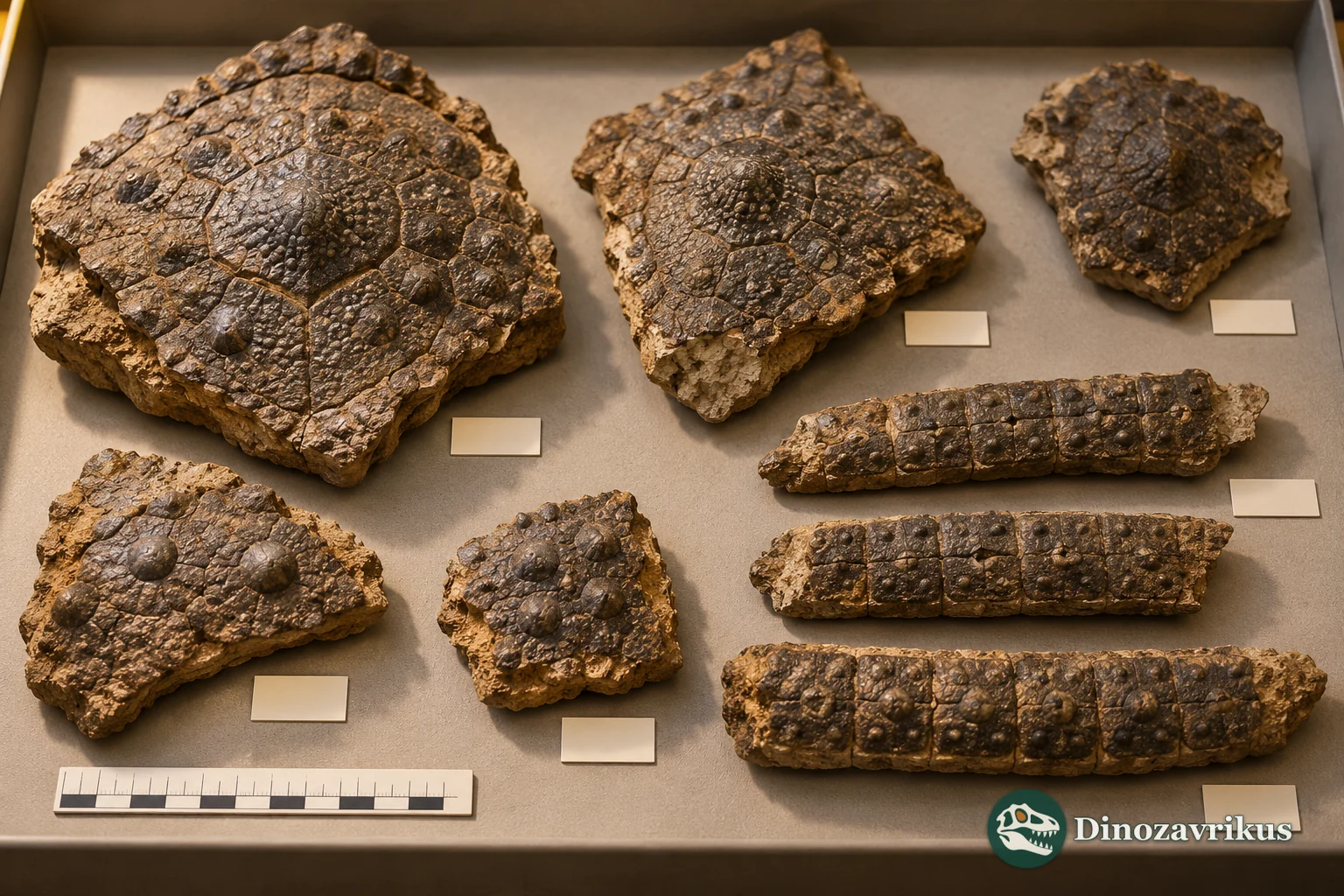
The specimen MLP 69-IX-9-9 retains much of the shoulder shield, pelvic shield and the seven bands between them. Its reported dorsal shell length is about 85 cm. Other published measurements place the shoulder shield near 22 cm, the pelvic shield near 40 cm and the tail armor near 45 cm. These are measurements of preserved parts of one specimen, not a reconstructed total body length.
The shell's articulated arrangement shows that the trunk could flex at the bands. Individual osteoderms display grooves, small openings and surface figures used in comparisons. Wear, damage and differences between positions on the shell can obscure those characters, so an isolated plate is less informative than an associated carapace.
Cave plates and uncertain ages
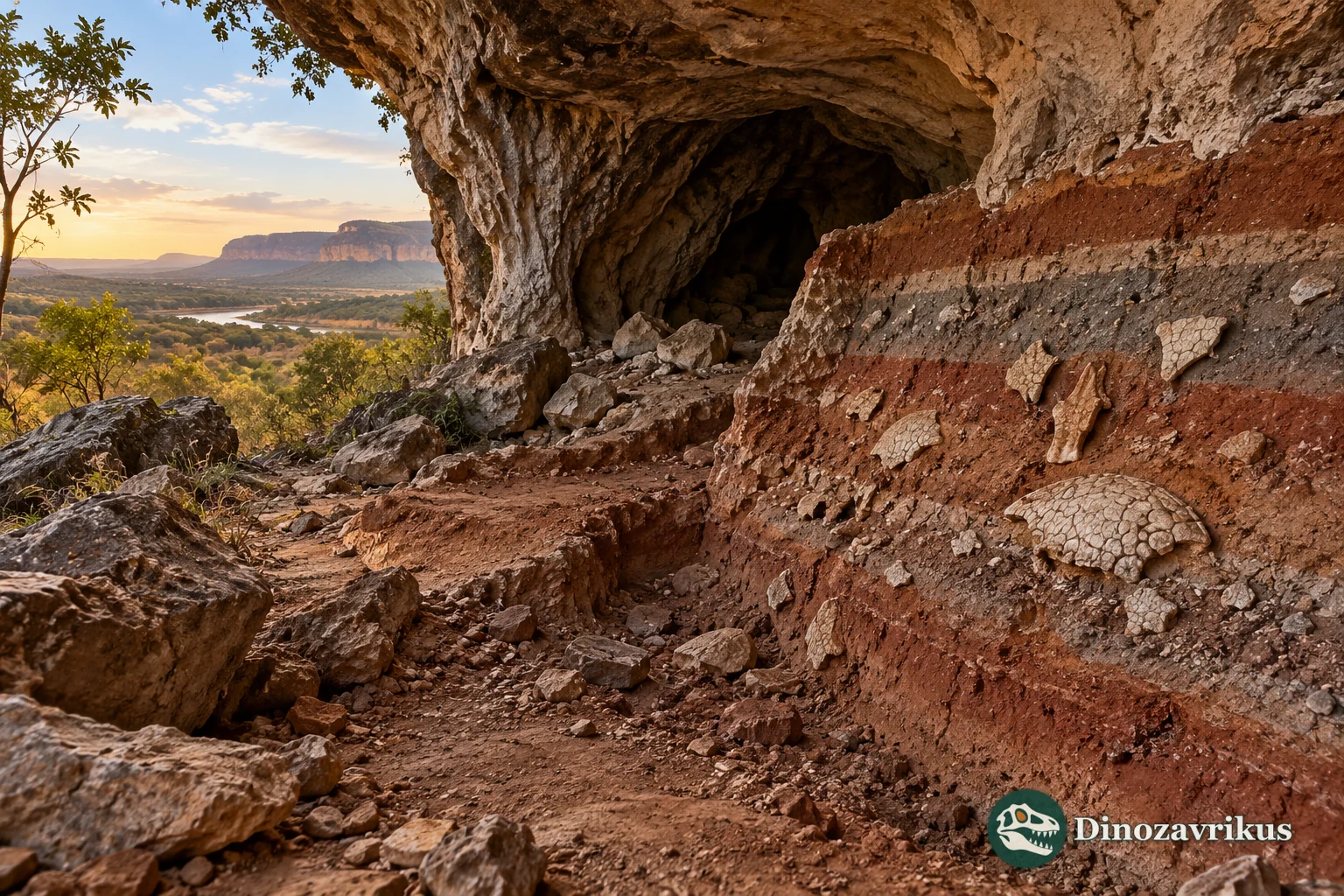
Researchers recovered detached Propraopus osteoderms in Gruta do Urso, a cave near Aurora do Tocantins in Brazil. The cave deposits were explored in field campaigns in 2009, 2011 and 2012. Plates document the animal's presence in the regional fossil record, but cave processes may have mixed material from different times and individuals.
A date of about 20,000 years ago reported for material from another nearby cave cannot simply be transferred to every Propraopus plate in Gruta do Urso. An isolated osteoderm has no built-in clock. The age of a particular occurrence depends on its own stratigraphic or dating evidence.
The animal beyond its shell
The associated carapace establishes size and construction of the armor much better than scattered plates do. The genus is generally placed among armadillos within Cingulata, but armor alone cannot reveal coat color, exact diet or speed. Comparisons with living armadillos suggest possible behavior only as an inference.
The cover is an artistic reconstruction. Its riverbank, skin texture and body posture are not photographs or direct records of an individual fossil. The fossil evidence supports an armored mammal with movable bands; the rest requires explicit caution.
Frequently asked questions
How many movable bands did Propraopus have?
The nearly complete carapace MLP 69-IX-9-9 preserves seven movable bands between its shoulder and pelvic shields.
Why is P. grandis treated as a synonym of P. sulcatus?
A comparison of numerous armor plates found no stable anatomical separation; the older name P. sulcatus then has priority.
Do cave plates represent one animal?
No. Detached osteoderms may come from different individuals or layers and require context before they can be associated.
Was Propraopus a glyptodont?
No. It was an armadillo with movable shell bands, while Glyptodon belonged to a different armored lineage with a more rigid back shell.