

Protopteryx fengningensis was an early enantiornithine from northern China. Two long tail feathers were narrow along most of their length and widened into vanes near the tips. Several skeletons also preserve flight feathers and a small tuft on the leading edge of the wing. These fossils make it possible to examine the flight of a bird that lived about 130 million years ago.
Quick facts
| Group | Enantiornithines |
|---|---|
| Age | Early Cretaceous (about 130 million years ago) |
| Region | Asia (Hebei Province, China) |
| Diet | No direct evidence |
| Type species | Protopteryx fengningensis |
| Holotype | IVPP V11665 |
| Wingspan | About 32–35 cm, estimated for three specimens |
| Mass | About 32–49 g, estimated for three specimens |
| Formation | Huajiying Formation |
What can the fossils tell us?
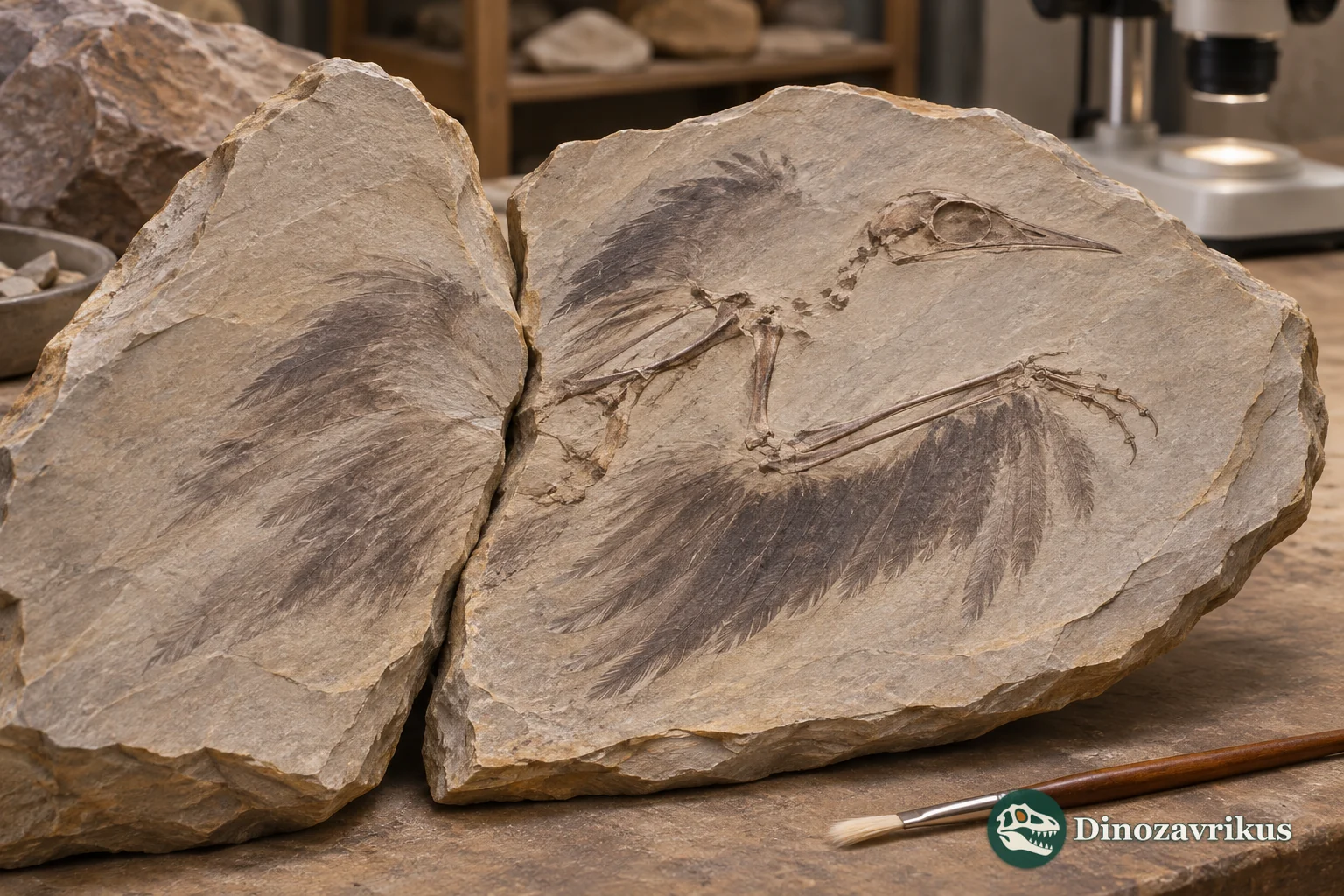
The feathers extend behind the pygostyle, the short bone made of fused tail vertebrae. Impressions show that the narrow ribbons widen near their tips.
The slab BMNHC Ph 1060 preserves evidence of an alula, a small cluster of feathers attached to the first finger.
Volcanic beds above and below the fossil horizon at Sichakou give ages in the range of about 129–131 million years. The mineral dates place the fossils within the rock sequence.
Bird fossils from Fengning
Fucheng Zhang and Zhonghe Zhou described Protopteryx in 2000 from specimens in Fengning County. The nearly complete holotype, IVPP V11665, is preserved on a slab and its counterpart. Two additional specimens, BMNHC Ph 1060 and Ph 1158, made it possible to compare the bones and plumage of several individuals. The Sichakou specimens come from shales within lake and river deposits of the Huajiying Formation.
Zircons from a volcanic layer about a metre above the Protopteryx horizon gave an age of 129.5 ± 0.9 million years. Earlier measurements from beds below it agree with an age of about 130 million years. The fossil layer records an early stage in the history of the Jehol Biota.
Feathers of the wings, tail and head
The primary and secondary flight feathers preserve their shafts and barbs. One slab also shows an alula on the first finger. In living birds, the small tuft can help control airflow at low speeds. Short contour feathers on the leg extended partway down the shin.
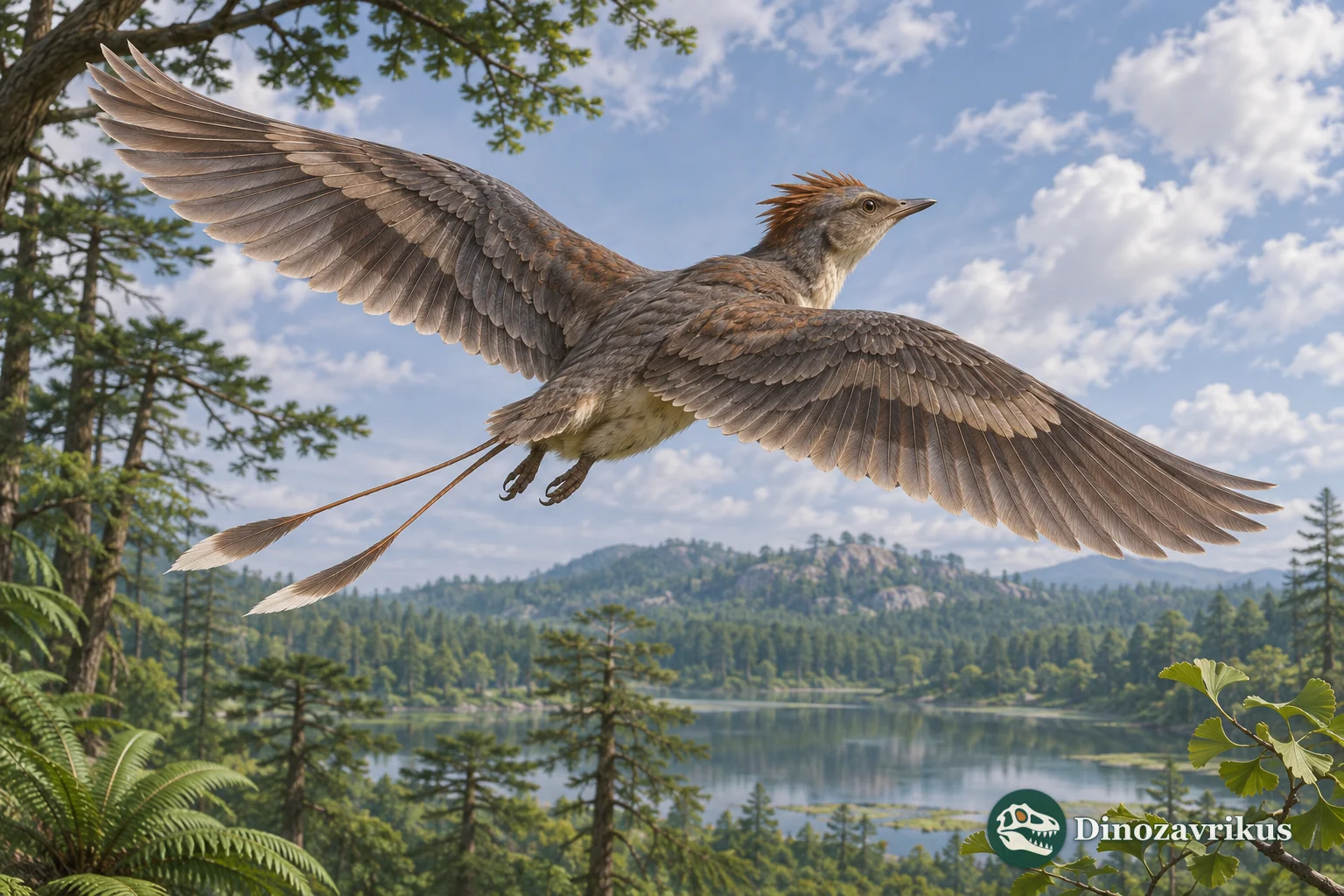
The tail ribbons of Protopteryx are nearly uniform in width along most of their length. Their vanes widen near the ends. The later Parapengornis preserves vanes along the full surviving length of both long feathers. Several Protopteryx specimens also show raised feathers over the head, suggesting a crest whose shape in life remains uncertain.
Estimating the wingspan and flight style
Researchers estimated a wingspan of roughly 32 to 35 cm and a body mass of roughly 32 to 49 g for three specimens. They used measurements of the bones together with equations informed by living birds. Each estimate comes with its own range of uncertainty.
Wing shape resembles that of living birds that alternate flapping with brief intervals when their wings are folded. Other features, including the crest where flight muscles attach on the humerus, suggest that intervals of gliding deserve consideration. Both interpretations depend on comparisons with modern flight.
What additional skeletons revealed
The new specimens show teeth in the maxilla, a bone of the upper jaw. Their hand bones are more fully fused than in the holotype. The researchers attributed the difference to growth. Changes with age matter when the characters of a species are being established from a small sample of skeletons.
Frequently asked questions
What does the name Protopteryx mean?
Its Greek roots mean first and wing or feather. The specific name refers to Fengning County.
How wide were its wings?
Three specimens yielded estimates of about 32 to 35 cm in wingspan from bones and reconstructed wing proportions.
Did Protopteryx have a crest?
Fossils preserve raised feathers over the head. A low crest is a plausible reconstruction.
Did it have teeth?
Additional skeletons show that the maxilla carried teeth. The original specimens also preserved teeth near the front of the jaws.