

In 1975 Jacques Herman named Protoxynotus from two incomplete teeth found at Misburg near Hanover. Both were assigned to the lower jaw. Teeth of a strikingly different shape circulated under another name until a comparison of material from Germany and Austria showed how the two jaws of this Cretaceous shark could have served different purposes.
Quick facts
| Age | Turonian to Maastrichtian, Late Cretaceous |
|---|---|
| Group | Dogfish sharks |
| Material | Isolated upper and lower teeth |
| Localities | Germany, Austria and Lebanon |
| Affinities | Dental evidence links it to sleeper sharks |
What can the fossils tell us?
Specimen kca 8 comes from Campanian deposits. It preserves features of the crown and root that can be compared with other lower teeth. The upper row had to be worked out from separate material.
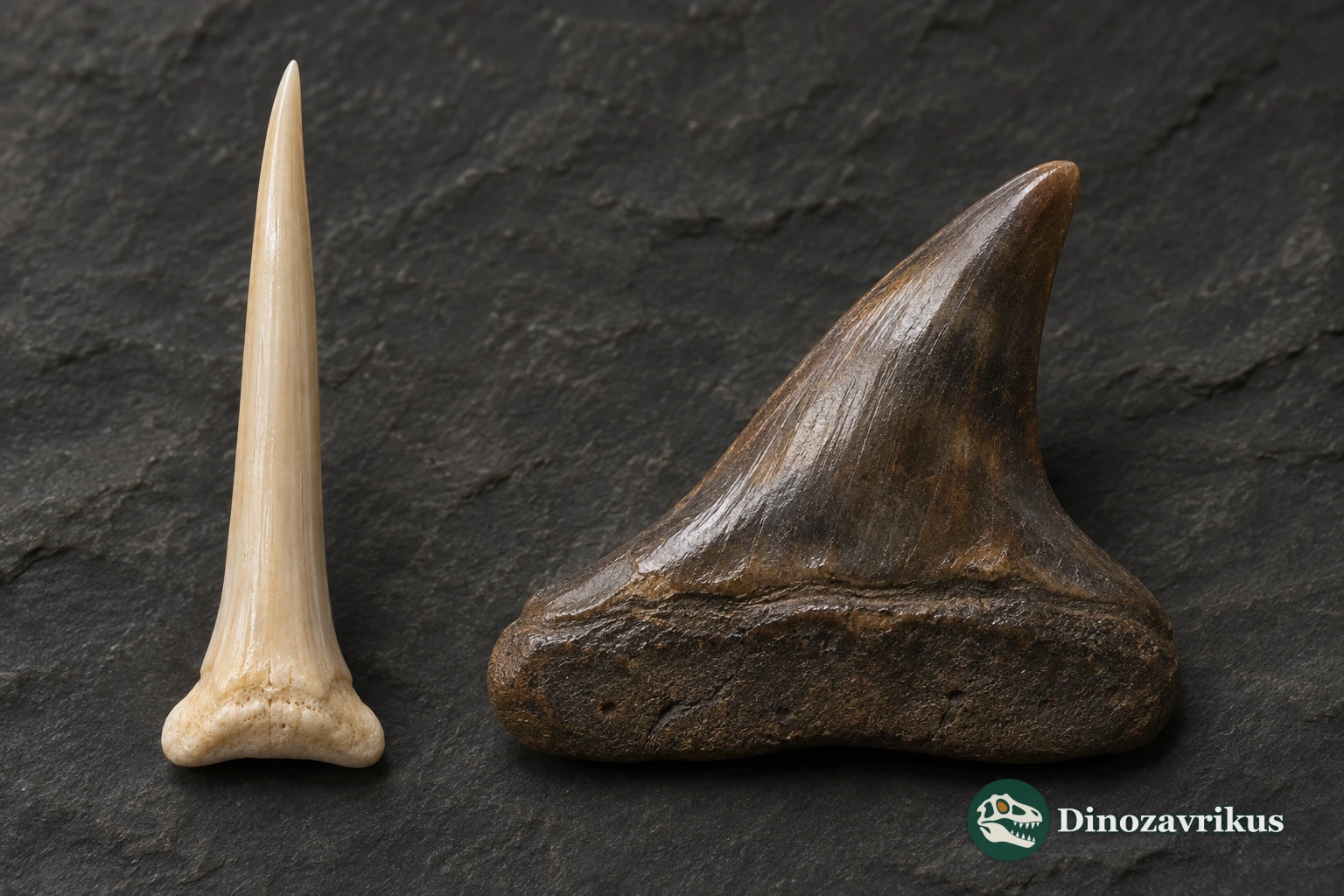
The revision assigned narrow upper teeth and flattened lower teeth to a single species. Their jaw positions were inferred by comparison because neither row was found articulated.
Isolated teeth from the upper Maastrichtian differ in the form of their crowns and roots. These supplied the type material for a second species.
Two names for material from Germany
The type species, Protoxynotus misburgensis, takes its name from Misburg. Its holotype, kca 8, is interpreted as a tooth from the centre of the lower jaw. The crown margin looked faintly serrated in the original description. A later examination attributed the irregularity to damage.
Detlev Thies and Müller described teeth from nearby Höver in 1993. The material later became known as Paraphorosoides ursulae. In 2022 a team led by Ivo Feichtinger compared the crowns, grooves and openings in their roots and assigned the Höver material to the same species as the Misburg specimens. The earlier name, Protoxynotus, has priority.
Gripping teeth and cutting teeth
The presumed upper teeth are narrow and needle-like. The lower teeth are compressed from front to back and bear a broader cutting edge with a relatively upright cusp. The revision proposes that the upper row could hold prey while the lower row cut it. The fossils leave the identity of that prey open.
Upper and lower teeth also differ in Proetmopterus. In that shark the main cusp of the lower teeth tips much farther to one side. Differences of this kind help palaeontologists distinguish isolated teeth and examine how the jaws might have worked.
From a Turonian tooth to the end of the Cretaceous
The oldest record is a single Turonian tooth from Wüllen in north-western Germany. It was tentatively assigned to a form close to the Misburg species. Campanian teeth occur in northern Germany and Bavaria. A Santonian occurrence in Lebanon shows that the Misburg species also reached the southern margin of the Tethys.
In Austria, 250 kilograms of marl from the Waidach section produced seven teeth, three complete and four fragmentary. They came from a level 1.25 metres below a gap in the sediments that spans the Cretaceous–Palaeogene boundary. The holotype of P. mayrmelnhoffi, NHMW/2021/0116/0001, is in the Natural History Museum Vienna. Teeth of this species reach no more than 1.8 millimetres in height.
A relative of sleeper sharks
Herman originally compared the lower teeth with those of living roughsharks. The upper teeth broadened the comparison. In the 2022 phylogenetic analysis, the nearest living lineage sampled was Zameus, a sleeper shark. Both species of Protoxynotus are known from isolated teeth. Body length and fin shape remain unknown.
Frequently asked questions
When did Protoxynotus live?
The genus occurs in several Late Cretaceous stages, from the Turonian to the Maastrichtian.
Why did the Höver material change names?
The 2022 revision recognised the same combination of crown and root features in both the Höver and Misburg material. The older name takes priority.
Were its teeth serrated?
The apparent serrations on the holotype were attributed to damage when it was re-examined. Well-preserved cutting edges are smooth.
What did it eat?
Its exact diet is unknown. The narrow upper teeth and blade-like lower teeth suggest how it could have held and cut prey.