

Provencemys is a name proposed for two Oligocene freshwater turtles from France. The fossils retain both the sutures between bones and the grooves made by the outer scutes. Differences in how they meet allow shells from Provence and Marseille to be compared.
Quick facts
| Group | Turtles, geoemydids (Geoemydidae) |
|---|---|
| Age | Oligocene, type material from the Chattian |
| Region | Europe (southern France) |
| Type species | Provencemys lachati |
| Holotype | MNHN.F.1873-356F, carapace and plastron |
| Carapace length | About 12–25 cm in the genus description |
| Scientific name | Provencemys |
| Diet | Exact diet unknown |
What can the fossils tell us?
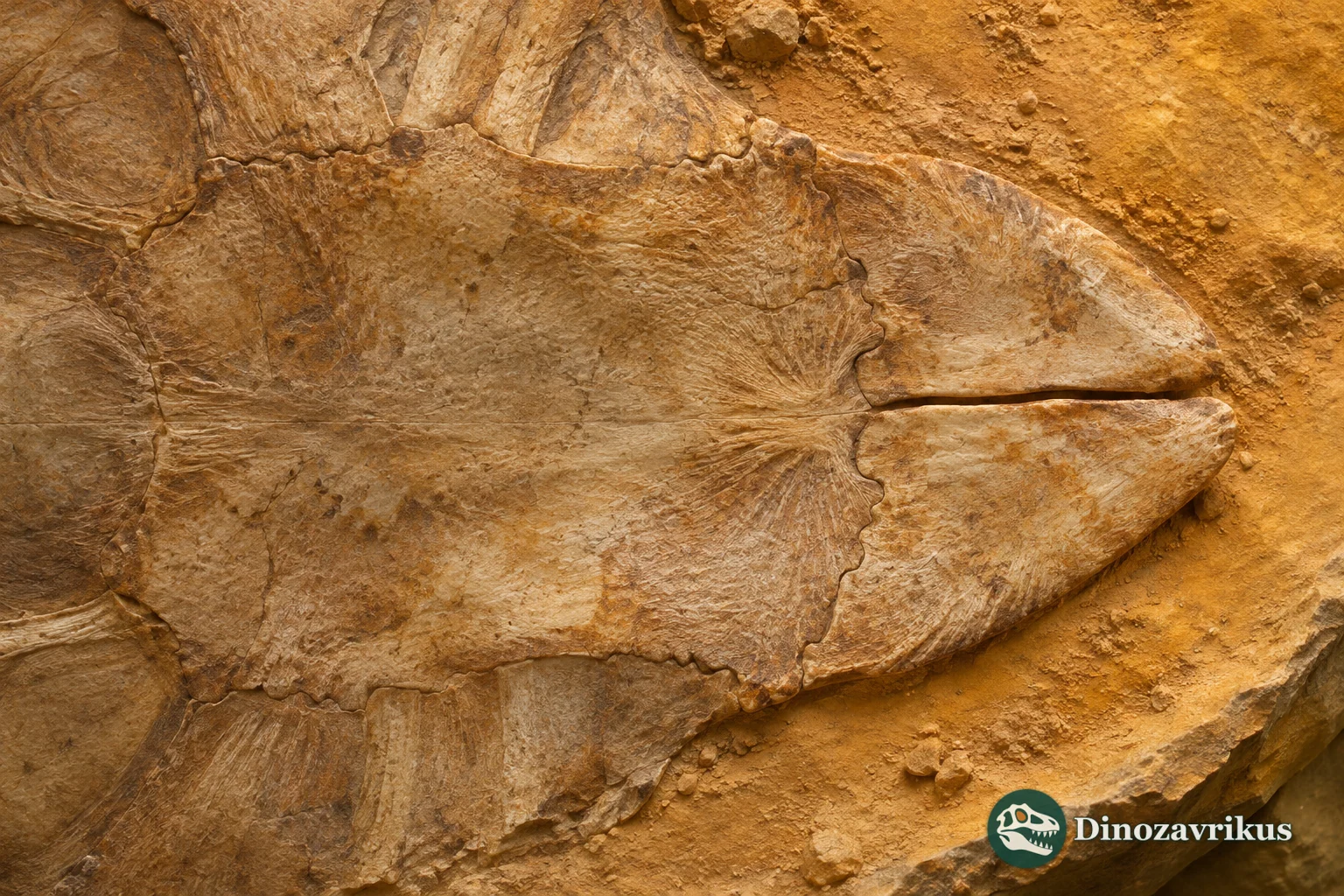
MNHN.F.1873-356F includes the carapace and plastron. It anchors the name lachati, first published in the genus Platyemys.
In material referred to laurenti, the groove between the humeral and pectoral scutes crosses the front midline bone of the plastron. It takes a different course in the type species.
The name-bearing specimens document shell proportions and scute boundaries. Researchers differ in how much weight they give those characters when drawing the boundaries of the genus.
Bois d’Asson and Marseille
The shell collected by Lachat at Bois d’Asson near Villeneuve is held in the National Museum of Natural History in Paris. Henri-Émile Sauvage described it as Platyemys lachati in 1873. When Sophie Hervet established Provencemys in 2004, she selected P. lachati as its type species.
The second species was originally named Clemmys laurenti in 1934. Its lectotype, MHNM 1982-826, comes from the red clays of Saint-Henri in Marseille. Both type localities are Chattian in age, within the late Oligocene. Assignments of fragmentary French material from older beds remain tentative.
Two sets of shell characters
The original diagnosis gives an approximate carapace length of 12–25 cm. In P. lachati it describes a low ridge at the back and a narrow cervical scute. Shells assigned to P. laurenti lack that ridge, and their last vertebral scute ends in front of the last midline bone.
On the plastron of the Marseille form, the entoplastron, a bone on the midline of the front lobe, is relatively large. The groove dividing the humeral and pectoral scutes crosses it. In the type species the same groove stays behind the bone or follows the edge of its suture.
Why the genus has other names
Julien Claude and Haiyan Tong proposed a broader concept of Palaeochelys that included Provencemys. Later work linked some Provençal material to Bergouniouxchelys. The differences between species can therefore be described more securely than their assignment to a genus.
The fossils document freshwater geoemydid turtles. The shell permits comparisons between specimens from different localities, while the details of their diet and soft tissues remain unknown.
Frequently asked questions
Where is the holotype kept?
The National Museum of Natural History in Paris holds it under the number MNHN.F.1873-356F.
How old are the name-bearing shells?
The holotype from Bois d’Asson and the lectotype from Marseille both come from Chattian deposits, the late Oligocene.
What distinguished the Marseille material?
In the laurenti form the groove between the humeral and pectoral scutes crosses the comparatively large entoplastron.
Why is the name Palaeochelys used for these fossils?
Some researchers assigned the shells to a broader Palaeochelys that included several groups of fossil European geoemydids.