

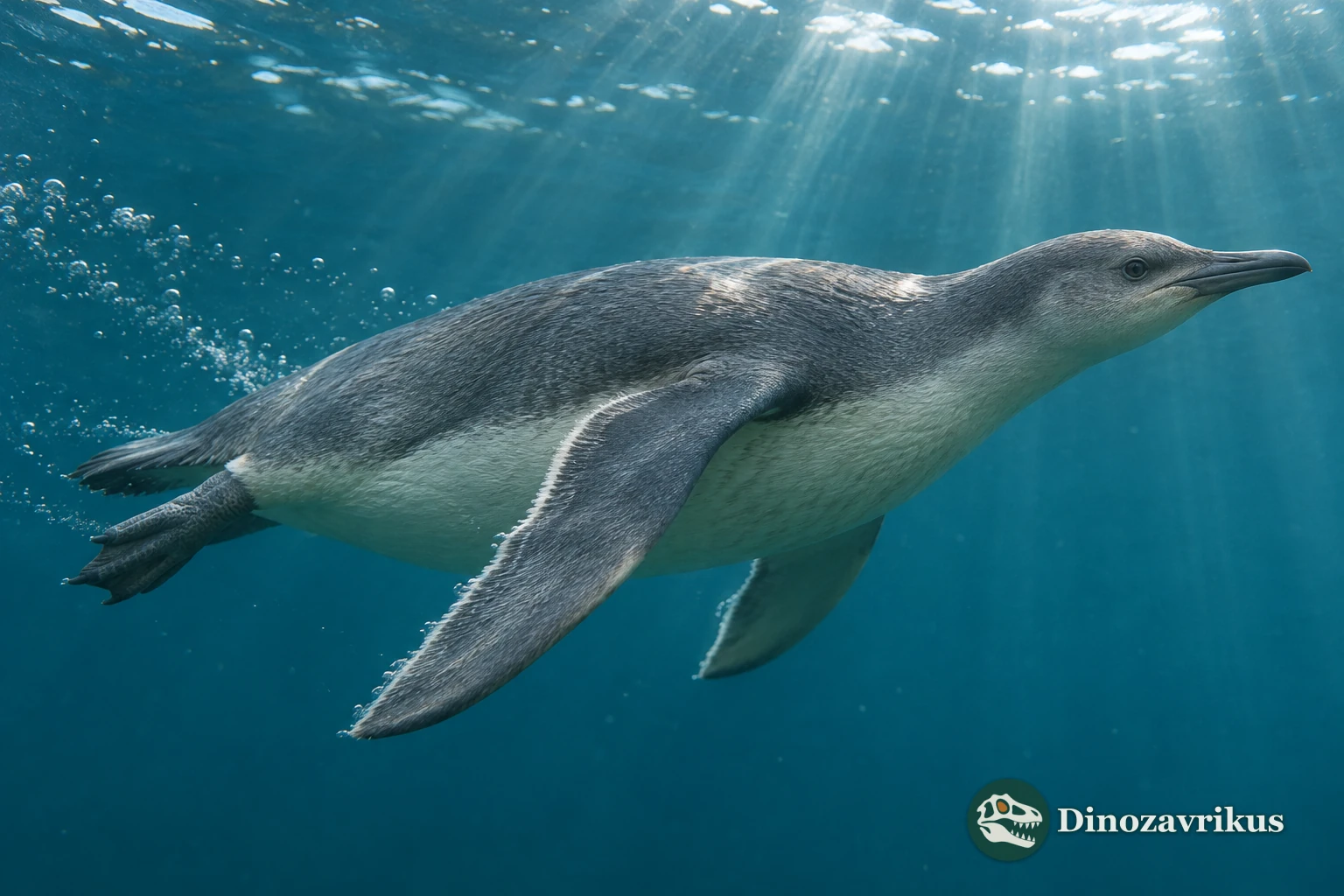
Pseudaptenodytes was a penguin from southern Australia. Its type species is known from an upper wing bone missing its distal end. The bone is similar in size to the humerus of a king penguin, but its depressions and outline distinguish the fossil species.
Quick facts
| Group | Sphenisciformes |
|---|---|
| Age | Late Miocene, about 7.5 to 6 million years ago |
| Locality | Spring Creek, Victoria |
| Holotype | Partial left humerus NMV P26668 |
| Preserved length | 100 mm |
What can the fossils tell us?
The figure measures the fragment. The distal end is missing.
A redescription identified an elliptical flattened part of a fossa and a gently curved front edge without a distinct angle.
Simpson tentatively included a second species. A later revision proposed treating its name as doubtful.
From the museum collection
J. Milligan presented the specimen to the museum in Victoria in 1916. NMV P26668 came from the Goodwood Formation at Spring Creek near Minhamite. George Gaylord Simpson named it Pseudaptenodytes macraei in 1970. The species name honours Colin Macrae, a fossil collector at Beaumaris.
Molluscs at the type locality were used to date the deposit to about 7.5 to 6 million years ago. Two fragments of carpometacarpi from Beaumaris were tentatively referred to the same species. Their association is provisional and the finds come from a different locality.
How the upper wing bone differs
In 2014 Travis Park measured 100 millimetres from the head of the surviving bone to the break. He identified two distinctive features. The lower part of a depression near the head has the shape of a flattened ellipse, and the front margin forms a gentle curve without a clear angle. Such features help distinguish birds even when the bones are similar in size.
Humeral anatomy was also important in assessing the South African fossil penguin Inguza. A subsequent study of Australian penguins placed Pseudaptenodytes among stem penguins, outside the clade uniting all living species.
Why the second name remains doubtful
Simpson tentatively placed Pseudaptenodytes minor in the genus. Its type, NMV P26669 from Beaumaris, is a partial right humerus. Park found that the available evidence did not establish a reliable diagnosis for a separate species. The type species P. macraei remains the securely diagnosed member of the genus.
Frequently asked questions
Where was Pseudaptenodytes discovered?
In the Goodwood Formation at Spring Creek in Victoria, Australia.
How long was its upper wing bone?
The surviving piece is 100 millimetres long. The distal end is missing.
Was it a direct ancestor of the king penguin?
Similar bone size does not establish that ancestry. A phylogenetic study placed it among stem penguins.
What happened to the proposed second species?
Its name was based on an incomplete bone from Beaumaris. It was judged doubtful in the revision.