

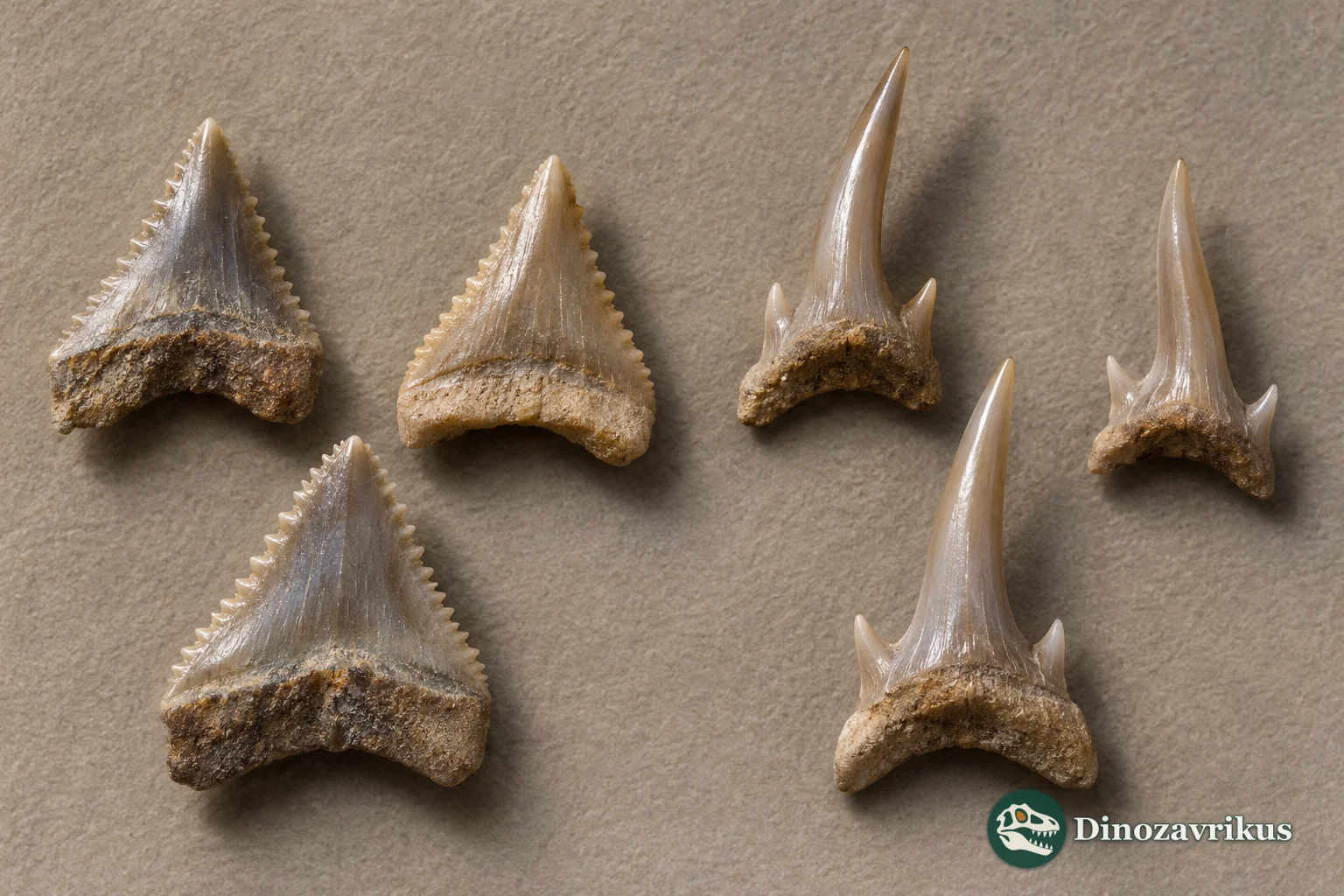
Pseudodalatias is known chiefly from small teeth found in Middle Triassic Spain and Late Triassic Britain. Some crowns are narrow with side cusplets; others are triangular and coarsely serrated. The contrast offers evidence about its dentition, not a measured outline of the shark. The cover is an artistic possibility.
Quick facts
| Genus | Pseudodalatias Reif, 1978 |
|---|---|
| Type species | P. barnstonensis, originally Dalatias barnstonensis |
| British material | Teeth from Rhaetian Westbury Formation bone beds |
| Spanish species | P. henarejensis from the Middle Triassic |
| Spanish holotype | MGUV-18970, an isolated tooth |
| Spanish sample | More than 100 teeth, with 16 tentatively assigned to the upper jaw |
| Body length | Not established from the described teeth |
What can the fossils tell us?
Sykes named barnstonensis under Dalatias from Barnstone material. His 1974 survey recorded teeth at nine British Westbury Formation sites. These are locality and tooth records, not skeletons.
The 2009 description of P. henarejensis used Middle Triassic Spanish teeth including holotype MGUV-18970. It did not provide a whole-body measurement.
Only 16 of more than 100 Spanish teeth were assigned to the presumed upper jaw. The authors warned that upper and lower assignments remain conventional without connected tooth rows.
Thin sections of P. henarejensis show a single-crystallite enameloid layer and thick orthodentine. Internal tissue proportions differ from P. barnstonensis despite an overall resemblance.
From Barnstone to a separate genus
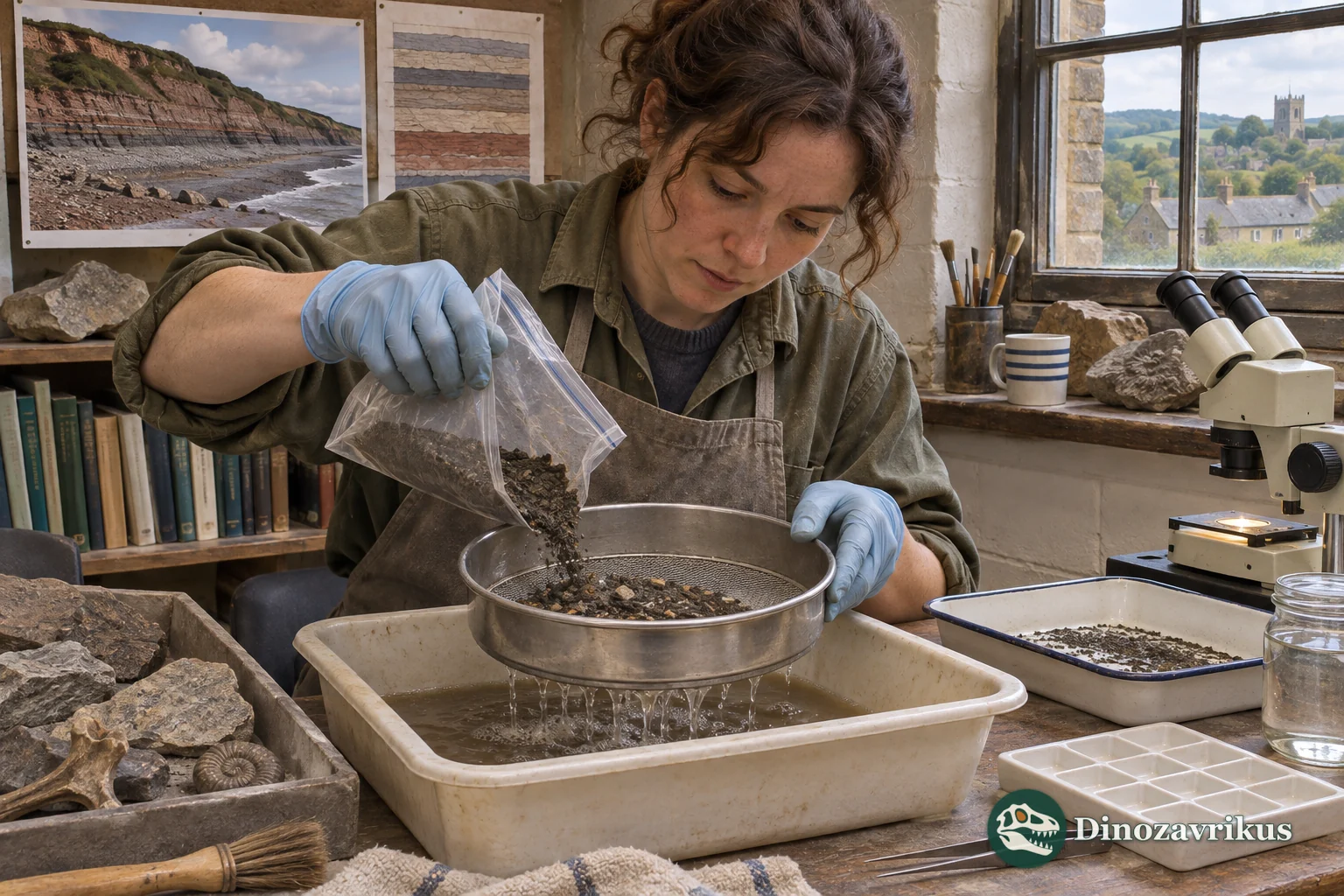
J. H. Sykes first described the Barnstone teeth as Dalatias barnstonensis in 1971 because they resembled those of a living kitefin shark. His 1974 study documented the species at nine British sites, all in bone beds low in the Westbury Formation. The Barnstone rock was friable enough to sieve for tiny teeth; samples from other localities varied greatly in yield.
Wolf-Ernst Reif later established Pseudodalatias. Similar crown outlines did not establish a close relationship to living Dalatias: the enamel-like tooth layer has a different microscopic structure. The older combination records a change of classification rather than a second animal. The tooth-based diagnosis invites comparison with Pteroscyllium, another fossil shark whose isolated teeth must be interpreted by position and preservation.
What the two crown forms show
One tooth form has a slender central cusp and small side cusplets. Another has a flattened triangular crown with coarse denticles near its base. The difference is evidence of heterodonty in the dentition. It does not identify a particular prey animal or tell us how fast the shark swam.
Botella and colleagues studied more than 100 teeth assigned to the Spanish species, but placed only 16 in the presumed upper jaw. They explicitly treated the upper and lower labels as a convention because no complete connected tooth row was available. The disparity might also reflect the smaller size of one tooth form and how the sediment was sampled.
A Middle Triassic Spanish species
Botella and colleagues named P. henarejensis in 2009. Holotype MGUV-18970 is a lateral tooth. Its teeth are smaller than those of the British type species, and thin sections reveal a thin single-crystallite enameloid coat over thick orthodentine and a conspicuous pulp cavity. P. barnstonensis differs in its internal tissue proportions.
Microscopy makes these distinctions possible even when a casual photograph shows only a broadly similar crown. As with the older shark Stethacanthulus, a place on the ancient shark family tree does not imply a direct ancestor-descendant relationship.
What remains unrecovered
The British teeth occur in marine bone beds, yet the number recovered from a sample depends on both original deposition and preparation. Sykes reported rich and poor samples from different sites; a count of teeth cannot be converted into a count of sharks.
The fossils discussed here do not preserve a complete skeleton, soft tissues, fin arrangement, colour or reliable whole-body length. The laboratory scene illustrates sieving and is not a photograph of Sykes or a named fossil collection.
Frequently asked questions
Why was the type species first called Dalatias?
Sykes compared the British teeth with those of a living Dalatias. Reif separated the fossil genus after further anatomical study.
Where was the type species found?
It was first recognized at Barnstone in England; later records came from eight other British Westbury Formation localities.
What is unusual about the Spanish tooth sample?
It contains two contrasting tooth forms, yet only 16 of more than 100 teeth were tentatively assigned to the upper jaw.
Can these fossils establish body length?
No. They document teeth and their tissues, not a measured complete shark.