

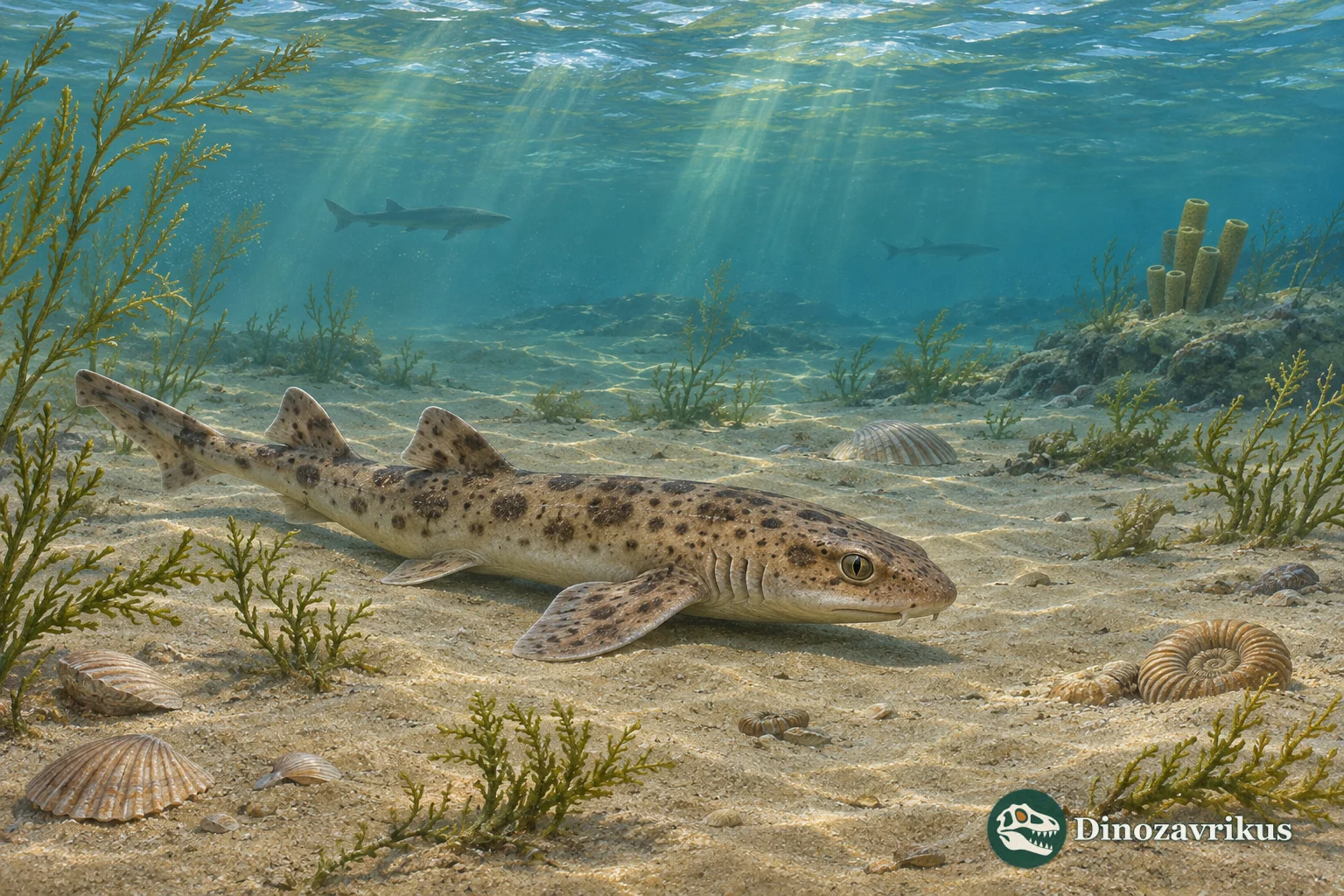
Pteroscyllium is a Cretaceous fossil shark genus with records from Lebanon and England. Small teeth with slender cusplets allow species-level comparisons. Its placement has been debated because tooth and body features invite different comparisons. The spotted bottom-dwelling animal on the cover is one cautious artistic possibility.
Quick facts
| Genus | Pteroscyllium Cappetta, 1980 |
|---|---|
| Type species | Pteroscyllium signeuxi from Santonian Lebanon |
| English species | P. hermani and P. downesi |
| P. hermani holotype | BMNH P. 66395, anterior tooth |
| P. hermani sample | 73 teeth; heights up to 4 mm |
| P. downesi holotype | NHMUK PV P 76886, Isle of Wight |
| Family | Debated in published comparisons |
What can the fossils tell us?
Cappetta introduced Pteroscyllium in 1980 with Santonian P. signeuxi as type species. Later English species require separate diagnoses.
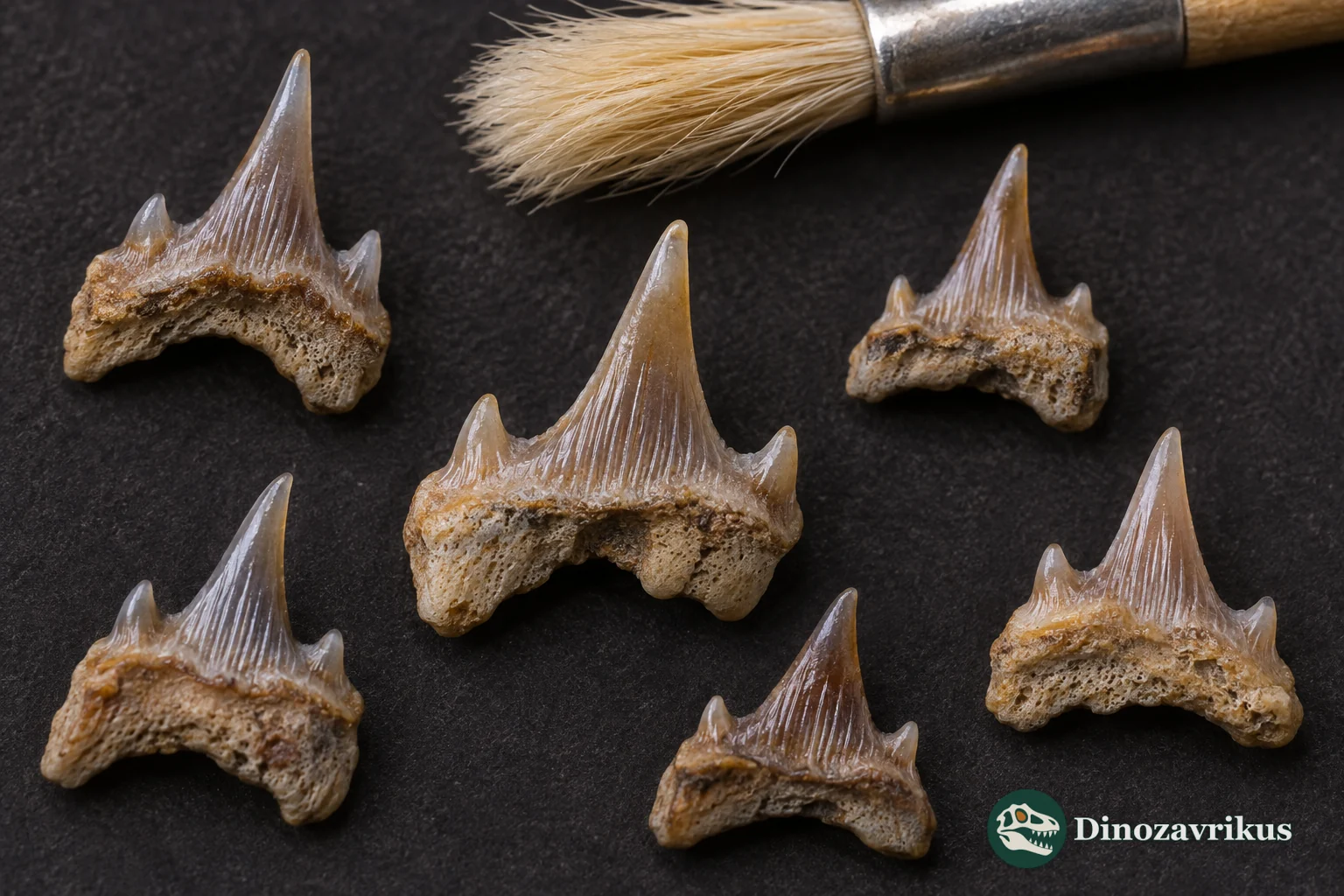
Underwood and Ward named P. hermani from English Chalk. Holotype BMNH P. 66395 is an upper Santonian anterior tooth; the teeth reach 4 mm high.
P. downesi holotype NHMUK PV P 76886 comes from early Aptian bed 16 of the Atherfield Clay. Its anterior crown has a slender cusp and extra incipient side cusplets.
The 2008 study left the family unresolved because some dental and fin characters suggested lamniform comparisons while body form and many small tooth files resembled catsharks.
From Lebanon to England
Henri Cappetta introduced Pteroscyllium in 1980 for P. signeuxi from Santonian Lebanon. Charlie Underwood and David Ward named the English species P. hermani in 2008, honouring shark researcher Jacques Herman. Its holotype BMNH P. 66395 is an anterior tooth from an upper Santonian phosphatic level at Winterbourne.
Their study considered 73 teeth from Winterbourne, Boxford, Taplow and other English sites. This is a tooth count, not a count of skeletons. As with Leptostyrax, a group of isolated teeth requires care when reconstructing the original jaw.
What the tiny teeth show
P. hermani teeth reach 4 mm in height. A tall narrow main cusp is flanked by one pair of short slender side cusplets. Strong lengthwise ridges mark the lower outer crown, while the inner main cusp face is unornamented. The low root has two lobes separated by a nutritive groove.
Front and rear tooth positions differ. The researchers recovered many teeth by dissolving phosphatic chalk and sieving the residue; microbial damage had already affected several roots. Broken edges should not be mistaken for a species trait.
An earlier Isle of Wight species
Duffin and Batchelor described P. downesi from the Atherfield Clay Formation near Atherfield Point. Holotype NHMUK PV P 76886 came from bed 16 of the Upper Lobster Member, dated to the early Aptian. Its front teeth have a slender central cusp, side cusplets and sometimes an incipient second pair.
Coarse ridges run down the outer crown, while finer ornament marks the inner face. These characters distinguish the Aptian material from the later P. hermani series. Dental characters in Egertonodus offer another example of why similar small shark teeth should not be merged across genera without comparison.
Why its relationships remain debated
Underwood and Ward noted a mix of features: some teeth and angular fins suggested lamniform affinities, while body form and numerous functional files of small teeth resembled catsharks. They did not settle the family. Later authors have treated particular species closer to catsharks, but that does not provide a measured outline or colour for every species in the genus.
The cover and seabed scene choose one plausible comparison. The English tooth samples do not establish exact body length, prey, skin pattern or swimming speed.
Frequently asked questions
What is the type species of Pteroscyllium?
P. signeuxi from Santonian Lebanon; Cappetta introduced the genus in 1980.
How many teeth were studied for P. hermani?
The 2008 study considered 73 teeth. Holotype BMNH P. 66395 is one anterior tooth.
How large are those teeth?
The described P. hermani teeth reach 4 mm high, a tooth dimension rather than a body measurement.
Is its relationship to living catsharks settled?
No. The 2008 study left the family unresolved after comparing catshark-like and lamniform-like features.