

The type species of Pseudoolenoides has nine movable segments. A related species preserves six. Researchers compared those counts with the relief of the tail shields and inferred that some segments which normally became free during growth remained part of the tail.
Quick facts
| Family | Bathyuridae |
|---|---|
| Age | Middle Ordovician |
| Named by | Lehi Hintze, 1953 |
| Type species | Pseudoolenoides dilectus |
| Type shell | AMNH-FI 26492, Utah |
| Type species thorax | Nine movable segments |
What can the fossils tell us?
One additional region of the tail shield is interpreted as a segment that stayed fused into it.
The cephalon is missing. The shape of the foremost segment helps assess whether the series is complete.
Comparison with growth stages led to the inference that juvenile traits persisted in adult shells.
The holotype from western Utah
Lehi Hintze established Pseudoolenoides in 1953. Its type species is P. dilectus. The articulated holotype, AMNH-FI 26492, comes from Dapingian beds of the Kanosh Formation in the southern Confusion Range near Ibex, western Utah.
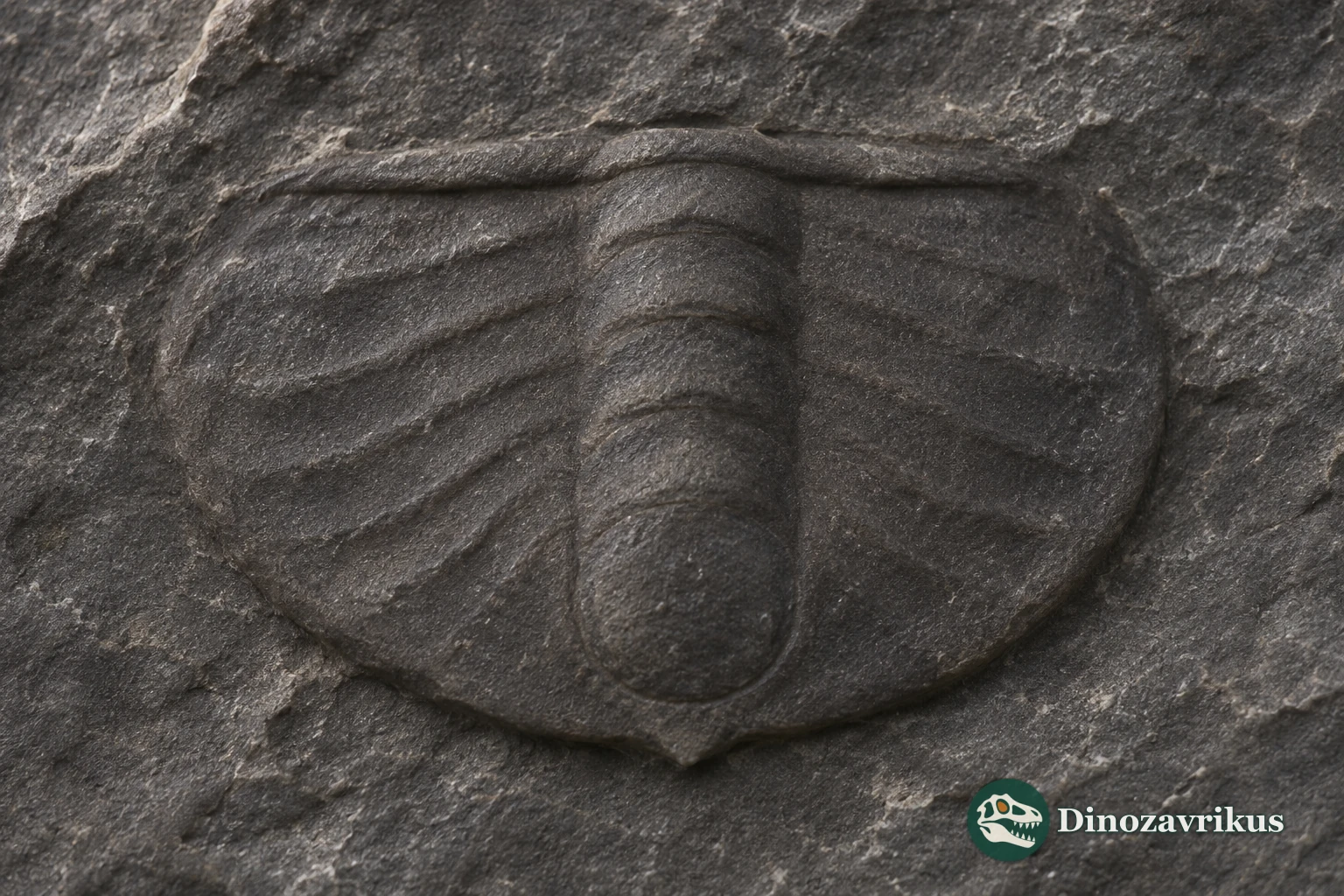
Nine segments are visible between the head and tail. The raised central axis of the tail is nearly parallel-sided. A small spine at the middle of the rear edge points almost directly downwards. In another Ordovician bathyurid, Lutesvillia, two spines project from the rear corners of its tail shield.
Where the movable thorax ends
During growth in many trilobites, segments at the front of the tail shield became free-moving. In adult P. dilectus, one region at the front of the pygidium is interpreted as a retained segment. Several later species retain four such regions, and P. acicaudus retains five.
A fossil of P. fossilmountainensis preserves six movable segments still joined to the tail. The short tips of the front segment resemble those of the first segment in other bathyurids. That feature supports the interpretation that the series is complete. Without an articulated head on that fossil, the original count cannot be checked directly.
The succession of Ordovician faunas
In a 2012 revision, Jonathan Adrain, Neo McAdams and Talia Karim recognised ten forms, nine of them formally named. Five occur in Dapingian beds and five in lower Darriwilian beds. The new named species came from the Kanosh Formation of Utah and the Oil Creek Formation of Oklahoma.
The sequence of finds agrees with the branching order obtained from a published analysis of shell characters. The authors proposed that adult tail shields in one branch retained developmentally earlier features. Shield anatomy and the differing counts provide evidence for that hypothesis.

Frequently asked questions
Where did the type specimen come from?
The articulated shell was found in the Kanosh Formation of the southern Confusion Range, western Utah. It is held at the American Museum of Natural History as AMNH-FI 26492.
How many movable segments does the type species have?
Nine are present. The foremost part of the fused tail shield is interpreted as one additional segment that remained part of the tail.
Did all species have the same number of free segments?
Another Utah species preserves six attached to its tail. Several regions of that tail have been interpreted as unreleased segments.
What does it mean to retain juvenile features?
Some parts of the mature tail resemble structures found at an earlier stage of growth. The inference comes from the shapes of the fossils.