

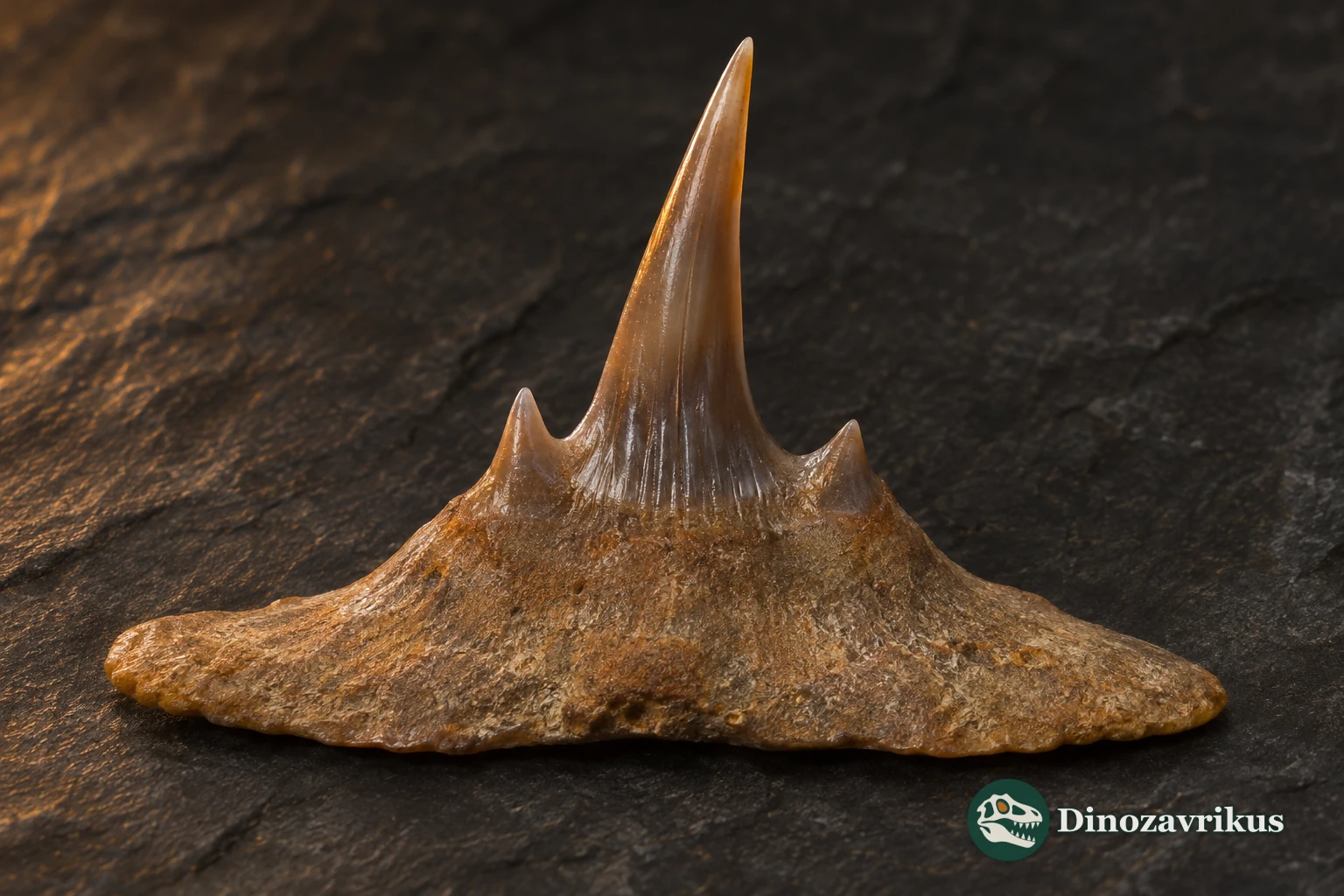
The tall central cusp of a Pseudoscyliorhinus tooth rose from a low root that spread beyond the edges of the crown. This feature helped unite two species of Cretaceous shark in one genus. One was named from teeth found in Germany, while the other spent decades in a genus that includes living catsharks.
Quick facts
| Age | Cenomanian to Campanian, Late Cretaceous |
|---|---|
| Group | Ground sharks |
| Material | Isolated teeth with flat-based roots |
| Localities | Include Germany, England and Ireland |
| Tooth size | Under 3 mm wide in one species |
What can the fossils tell us?
The base is conspicuously flat. Side and basal views show how far the root flares around the crown, which helps distinguish the genus from other fossil sharks.
Stoke Clump and Downend yielded the largest groups of teeth. Together the samples show variation among isolated specimens. Their exact position in an intact jaw remains uncertain.
In 2008 a fossil species originally named in the living catshark genus was moved to Pseudoscyliorhinus. The authors based the transfer on several shared features of the teeth.
Naming the genus
Arnold Müller and Cajus Diedrich described Pseudoscyliorhinus schwarzhansi in 1991 from Cenomanian teeth found in Germany. It became the type species. Jacques Herman had named a similar fossil shark Scyliorhinus reussi in 1977. Charlie Underwood and David Ward transferred Herman’s species to Pseudoscyliorhinus in 2008 after comparing the crowns and roots.
The root of P. reussi is flatter, with a less distinct groove at the base than in the German type species. In some of its anterior teeth, ridges near the bottom of the crown cross to form a narrow band of net-like ornament. Distinguishing these similar species depends on details that wear or damage can obscure.
What an isolated tooth looks like
The P. reussi teeth in the published sample are less than 3 millimetres wide. The main cusp is slender and nearly round in cross-section. It is flanked by one or, more often, two pairs of shorter cusplets. The root extends on all sides and has a flat underside. Magnification reveals a row of tiny openings below the boundary between root and crown.
Crassescyliorhinus, another shark the authors examined from Late Cretaceous deposits, had a stouter main cusp and a bulkier root with a V shape in basal view. Comparing both parts of the tooth helps separate the genera even when the crowns have a similar outline.
The English and Irish collections
Underwood and Ward examined 124 teeth of P. reussi. Stoke Clump yielded 71 of them and Downend another 35. The remaining finds came from Boxford, two phosphatic horizons at Winterbourne, the upper phosphatic horizon at Taplow and Minnis North in Northern Ireland. The five figured specimens numbered P. 66363–66367 are in the Natural History Museum, London.
The 2008 study noted similarities to catsharks but found no living species with quite the same root. A later study established the extinct family Pseudoscyliorhinidae. The skeleton discussed in that study belongs to a different genus. The size and appearance of Pseudoscyliorhinus itself remain unresolved.
Frequently asked questions
When did Pseudoscyliorhinus live?
The fossil record of the genus spans the Cenomanian through Campanian stages of the Late Cretaceous. The type species comes from Cenomanian deposits in Germany.
What is distinctive about its teeth?
The low, flat-bottomed root spreads well beyond the tall crown. This feature is particularly striking in P. reussi.
How many teeth did the 2008 study examine?
The P. reussi sample contained 124 teeth. Most came from two sites in southern England, Stoke Clump and Downend.
Do the teeth reveal the shark’s body length?
Three millimetres refers to the width of individual teeth. Estimating length would require other remains or a calibrated relationship between body size and tooth size.