

Four teeth less than a millimetre wide turned up in Cenomanian deposits of the Teutoburg Forest. Arnold Müller and Cajus Diedrich used them to describe Pseudospinax in 1991. The low crown resembled that of another extinct shark, Protospinax, while the root gave them grounds for recognising a separate genus.
Quick facts
| Age of type species | Cenomanian, Late Cretaceous |
|---|---|
| Locality | Werther-Ascheloh, Germany |
| Material | Four teeth in the original description |
| Holotype | Tooth 12 605, Münster |
| Holotype width | 0.72 mm |
What can the fossils tell us?
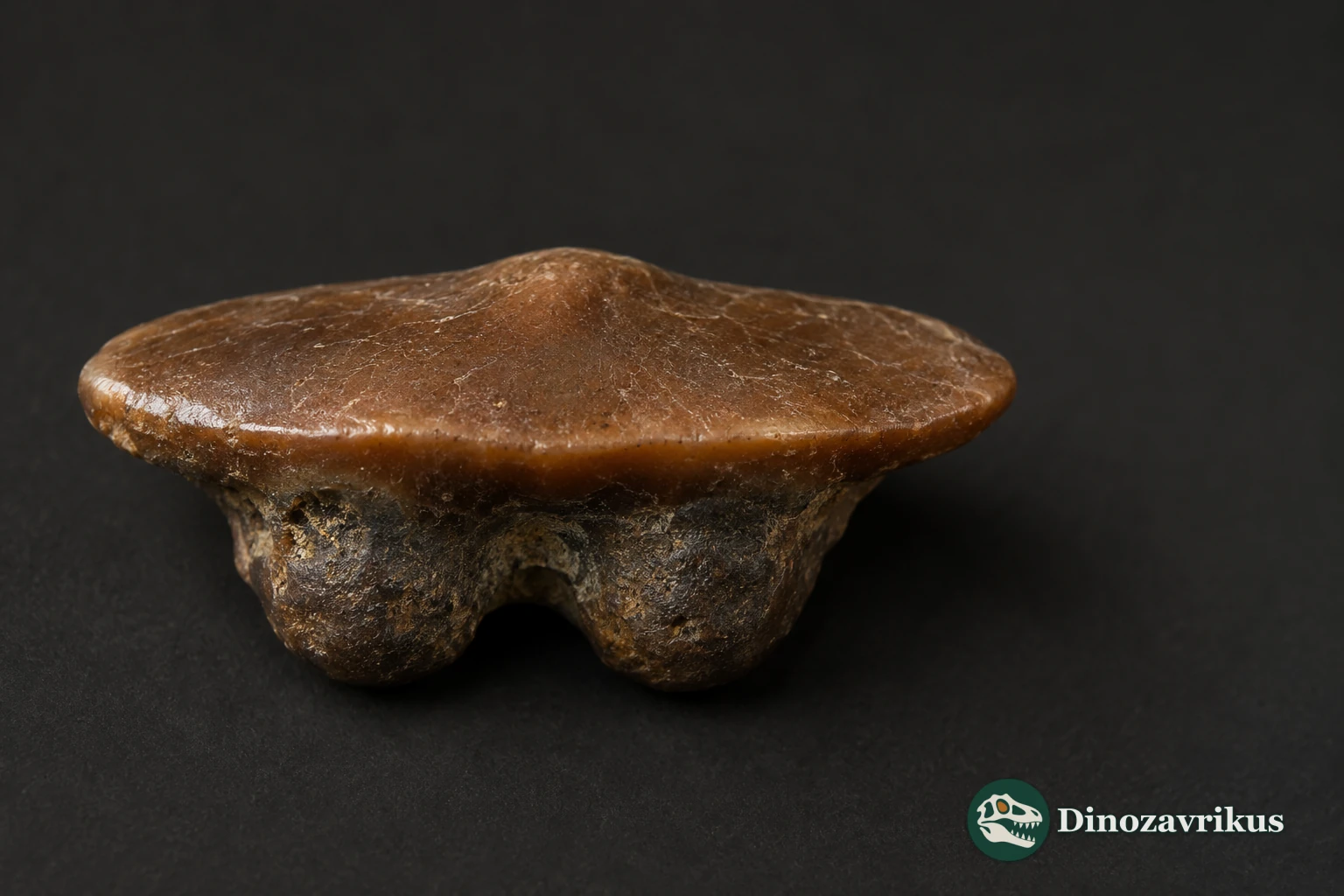
The tooth from Werther-Ascheloh has a transverse crest and two rounded root lobes. Together these features make the specimen useful for comparing other finds.
The original authors recognised open channels in the root and placed the genus among carpet sharks. Four teeth were too little to assign it to a family in that study.
Neither of the two teeth from the Kłęby borehole preserves its root. Their similar crowns alone leave a Middle Jurassic record uncertain.
Four teeth from a German quarry
The type species, Pseudospinax pusillus, comes from a quarry at Werther-Ascheloh. The teeth were recovered from a sediment gravity-flow deposit close to the lower–middle Cenomanian boundary. The holotype, tooth 12 605, is in the Westphalian Museum of Natural History in Münster. It is 0.72 millimetres wide and 0.41 millimetres high. The authors thought it probably came from near the front of the jaw.
Pseudoscyliorhinus also occurs in Cenomanian deposits of the region. Its teeth have a broad base but carry a slender main cusp and smaller lateral points. The centre of the crown in the type species of Pseudospinax rises only slightly.
Anatomy of a tiny tooth
The broad, oval crown overhangs the root on the outer side. A low crest runs across it and rises slightly in the middle. On the inner face a downward projection extends almost to the base of the root. The root itself is broad but compressed from front to back, with two rounded lobes that open towards the lip.
The original authors compared the crown with Protospinax but placed their new genus among carpet sharks on the basis of its root. Later comparisons also took account of the outline of the overhanging crown margin. With no skeleton of the type species, these details say little about the shark’s body shape.
Possible records before the Cenomanian
Charlie Underwood and Simon Mitchell named an additional species from English teeth in 1999, P. heterodon. Its generic placement has since been debated. Teeth within the sample differ markedly in form, so a character seen in an isolated crown may vary with position in the jaw.
The Jurassic material from Poland is less certain still. Two smooth crowns were found at a depth of 244.8–245.7 metres in Callovian core from the Kłęby borehole. Neither crown preserves a root. They were assigned to the genus provisionally because a convex lower crown edge also occurs in some similar teeth of Protospinax.
Frequently asked questions
Where does the name Pseudospinax come from?
The name refers to the resemblance the authors saw between its tooth crowns and those of Protospinax.
Where is the holotype kept?
Tooth 12 605 belongs to the collection of the Westphalian Museum of Natural History in Münster.
Did Pseudospinax live in the Jurassic?
The Callovian teeth from Poland are only tentatively assigned to the genus. The type species comes from the Cenomanian.
How large was the shark?
The specimens provide tooth measurements. The body length of the type species has not been established from its four teeth.