

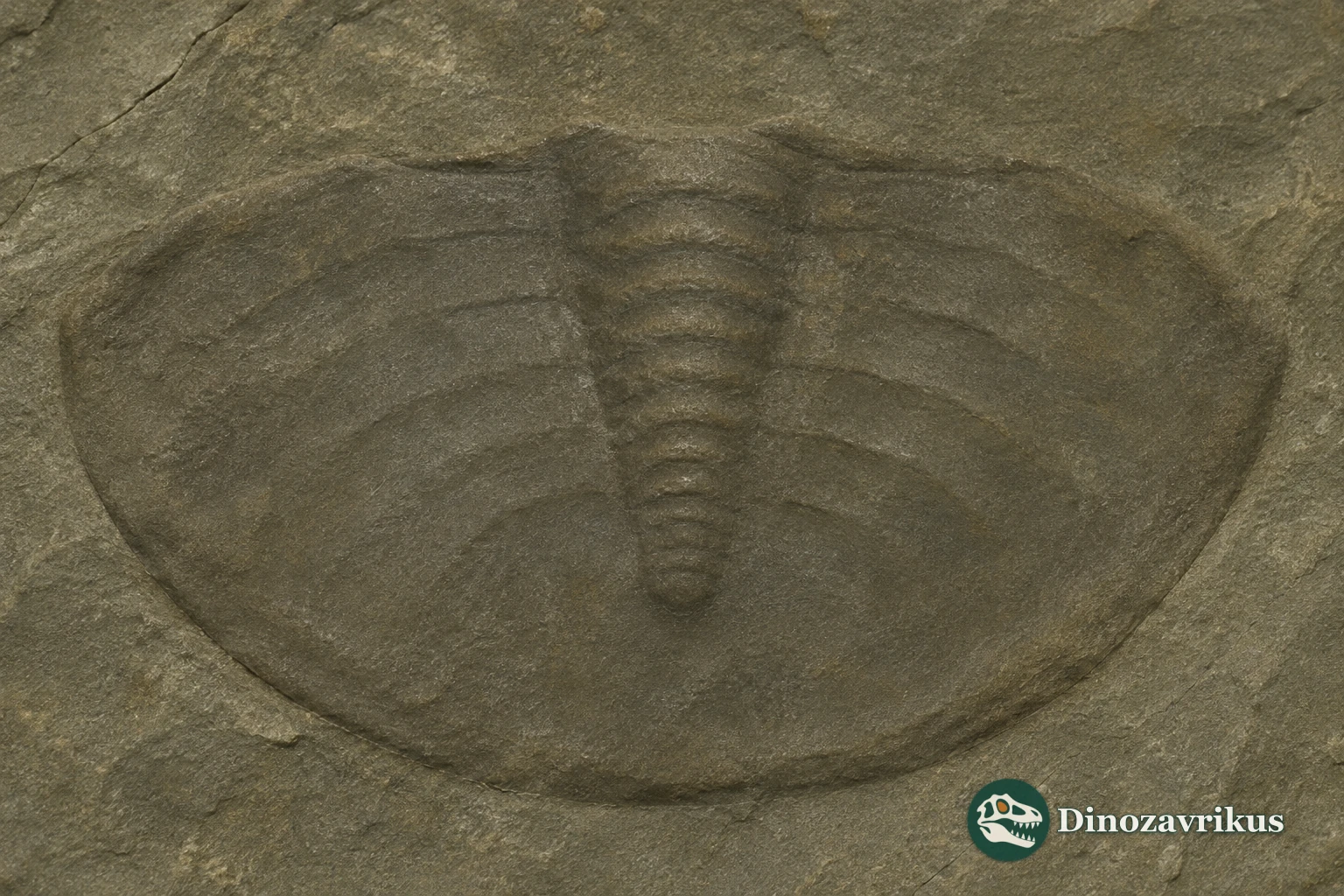
An impression of Pseudowaribole from Upper Devonian beds near Velbert measures just over one and a half centimetres. It preserves nine movable segments, a broad head rim and narrow, band-shaped eyes. Isolated shields add detail for comparison with other species.
Quick facts
| Group | Proetida |
|---|---|
| Age | Late Devonian, also Early Carboniferous in a broad usage |
| Named by | Gerhard and Renate Hahn, 1967 |
| Type species | Pseudowaribole octofera |
| Complete impression | 15.3 mm, near Velbert |
| Velbert species | Nine thoracic segments |
What can the fossils tell us?
That length comes from a complete impression. Isolated pieces can only be measured individually.
The second carapace lies in pieces. Its thorax was compared with the complete series of segments in the holotype.
Relief on the flanks is low. The rim is less distinct than the axis and the foremost ribs.
The genus name and a road-cut fossil
Gerhard and Renate Hahn established Pseudowaribole in 1967 as a subgenus of Archegonus. The type species is Cyrtosymbole (Waribole) octofera, described by Rudolf and Emma Richter in 1926 from the Sauerland. Later authors also used Pseudowaribole at genus rank.
Gerhard Hahn and Carsten Brauckmann described P. quaesita in 1984. K. Weber recovered its holotype, impression T.K. 34, from the road cutting at Langenhorst, north of Velbert. The complete impression is 15.3 mm long. The same upper Famennian outcrop yielded two nearly complete but damaged shells.

A broad head rim and a short thorax
The head of P. quaesita has a wide, flat front rim. The raised central glabella narrows in the middle and slightly overhangs the rim. A narrow eye hugs the edge of each curved eye lobe. The holotype has an eye about 1.8 mm long and sickle-shaped cheek spines with broad bases.
Nine segments join the head and tail. Another specimen, SMF 80759, was found in pieces, but its nine thoracic segments could be compared with the holotype. Low ridges at the articulations weaken towards the tail. The shells of Helioproetus, another Late Devonian proetid, preserve surfaces that can be compared with these joints.
Tail relief and the limits of the genus
The rounded tail of P. quaesita shows eleven rings on the tapering axis and five clearly defined pairs of ribs to the sides. In the diagnosis of the genus, the front and rear bands of the ribs meet to form a raised ridge. In the Velbert species the relief is subdued and the broad rim is barely set off from the rest of the shield.
The material varies between species. One Late Devonian species, P. sulcata, was assigned to the genus from a single free cheek with a distinctive ridge beside the eye. The broader concept of the genus includes Geigibole, which is among the trilobites recorded from Early Carboniferous limestones of the Carnic Alps.
Frequently asked questions
Which is the type species of Pseudowaribole?
P. octofera of the Sauerland. The Richters named the species in 1926, before the genus was established.
Where was the complete impression found?
It came from a road cutting at Langenhorst north of Velbert. The described impression is 15.3 mm long.
How many thoracic segments did the Velbert species possess?
Nine are represented in the holotype and in a second shell preserved in pieces from the same locality.
Can a single cheek help identify the genus?
The cheek spine, outer border and ridges beside the eye provide characters. This was the basis for assigning P. sulcata to the genus.