

Psilosemys is known from early Eocene shell material in the Bighorn Basin of Wyoming. A groove at the rear of the upper shell and the joints between the upper and lower shell make the fragments useful for tracing emydid ancestry. Researchers differ on where it belongs along that lineage.
Quick facts
| Group | Turtles, emydid lineage (Pan-Emydidae) |
|---|---|
| Age | Early Eocene, Ypresian |
| Region | North America: Wyoming, USA |
| Type species | Psilosemys wyomingensis |
| Holotype | UCMP 179440, carapace fragments |
| Scientific name | Psilosemys |
| Diet | No direct evidence |
What can the fossils tell us?
The type specimen comes from Fifteen Mile Creek in Washakie County. The sediments at the locality place it in the early Eocene.
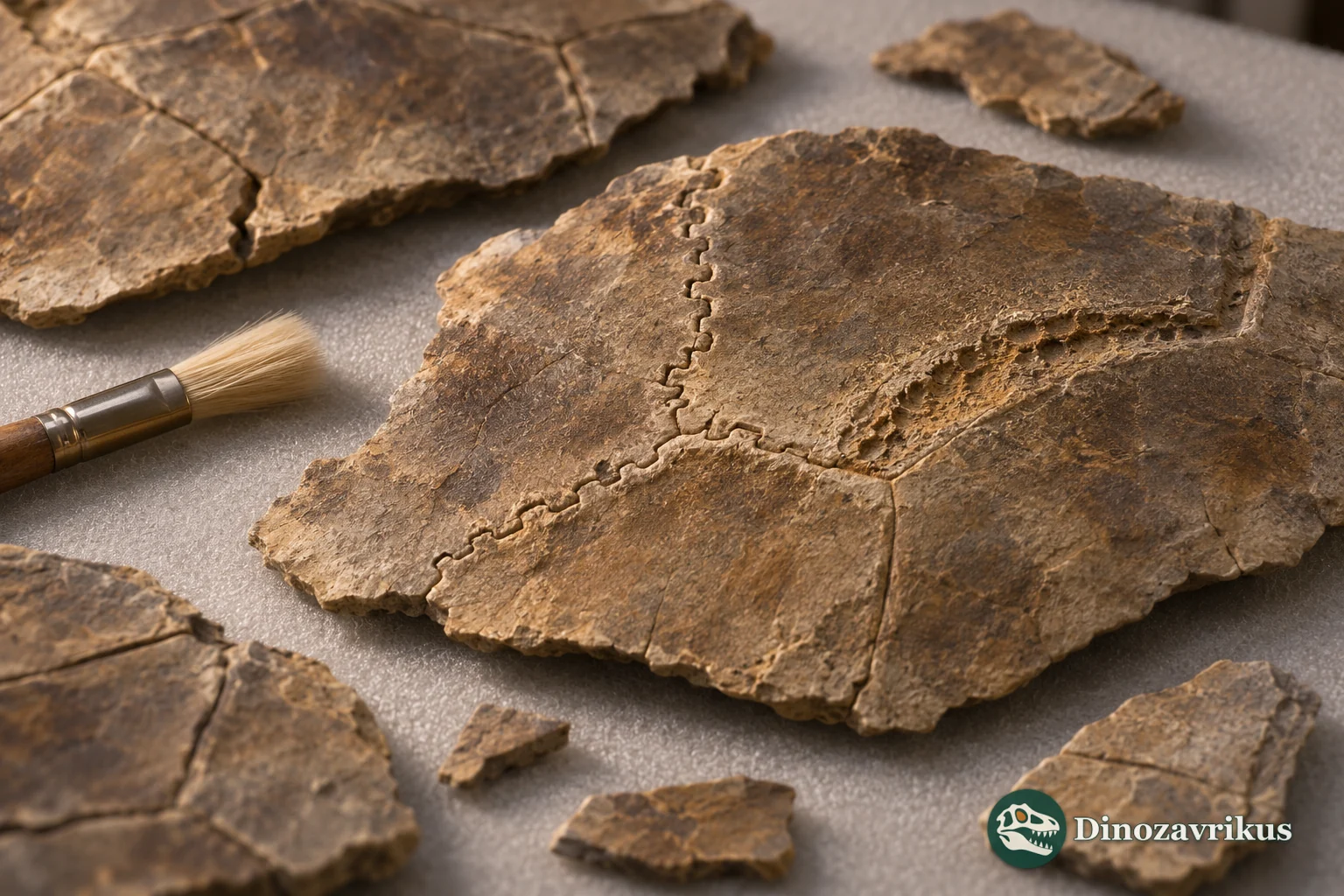
Grooves show the last vertebral scute extending onto the pygal bone. A pair of marginal scutes flanked it, a useful combination for comparison.
The shell supports a place in Pan-Emydidae. Its features leave more than one possible position relative to living emydids.
A name based on fragments
J. Howard Hutchison described Psilosemys wyomingensis in 2013. The type, UCMP 179440, consists of parts of the upper shell collected at Fifteen Mile Creek, Washakie County. Other material assigned to the species is recorded in Washakie and Big Horn counties. These finds come from the Willwood Formation, and the type locality lies in Ypresian beds.
Tracing the scute boundaries
In Psilosemys, the final vertebral scute extended back onto the pygal, the midline bone at the rear edge of the upper shell. The twelfth marginals remained paired and the shell showed little surface ornament.
Referred pieces help describe the plastron. The pectoral scutes fell behind the entoplastron, the unpaired bone in its front lobe. The bony support connecting the lower shell to the upper reached the costal plates. Each observation refers to a different part of the shell.
How close was it to living emydids?
Hutchison treated Psilosemys as sister to the crown group of living emydids. Evangelos Vlachos noted that its wide cervical scute, narrow vertebrals and bony bridge might indicate a position closer to living forms. His review left the relationships among early members of Pan-Emydidae unresolved.
Early Eocene sites in Wyoming also preserve Baltemys. Its shell belongs to the mud and musk turtle lineage, another branch present in the same region at the time.
Frequently asked questions
What does the type specimen preserve?
The type consists of fossil carapace fragments. Other assigned pieces add details of the lower shell.
Where were the fossils found?
They come from the Willwood Formation in Wyoming. The type locality is in the Fifteen Mile Creek area.
Was Psilosemys a member of the modern turtle family Emydidae?
Its shell supports a place on the emydid lineage. Its membership in the crown group remains uncertain.
What is known about its food?
The published shell material supplies no direct evidence of diet.