

Ptychogaster was a European geoemydid turtle with a movable joint in its plastron. The front of the lower shell was held firmly against the carapace, while the rear could pivot. The bones around the joint are preserved in early Miocene fossils from Mokrá Quarry in Czechia.
Quick facts
| Group | Turtles, geoemydids (Geoemydidae) |
|---|---|
| Age | Eocene, Oligocene and Miocene |
| Region | Europe |
| Type species | Ptychogaster emydoides |
| Scientific name | Ptychogaster |
| Diet | No direct dietary evidence |
What can the fossils tell us?
The type species comes from Saint-Gérand-le-Puy, France. Early Miocene fissures at Mokrá Quarry preserve separate plates that collectively document much of the shell.
The joint lay between the two main pairs of lateral plastral bones. The forward half of the plastron retained a firm connection to the carapace.
The combination of shell characters supports identifying the fossils as Ptychogaster. The plates do not preserve enough diagnostic features to name a species.
The Allier fossils
Auguste Pomel named the genus and its type species, P. emydoides, in 1847 from material near Saint-Gérand-le-Puy. The original plastron is known from its description and illustration. A later revision reported that the specimen itself was missing. Other fossils of the type species from the same locality are held at the National Museum of Natural History in Paris.
How the underside moved
The hinge ran between the hyoplastra and hypoplastra, paired bones on either side of the midline. It lined up with the sixth pair of peripheral bones in the carapace. The rear portion could pivot while the forward portion stayed anchored. Comparable hinges evolved independently in several turtle groups. In the North American geoemydid Echmatemys, other shell features are more useful for distinguishing the fossil species.
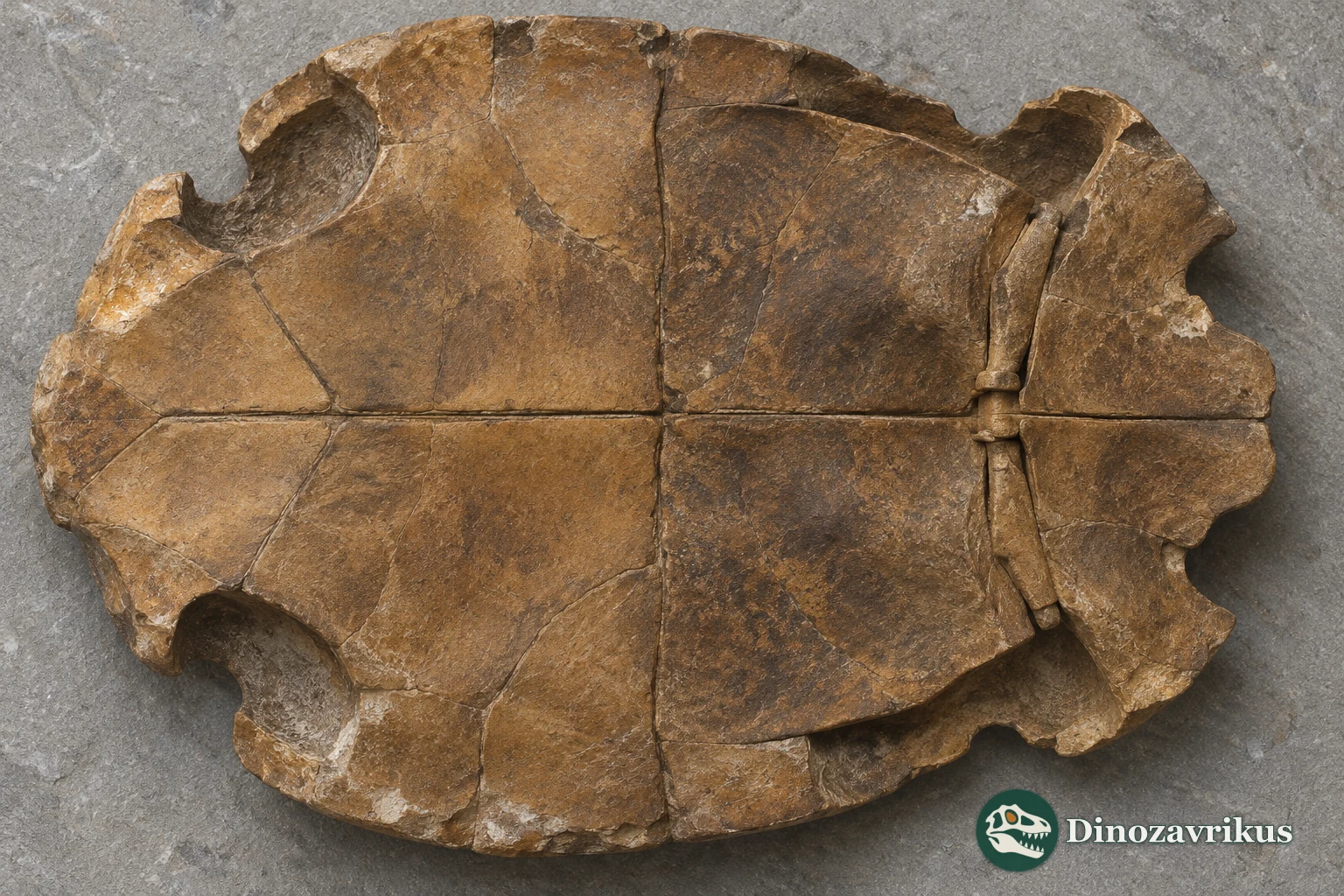
Disarticulated plates at Mokrá
Burdigalian fissure deposits at Mokrá Quarry yielded isolated bones of the upper and lower shell. Specimens Pal. 1300–1318 together document much of its anatomy, including parts of the hinge. The researchers compared the shell outline and scute grooves with those of the type species and related fossils. They left the species identification open.
The changing limits of the genus
European material referred to Ptychogaster spans the Eocene, Oligocene and Miocene. One revision placed the Late Miocene species P. batalleri of the Vallès-Penedès Basin in the subgenus Temnoclemmys. Early Eocene fossils of the wider ptychogastrine group in France belong to other genera. The age of that wider group cannot be used as the age of Ptychogaster itself.
Water and land
Ptychogastrines have been interpreted as aquatic or semiterrestrial. The fixed front and movable rear of the plastron provide evidence of how the shell protected the animal. Habitat use is harder to infer from the hinge alone.
Frequently asked questions
Which part of the shell moved?
The rear lobe of the plastron could pivot along a transverse joint. The front remained firmly attached.
What is the type species?
Ptychogaster emydoides, described by Auguste Pomel from fossils near Saint-Gérand-le-Puy in France.
Why were the Czech fossils left unnamed at species level?
The preserved plates show characteristic features of the genus, but do not carry enough information to distinguish among close species.
What did Ptychogaster eat?
The studied fossils consist largely of shell bones. They provide no direct record of its food.