

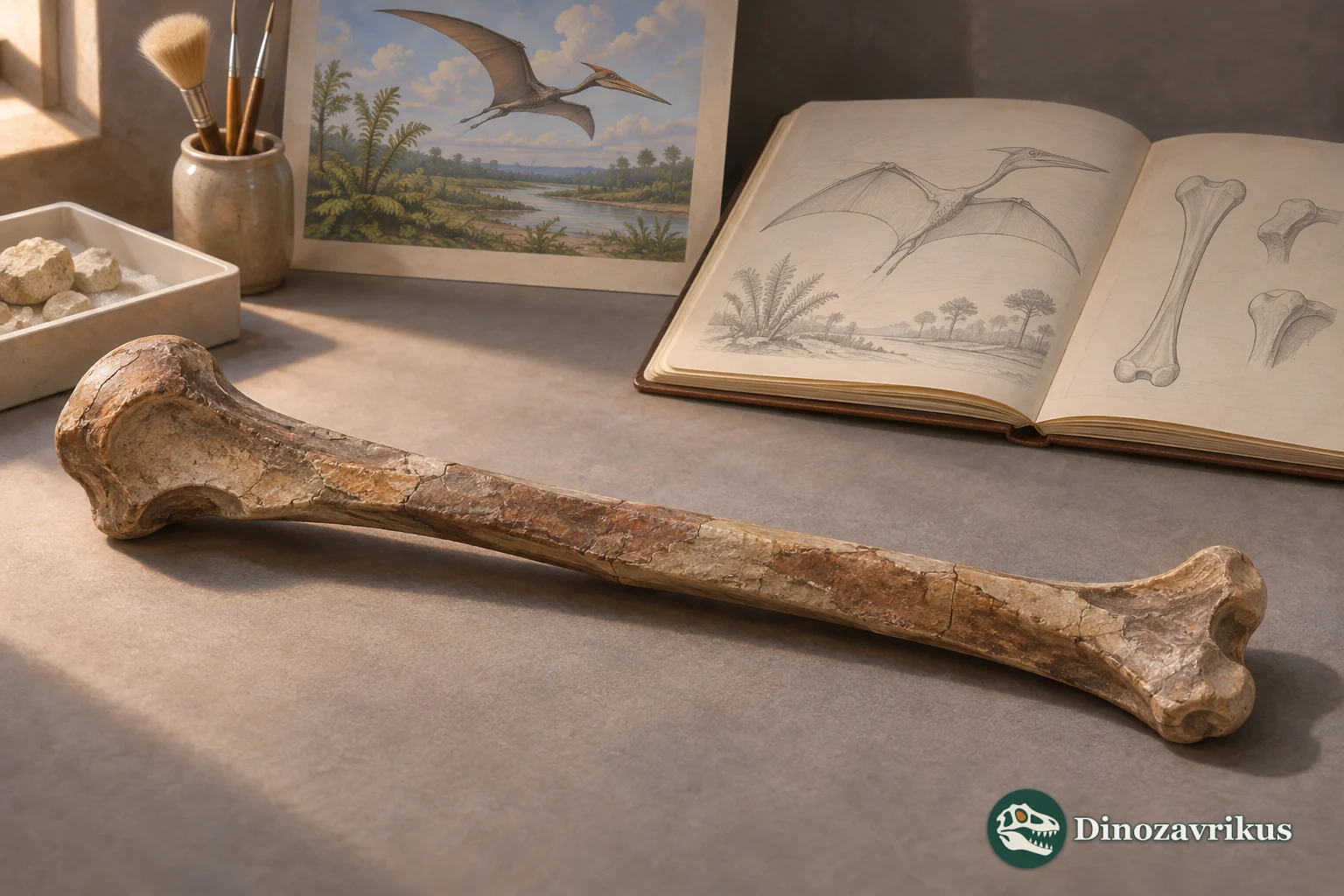
Radiodactylus langstoni was named from a single left humerus from Early Cretaceous Texas. No associated skull, teeth or complete wing are known for this species. The bone provides evidence for comparison among pterodactyloid pterosaurs, while the animal on the cover is a comparative artistic reconstruction.
Quick facts
| Named species | Radiodactylus langstoni, Andres and Myers, 2013 online |
|---|---|
| Holotype | SMU 72547, an isolated left humerus |
| Locality | Squaw Creek, Texas, United States |
| Rock unit | Glen Rose Formation |
| Geological age | Upper Aptian to lower Albian, Early Cretaceous |
| Original placement | A non-azhdarchid azhdarchoid in the Andres and Myers analysis |
| Skull and teeth | Not associated with the holotype |
| Wingspan | Not reliably established from one humerus |
What can the fossils tell us?
SMU 72547 does not include a skull, wrist, wing fingers or pelvis.
The interval dates the Glen Rose Formation at the locality, not the individual to a precise year.
The bone was first assigned to an indeterminate azhdarchid before Andres and Myers named a separate taxon.
One humerus cannot reveal teeth, exact wing proportions, body colour or specific prey.
A single Texas fossil and a new name
Specimen SMU 72547 is an isolated left humerus from the Squaw Creek area of Texas, in rocks of the Glen Rose Formation. The locality is assigned an upper Aptian to lower Albian age. This is a geological interval for the deposit, not a measured date for the animal's death.
The bone was initially identified as an indeterminate azhdarchid. Brian Andres and Timothy Myers later named Radiodactylus langstoni while reassessing Texas pterosaurs. The species honours palaeontologist Wann Langston Jr. The genus name alludes to the power facility associated with its discovery, rather than to a biological trait.
What the humerus can and cannot show
The humerus linked the shoulder to the forearm. Its joint surfaces and muscle attachments can be compared with those of other pterosaurs. Those features support anatomical study, but the type specimen has no skull, jaws, teeth, wrist, wing finger, vertebrae or pelvis attached to it.
No measured wingspan follows from an isolated upper arm without reconstructing the missing parts. Likewise, a particular beak form, feeding style, body mass or colour cannot be read from the bone. Any whole-animal picture must borrow general anatomy from other pterodactyloids.
The placement question
In the Andres and Myers analysis, Radiodactylus was an azhdarchoid outside Azhdarchidae. This differed from its earlier assignment as an unnamed member of that family. Alexander Averianov's subsequent review discussed the Texas humerus and comparisons with azhdarchid arm bones. A single element leaves the placement open to testing by more complete discoveries.
Texas also yielded Alamodactylus and Aetodactylus. Their specimens provide regional context, not missing body parts for Radiodactylus. They must be assessed as separate species.
Reconstructing an incomplete animal
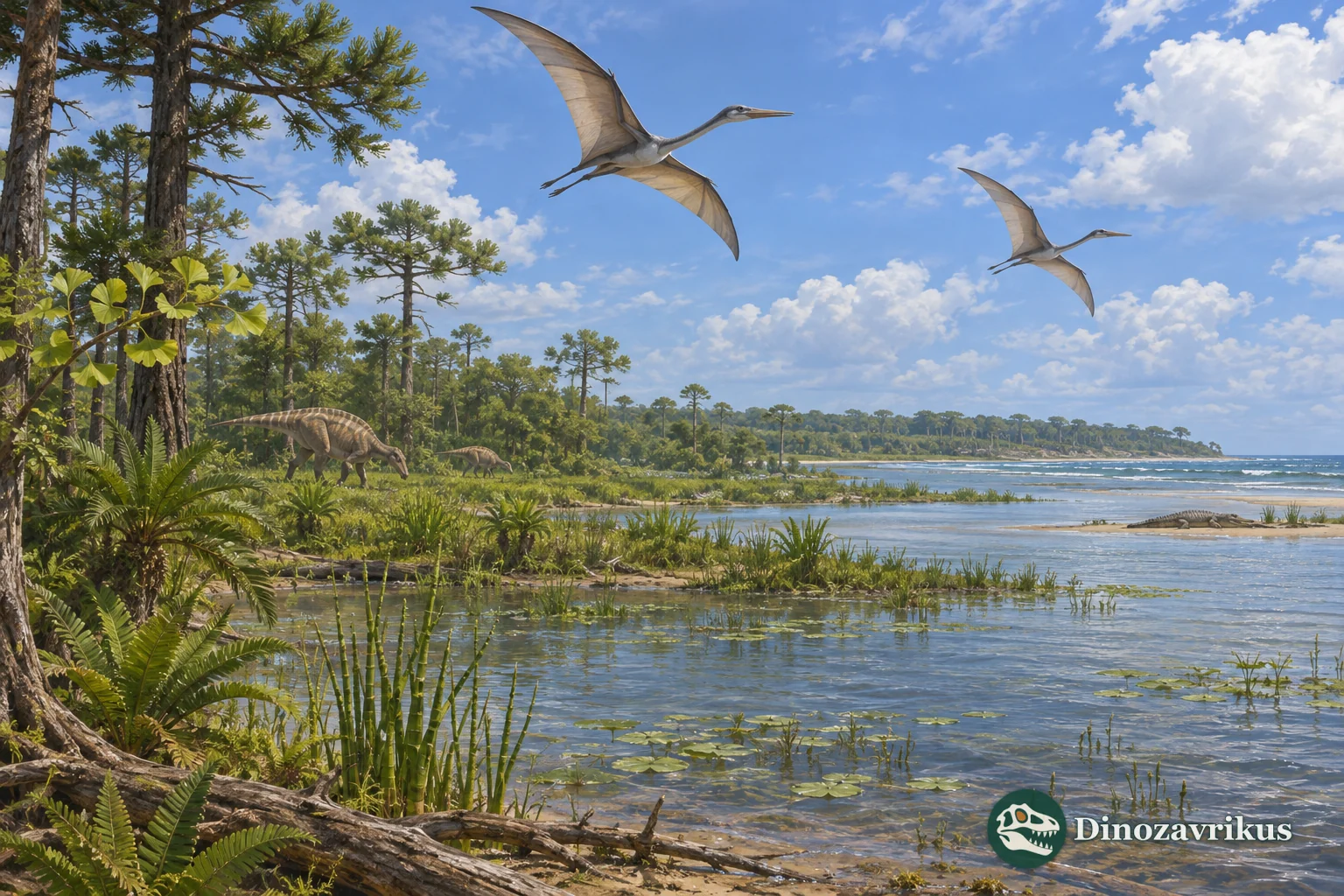
The illustrated living pterosaur and coastal landscape are possibilities for Early Cretaceous Texas. They are not observations of SMU 72547. Neither a land-based feeding posture nor soaring above water establishes this animal's actual diet or behaviour. Further associated fossils would be needed to test head shape, wing span and lifestyle.
Frequently asked questions
Where was Radiodactylus found?
Its type humerus comes from Squaw Creek in Texas, in the Glen Rose Formation of late Aptian to early Albian age.
What remains of the animal?
The named fossil is one isolated left humerus. No skull, teeth or other wing bones were found with it.
Was it an azhdarchid?
The bone was first labelled an indeterminate azhdarchid. Andres and Myers recovered the named species as an azhdarchoid outside that family.
Can its size and diet be determined?
A reliable whole-body size or wingspan and a specific diet cannot be established from the humerus alone.