

Rafetoides is a genus name proposed for European Eocene softshell turtles. Its type species is known from a rounded carapace disc from southern England. The proportions of that disc help diagnose the species, while the proposed genus has yet to be tested across all the fossils assigned to it.
Quick facts
| Group | Turtles, softshell lineage (Pan-Trionychidae) |
|---|---|
| Age | Middle and Late Eocene (Priabonian for the holotype) |
| Region | Europe (England and France) |
| Type species | Trionyx henrici |
| Holotype | BMNH R30407, bony carapace disc |
| Scientific name | Rafetoides |
| Diet | Exact diet unknown |
What can the fossils tell us?
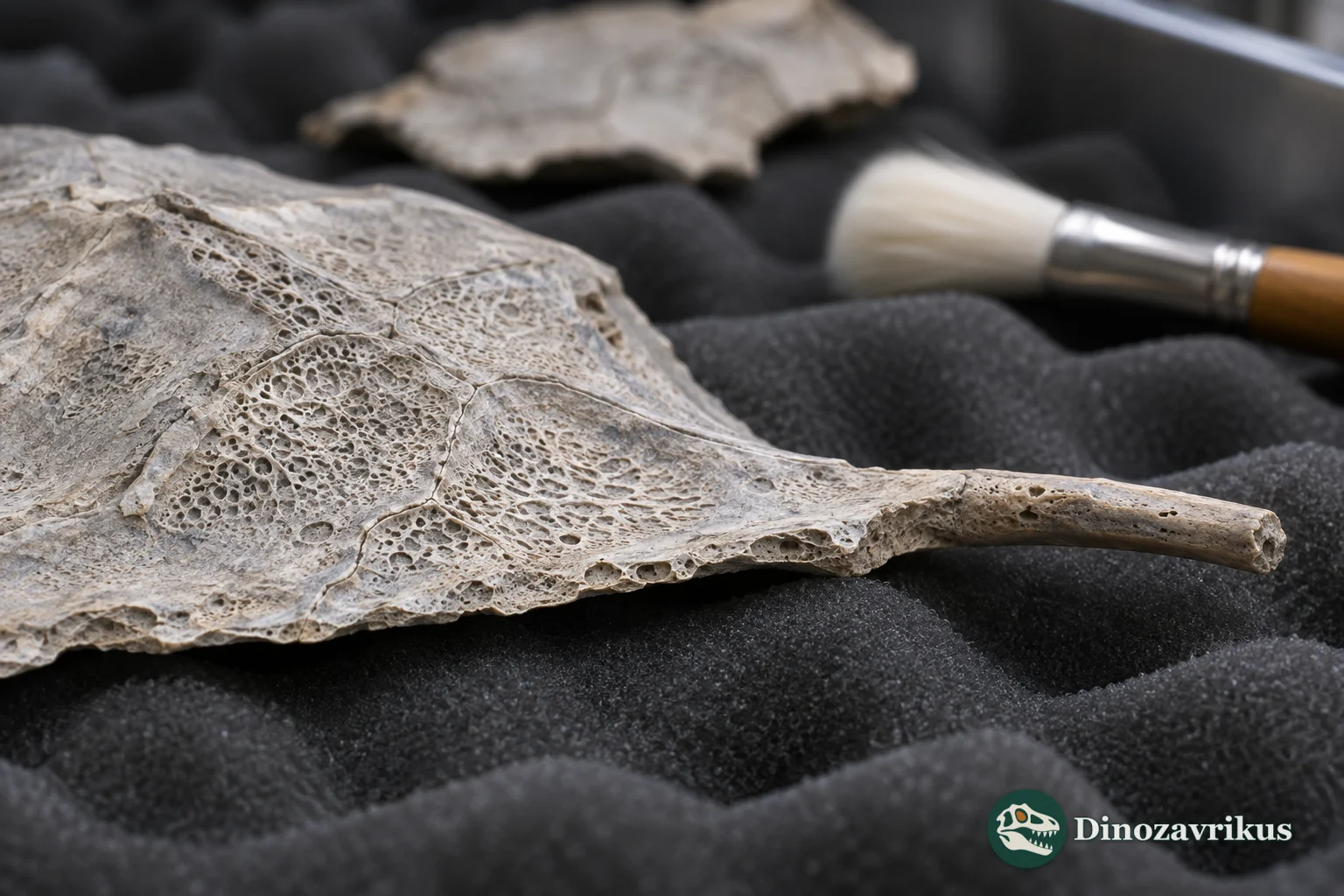
The name-bearing specimen BMNH R30407 preserves a rounded bony disc. Its nuchal, the bone at the front of the shell, is missing.
The Totland Bay Member of the Headon Hill Formation places the type locality in the Late Eocene.
Fossils from Messel and Geiseltal once associated with Rafetoides were compared anatomically and reassigned to Palaeoamyda.
An English fossil at the centre of the name
Richard Owen described Trionyx henrici in 1849. Hans-Volker Karl made it the type species of Rafetoides in 1998. The holotype, BMNH R30407, comes from Hordle Cliff, historically Hordwell, on the Hampshire coast. The modern revision places its locality in the Late Eocene Totland Bay Member of the Headon Hill Formation.
Referred material extends the species into the Middle Eocene. The reviewed record includes England and France.
Recognising the bony disc
The carapace disc reached about 30 centimetres in the type species. Its outline is rounded and the ornamented regions of the disc are well developed. The eighth pair of rib-bearing plates is short and broad, and the diagnosis records the absence of a preneural bone. These features provide a set of landmarks for comparing isolated shell material. The Cretaceous softshell Kuhnemys illustrates how a different arrangement of disc bones can distinguish another lineage.
Which fossils belong in Rafetoides?
Karl included several European species, among them T. silvestris, named from English skull material. In their 2017 review, Georgios Georgalis and Walter Joyce treated it separately from T. henrici. They saw scope for a distinct European Eocene softshell lineage and noted that Rafetoides would be an available name. They retained the provisional combination ‘Trionyx’ for individual species pending better tests of relationships.
German fossils at Messel and Geiseltal were at one stage referred to Rafetoides austriacus. Edwin Cadena’s comparison of skull and shell anatomy in 2016 placed that material in Palaeoamyda messeliana. The reassignment concerns the German specimens. The English type retains its own diagnosis.
Frequently asked questions
When and where did the type species live?
Its holotype comes from Priabonian deposits at Hordle Cliff in Hampshire, England.
How large was the carapace?
The bony disc reached about 30 centimetres in the type species. The soft margin would have extended beyond the disc.
Is Rafetoides another name for Trionyx?
Rafetoides was proposed as a separate genus. Quotation marks around ‘Trionyx’ in later work indicate provisional use of the original combination.
Were the Messel fossils the same turtle?
A 2016 redescription assigned the studied material from Messel and Geiseltal to Palaeoamyda messeliana.