

Rasettia was a Late Cambrian trilobite known from North and South America. At Quebrada Oblicua in western Argentina, pieces of its head and tail shields occur in a limestone block displaced from its original setting.
Quick facts
| Group | Trilobites, family Illaenuridae |
|---|---|
| Age | Late Cambrian, Furongian |
| Region | North America: Canada and United States. South America: Argentina |
| Type species | Rasettia capax |
| Diet | Unknown |
What can the fossils tell us?
The Argentine revision examined three cranidia and 23 tail shields of R. crucensis.
The trilobites preserved together inside the limestone support a late Furongian age for the Argentine Rasettia material.
A fragment from the Jones Ridge area agrees with R. capax in most respects, although its shallower axial furrows make the species identification tentative.
A replacement name
Elkanah Billings named the Quebec species Bathyurus capax in 1860. It was later made the type species of Platycolpus, a name that was already in use. Christina Lochman proposed Rasettia in 1953 as the replacement genus name. The species is now known as Rasettia capax.
The Argentine tail shield
Carlos Rusconi described the Argentine species in 1953. Its holotype is a tail shield, specimen 16876. The later study of material from Quebrada Oblicua examined three cranidia, which are the central parts of head shields, and 23 separate tail shields.
In R. crucensis, the tail shield is broad and nearly oval, with a continuous spineless rim. Its short central axis reaches about halfway down the shield. In the North American R. capax, the axis is longer and the surface is pitted. A slight indentation on the rim of one Argentine specimen may reflect preservation. The name R. excavata, based on that specimen, was treated as a synonym of R. crucensis.
Dating the limestone block
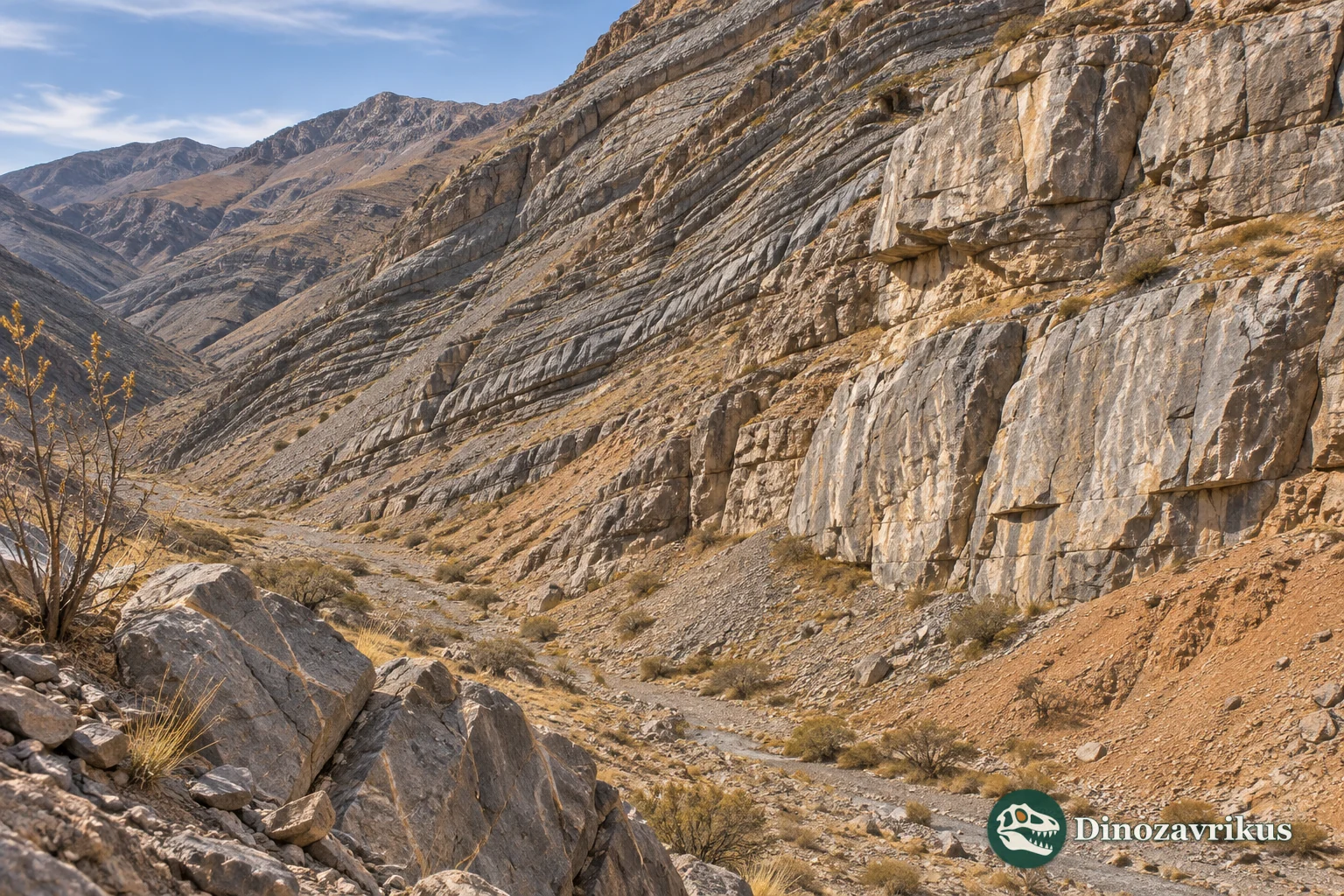
The Argentine specimens come from a displaced limestone block called the La Cruz Olistolith. The ravine contains separate blocks with trilobites of different ages, so the fossils within each block provide an important dating check. The Rasettia assemblage is comparable to late Furongian faunas of North America.
The type species was originally described from Quebec and has been reported elsewhere in North America. Several diagnostic fossils help establish where a bed sits in a sequence. The Late Cambrian trilobite Calvinella lends its name to a different assemblage in northern China.
Frequently asked questions
Which species is the type of Rasettia?
Rasettia capax. Billings originally described it as Bathyurus capax in 1860.
What is preserved in the Argentine collection?
The revised collection contains three cranidia and 23 tail shields.
How do the Argentine and North American species differ?
R. capax has a longer tail-shield axis and a pitted surface compared with R. crucensis.
What is the La Cruz Olistolith?
It is a displaced block of Cambrian limestone at Quebrada Oblicua that preserves Rasettia and other trilobites.