

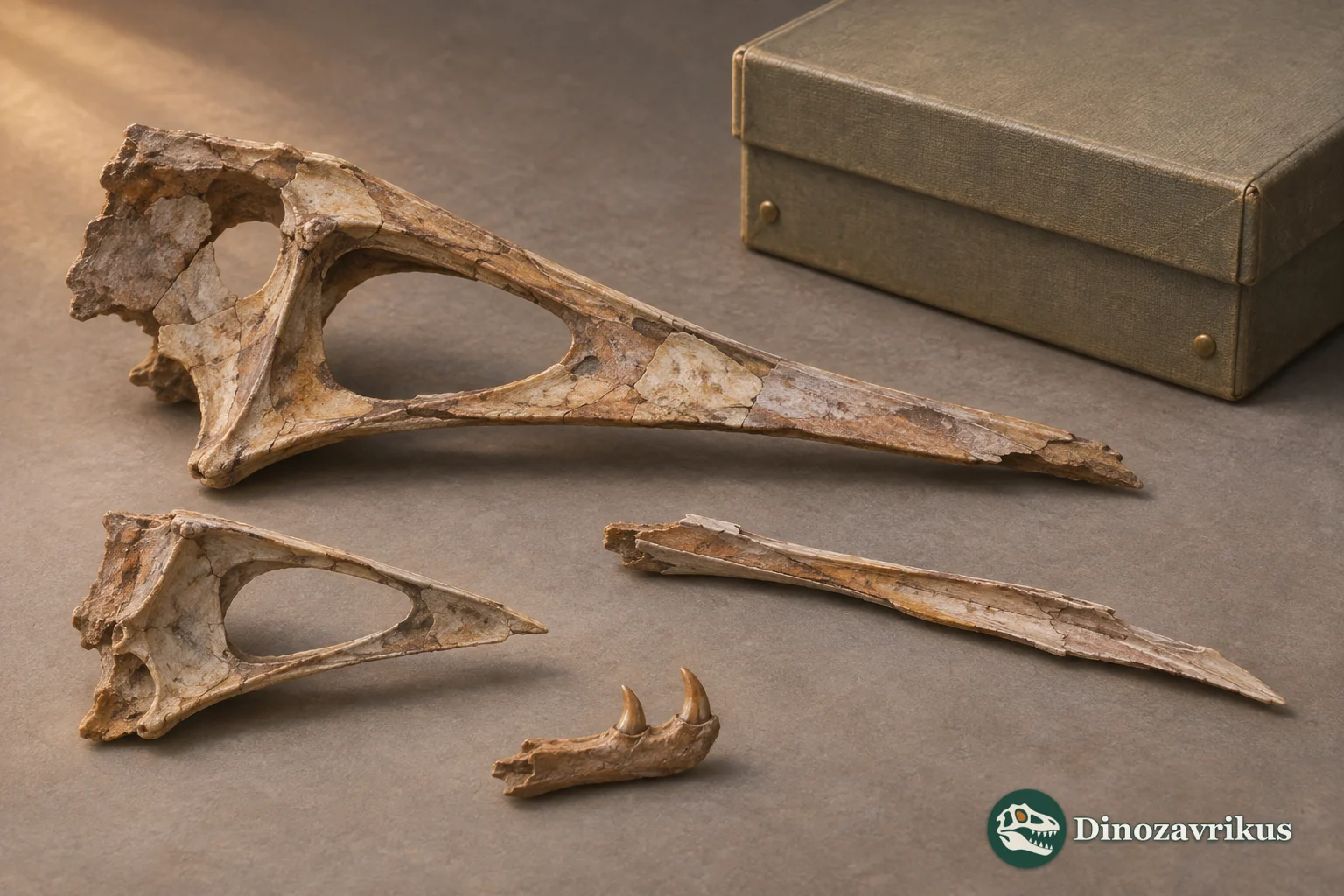
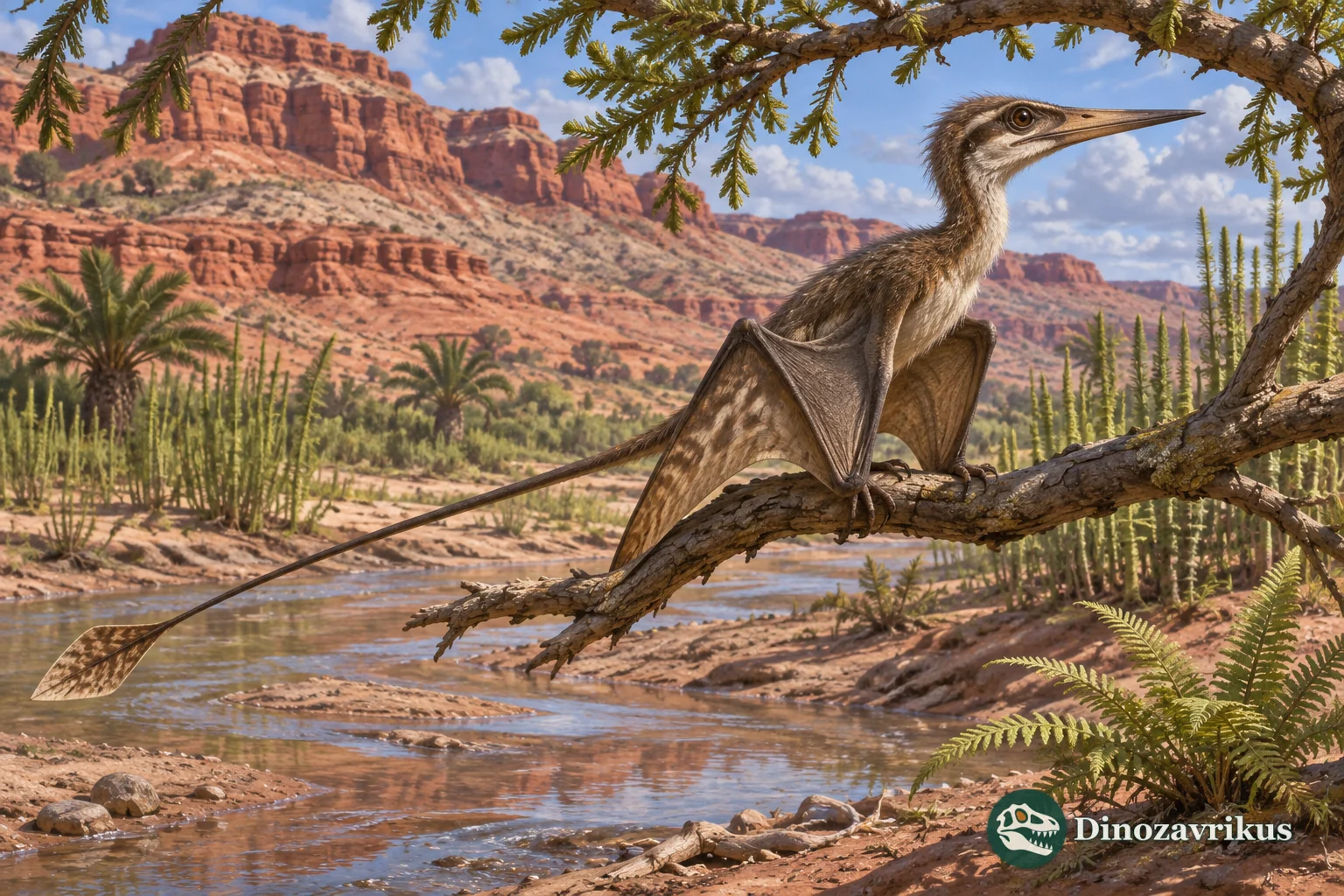
Rhamphinion jenkinsi was named from three pieces of a skull in the Early Jurassic Kayenta Formation of northeastern Arizona. The jaw material also preserves two teeth. Those fragments allow some comparisons among early pterosaurs, but they do not provide a complete skull or any wing bones. The cover depicts a possible early pterosaur rather than a documented whole specimen.
Quick facts
| Named species | Rhamphinion jenkinsi, Padian, 1984 |
|---|---|
| Holotype | MNA V 4500, three skull pieces and two teeth |
| Locality | Northeastern Arizona, United States |
| Rock unit | Kayenta Formation |
| Age | Early Jurassic; the original paper marked the formation's age as uncertain |
| Comparative feature | Jugal boundaries of the orbit and antorbital opening |
| Wing material | No wing bone assigned to the named specimen |
| Wingspan | Not established from the holotype |
What can the fossils tell us?
An occipital region, most of a left jugal and a jaw fragment with two teeth survive, but not a complete skull.
Padian used the jugal's orbital and antorbital margins while noting that the fragmentary specimen is difficult to diagnose.
A fourth metacarpal from the Kayenta Formation belongs to a pterosaur but could not be assigned to Rhamphinion.
A later attribution of a Jurassic British skull to Rhamphinion was judged unsupported in a 2018 review.
Discovery in the Kayenta Formation
Kevin Padian described two pterosaur finds from the Kayenta Formation in 1984. He named the first Rhamphinion jenkinsi from incomplete skull material. The name refers in part to the back of the head, a conspicuous portion of the specimen. The species honours Farish Jenkins, whose research was closely associated with the Kayenta vertebrates.
The second find was a well-preserved left fourth metacarpal, a wing bone. Padian could place it within a broad early pterosaur grouping but could not identify it as Rhamphinion. Finding both fossils in one formation does not join them into a single skeleton.
What the type material preserves
The holotype consists of an occipital region, most of a left jugal and a possible dentary fragment with two associated teeth. The position and shape of the jugal borders beside the orbit and antorbital opening helped the original comparison. Padian nevertheless stressed that diagnosis was difficult because so little of the skull survives and the occipital anatomy of early pterosaurs was poorly understood.
There are no associated vertebrae, pelvis, wing bones or tail. The teeth show a toothed region of the jaw, but neither the complete tooth row nor prey. A wingspan or precise body mass cannot be read from MNA V 4500.
Age, range and relationships
The Kayenta Formation is Early Jurassic. Padian placed a question mark before its precise age in the original paper. Later Sinemurian to Pliensbachian assignments refer to the rock interval, not a precise date for this individual.
Eotephradactylus provides an older North American pterosaur comparison, so an old claim that Rhamphinion was the continent's earliest is outdated. Campylognathoides offers a more complete Early Jurassic toothed pterosaur skeleton, but its body cannot fill the missing parts of Rhamphinion.
A disputed British identification
A Jurassic skull from England was once labelled Rhamphinion. A 2018 reassessment found little proportional similarity and considered that identification unsupported because the comparison lacked a descriptive justification. Arizona remains the secure range for the named genus. The Arizona illustrations show possible postures and wing outlines, not direct evidence from the head fragments.
Frequently asked questions
Where was Rhamphinion discovered?
The type material came from the Kayenta Formation in northeastern Arizona, United States.
What remains of its skull?
Three incomplete portions include the occipital region, most of a left jugal and a possible jaw piece with two teeth.
Does the separate wing bone belong to it?
That has not been demonstrated. Padian described it as another Kayenta pterosaur specimen without a genus-level assignment.
Is its wingspan known?
No. The named specimen has no wing bones, and the separate metacarpal cannot safely supply them.