

Rhamphosuchus was a large long-snouted crocodylian from South Asia. Most specimens preserve parts of the jaws, including areas where the teeth met the palate. New material from Pakistan has helped identify a second species and provides a basis for estimating its size.
Quick facts
| Type species | Rhamphosuchus crassidens |
|---|---|
| Second species | Rhamphosuchus pachyrhynchus |
| Group | Gavialoidea in the 2025 revision |
| Region | Siwalik Hills and other South Asian localities |
| Age of material from Bugti | Late Aquitanian, Early Miocene |
| Estimated length | About 6–8 m for large R. pachyrhynchus, from jaw proportions |
What can the fossils tell us?
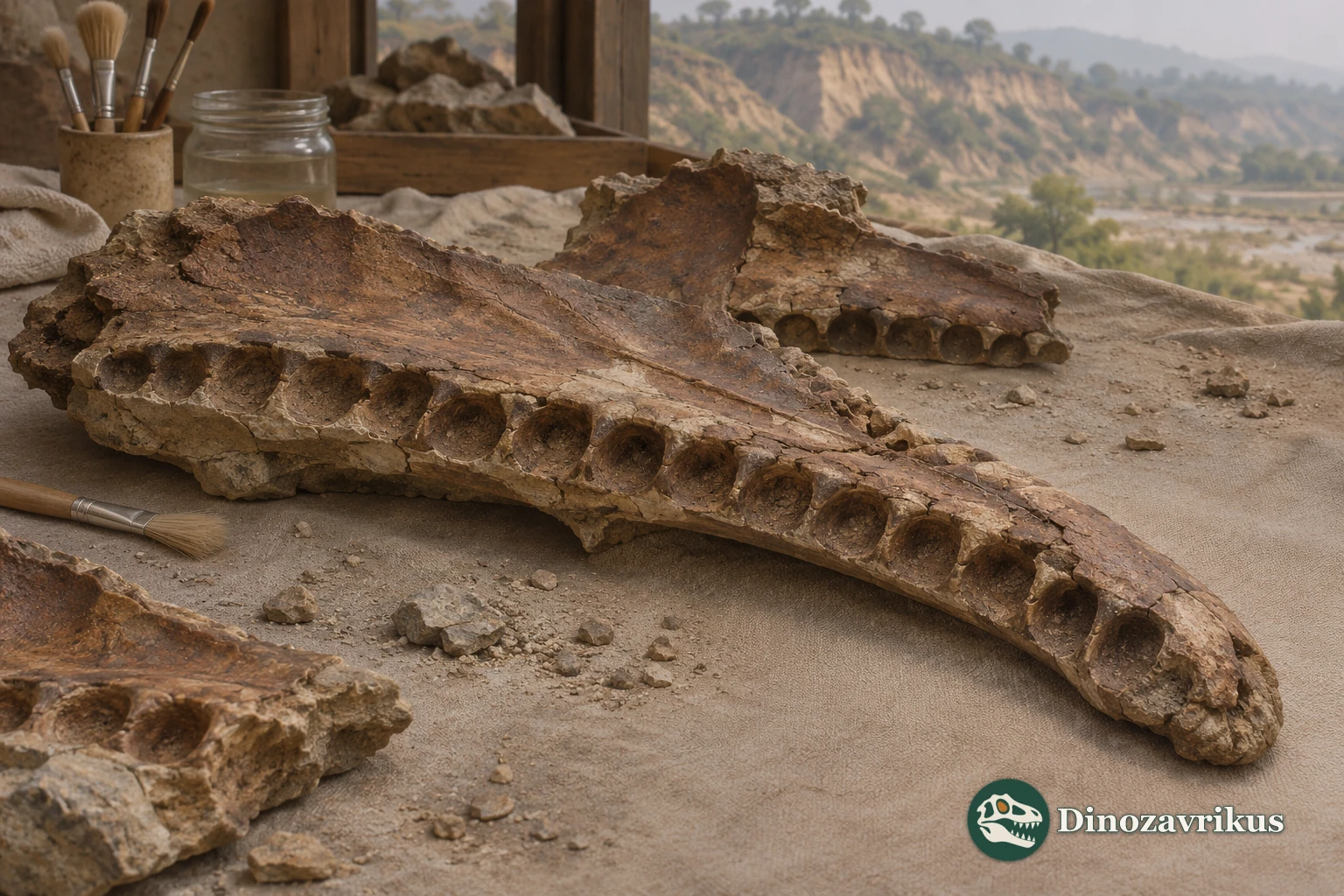
The lower teeth met the palate inside the upper tooth row. The bone records where the teeth engaged, though it leaves the usual prey unknown.
Material assigned to the second species from several Bugti localities comes from a late Aquitanian level. Many older collections lack that degree of stratigraphic detail.
Comparisons with Sarcosuchus yielded 6–8 m for large examples of the second species. The saltwater crocodile gave about 7 m.
From Siwalik collections to a separate genus
Proby Thomas Cautley and Hugh Falconer collected fossil vertebrates in the Himalayan foothills during the first half of the nineteenth century. They published the name of the type species, now Rhamphosuchus crassidens, in 1840. Richard Lydekker erected the genus in 1886. A cast of the London specimen BM 39802 is held in Paris.
The genus combines an elongated, flattened snout with wide upper jaws. In large specimens, adjacent maxillary sockets almost touch and increase in diameter back to at least the fifth position. The lower tooth row closed inside the upper row. The 2025 revision classified Rhamphosuchus as a gavialoid. Other members of the group, such as Eogavialis, also had long snouts.
The second species and material from Pakistan
In 2025 Erwan Courville and colleagues transferred Lydekker’s Gharialis pachyrhynchus to Rhamphosuchus. Its holotype, GSI (IM) E30, is the front of a snout from the Laki Hills in Sindh, Pakistan. Compared with the type species, it has a broader outer nostril with a higher lateral rim.
Similar jaw material from the Bugti Hills in Balochistan came from a level near the top of the Chitarwata Formation, dated to the late Aquitanian. The original Laki Hills specimen has a broader age assignment around the Oligocene–Miocene boundary. These dates apply to particular specimens of the second species.
How large could it grow?
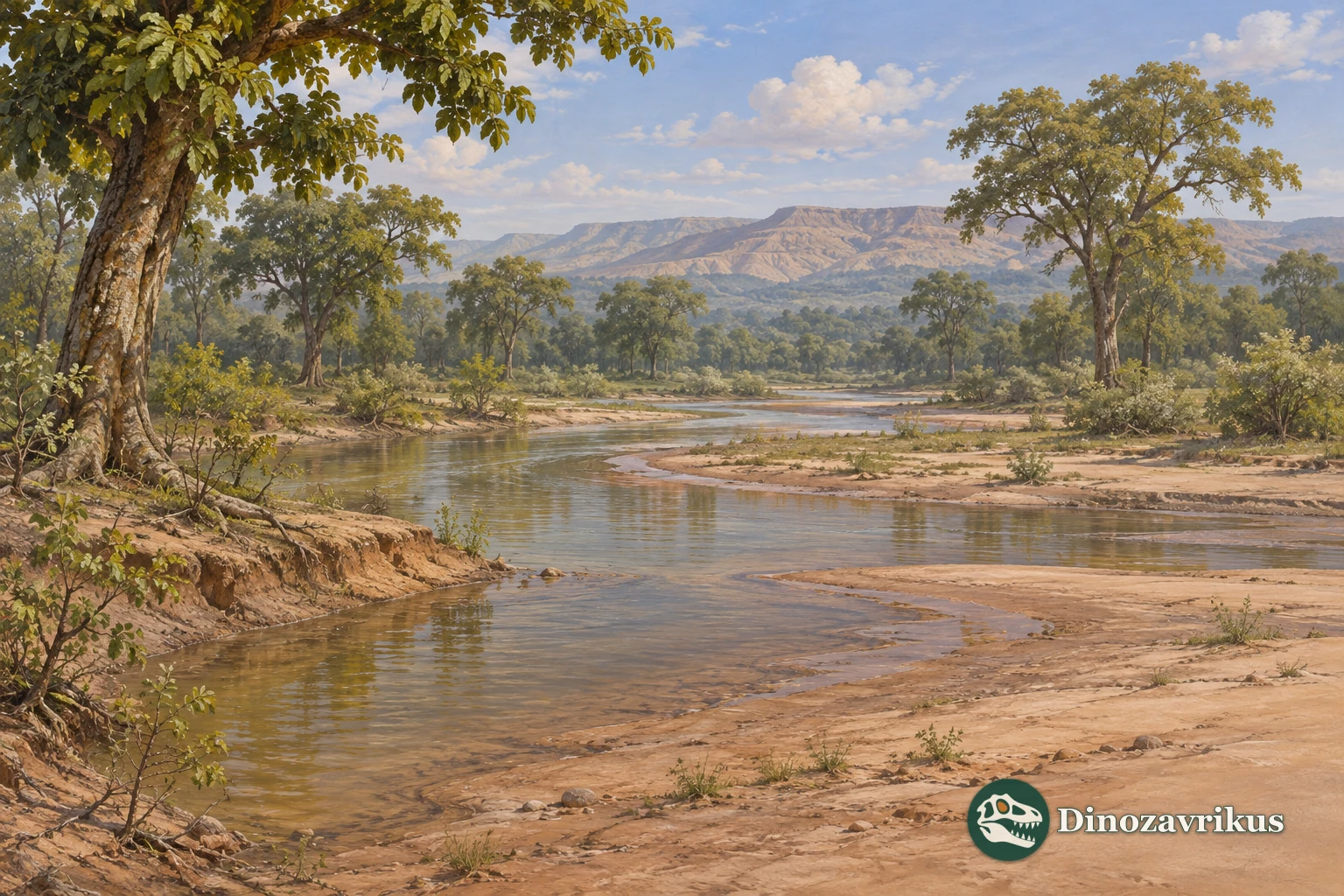
Using Sarcosuchus as the reference, the researchers estimated 6–8 m in overall length for the largest jaw fragments of R. pachyrhynchus. Using the living saltwater crocodile gave about 7 m. The estimated skull length of the holotype is 82–105 cm, a calculation based on a different specimen.
The broad, low snout and large tooth sockets show the animal was equipped to seize prey with long jaws. The fossils do not establish how much of its diet was fish or other vertebrates. The reconstruction uses the known jaw shape and infers the soft tissues and posture.
Frequently asked questions
Which two species did the revision recognise?
The type species Rhamphosuchus crassidens and R. pachyrhynchus, transferred to the genus in 2025.
Was an eight-metre skeleton found?
The size estimate comes from large jaw fragments of the second species, scaled against other crocodyliforms.
How do their nostrils differ?
The bony outer nostril of the second species is broader and has a more elevated lateral margin.
How old are the Bugti fossils?
The material discussed here comes from the late Aquitanian, in the Early Miocene.