

Rhynchippus was a South American notoungulate best documented by late Oligocene fossils from Patagonia. Its name and three-toed limbs may recall a horse, but it was not a true horse. Skulls, teeth and limb bones tell a separate evolutionary story.
The genus belongs in the ancient mammal catalogue. Trachytherus also lived in the broader Paleogene world of South American notoungulates but belonged to a different lineage. A similar herbivorous outline is not evidence of close kinship.
Quick facts
| Scientific name | Rhynchippus Ameghino, 1897 |
|---|---|
| Type species | R. equinus |
| Group | Notoungulata, Toxodontia |
| Studied skull | MPEF PV 695; length 219 mm |
| Locality | Cabeza Blanca, Chubut, Argentina |
| Age of studied skull | Late Oligocene, Deseadan |
| Limbs | Three digits on fore and hind feet |
What can the fossils tell us?
MPEF PV 695 is 219 mm long and 122.5 mm wide across the zygomatic arches. These are measurements of one skull, not a direct estimate of body mass for the whole genus.
Tomography reveals a tympanic cavity connected with an epitympanic sinus and inflated auditory bullae. Bone canals support a proposed vascular route; they do not measure hearing directly.
Comparisons of R. equinus, R. pumilus and R. brasiliensis use size and molar folds. Wear changes the crown surface, so a lone tooth may not be conclusive.
Ameghino's name and the type series
Florentino Ameghino named R. equinus in 1897 without selecting a single holotype from the original series. MACN A 52–31, a mandible and upper-jaw fragments, was later described as a lectotype in an unpublished catalogue. Because that designation was never validly published, the specimen should not be presented as an uncontested formal lectotype.
The detailed 2016 anatomical revision instead centres on MPEF PV 695, an exceptionally preserved adult skull from Cabeza Blanca in Chubut. It is held by the Egidio Feruglio Paleontological Museum in Trelew. Researchers compared museum material from Argentina and Chicago and used CT to inspect internal structures without cutting the skull apart.
What the skull and tooth row show
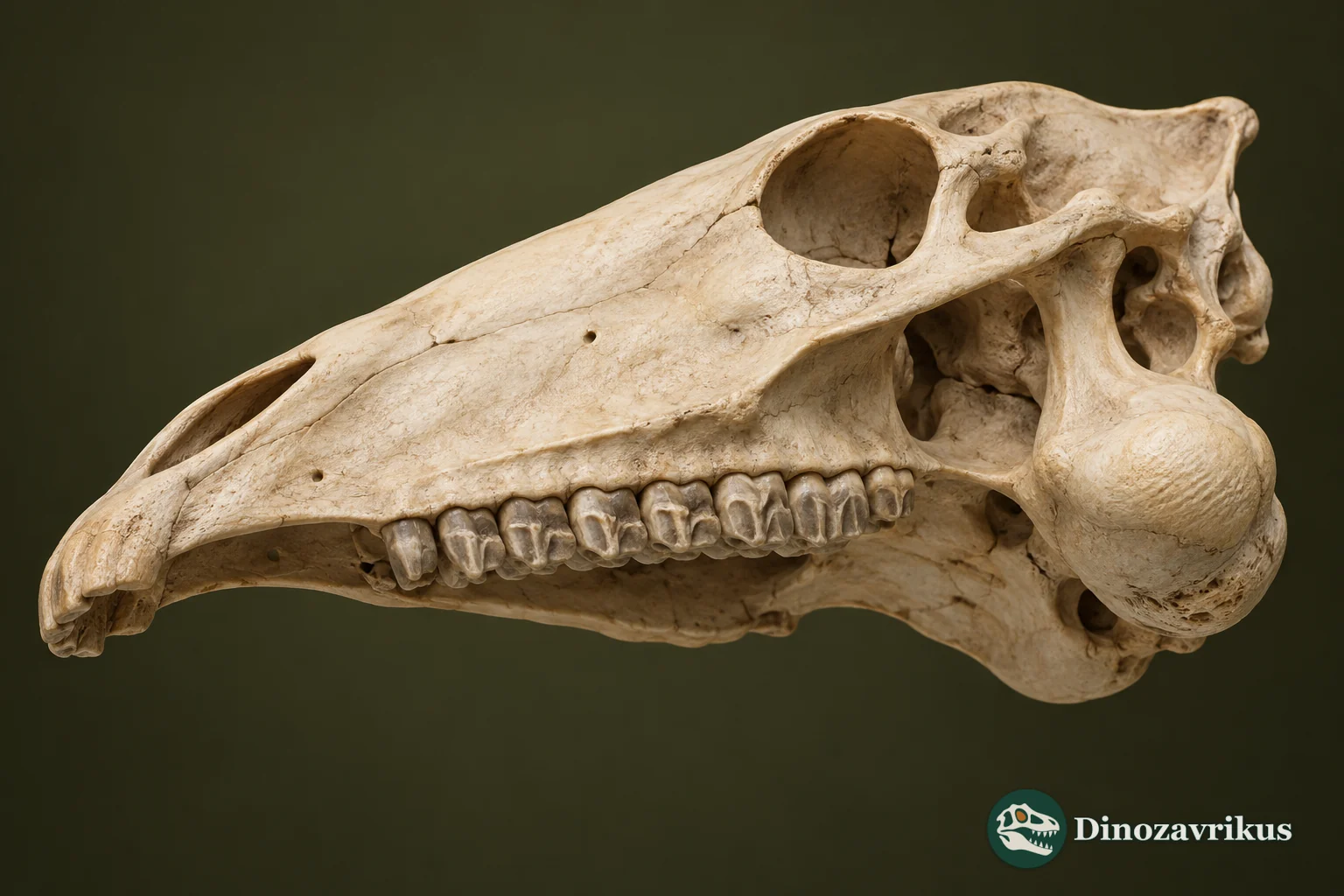
MPEF PV 695 measures 219 mm from the rear of the skull to the front of the snout and 122.5 mm across the zygomatic arches. All permanent teeth had erupted and show wear, supporting an adult age. Those measurements describe one individual; converting them into a genus-wide body length or mass requires an additional model.
The upper tooth row is continuous rather than interrupted by a large gap. Transverse ridges and enamel folds characterize the cheek teeth. An anteriorly bifurcated central fossette of the upper molars contributes to the revised diagnosis of R. equinus. Crown wear can change the visible pattern, while R. pumilus is generally smaller. Size alone is not a complete species diagnosis.

An unusual middle ear
CT revealed inflated auditory bullae, a tympanic cavity and an epitympanic sinus in the rear of the skull. The researchers traced bony canals and proposed an intratympanic course for the internal carotid artery as well as routes for major venous sinuses. Vessels themselves are not preserved as separate fossil tissues, and the cavities do not directly reveal the exact frequencies the animal could hear.
The petrosal and surrounding bones provide characters useful for comparing notoungulates. These observations matter because a traditional family called Notohippidae appears unlikely to be a single natural clade in phylogenetic analyses. A historical family name therefore should not be treated as a final map of relationships.
Other species, strata and life appearance
Some comparative studies recognize R. equinus, R. pumilus and R. brasiliensis. At Barrancas Blancas, two upper premolars with part of the palate, MPEF-PV 2558/1–2, were referred to R. pumilus by comparison with the type MACN-A-5261 and other museum material. Their association does not reveal the rest of that individual's body.
The MPEF PV 695 skull came from a Deseadan late Oligocene level in the middle Sarmiento Formation at Cabeza Blanca. Limb anatomy reported for R. equinus includes three digits on both front and hind feet. High-crowned, ridged teeth support plant processing, but they do not identify a precise forage species or running speed. Coat colour and soft facial contours in the cover are artistic choices.
Frequently asked questions
Was Rhynchippus a true horse?
No. It was a South American notoungulate in Toxodontia. Three toes and a superficially similar silhouette do not place it in the horse family.
What is MPEF PV 695?
A nearly complete adult R. equinus skull from Cabeza Blanca, studied with conventional anatomy and CT scanning.
How large was Rhynchippus?
One well-preserved skull measures 219 mm. That is not a direct whole-body length or mass estimate for the genus.
Why is Notohippidae disputed?
Animals were historically grouped by similarities including tooth form, but phylogenetic analyses do not recover all traditional members as one natural branch.