

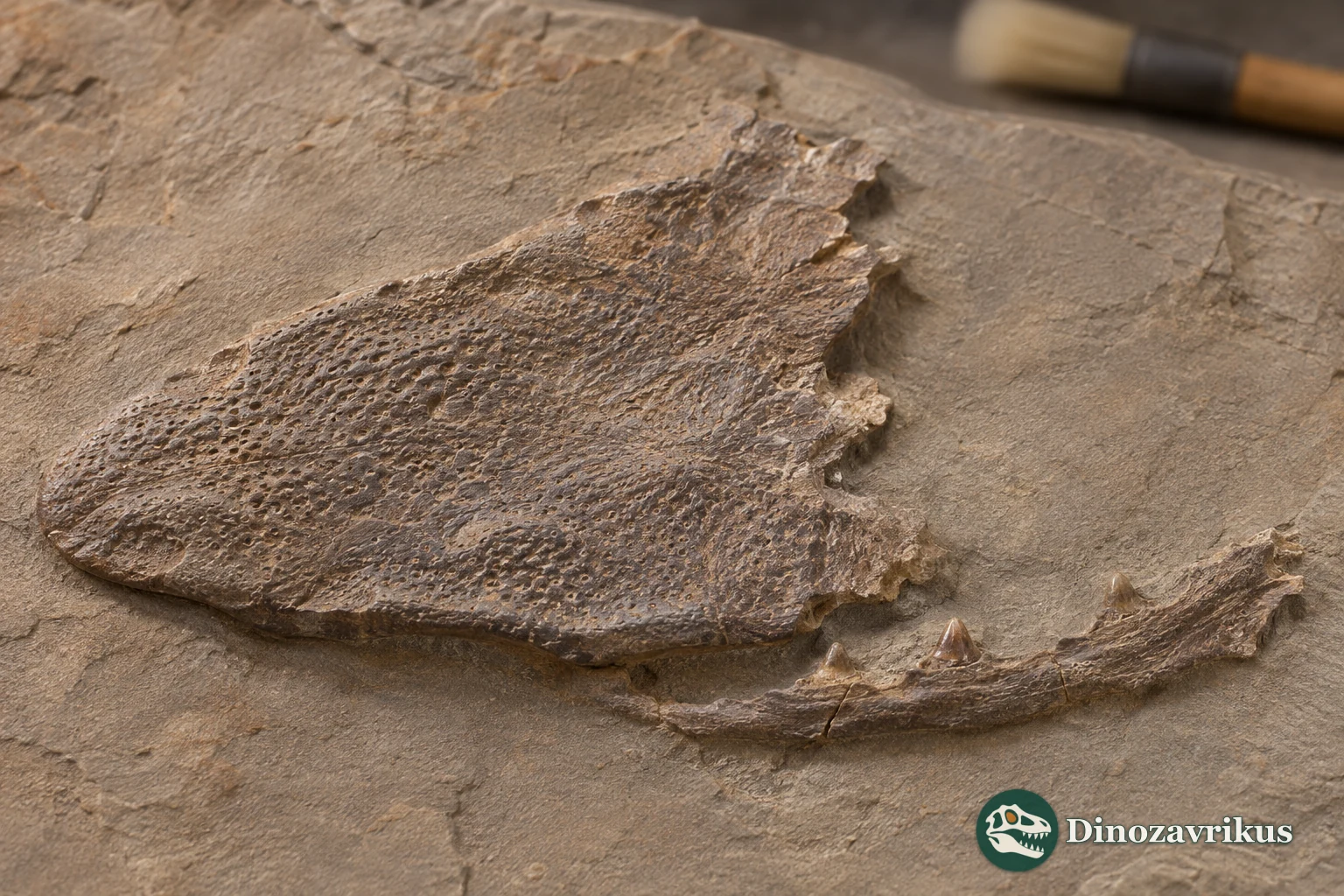
Rhytidosteus was a Triassic temnospondyl from South Africa. Richard Owen named it in 1884 from a fossil preserving the front of the head. Some older reconstructions used a more complete skull of another amphibian to fill in the parts missing from the type specimen.
Quick facts
| Group | Temnospondyls (Temnospondyli) |
|---|---|
| Age | Triassic |
| Region | Africa (Free State, South Africa) |
| Type species | Rhytidosteus capensis |
| Scientific name | Rhytidosteus |
| Diet | Exact prey is unknown |
What can the fossils tell us?
The holotype, BMNH R455, preserves the snout, the front portions of the lower jaw in articulation and the rear part of its right branch.
Rhytidosteus gave its name to Rhytidosteidae. One comparative analysis placed it closer to Trematosaurus than to the sampled rhytidosteids.
Owen recorded the locality as Beersheba. The collecting details are too imprecise to identify the rock layer from which the specimen came.
A specimen from the Free State
Owen recorded Beersheba, in what is now South Africa’s Free State Province. The collecting details have led to competing correlations with the Lystrosaurus and Cynognathus assemblage zones. The fossil is Triassic, but the imprecision of the locality record prevents a confident assignment to a narrower interval.
How an older reconstruction was made
Alfred Romer in 1947 suggested that Rhytidosteus and Microposaurus casei represented the same species, and drew on the outline of the more complete Microposaurus skull to fill in gaps. John Cosgriff later rejected the proposed association. Material of Peltostega, another amphibian discussed in studies of rhytidosteids, preserves the opposite end of the skull, behind the eyes.
The limits of the material
Additional fragments of the braincase and clavicle, catalogued as BMNH R503, were once regarded as associated with the type. The validity of that association has been questioned. A 2011 analysis recovered Rhytidosteus next to Trematosaurus, outside the sampled rhytidosteids. The authors emphasized that a partial snout supplies relatively few comparable characters.
Frequently asked questions
Who named Rhytidosteus?
Richard Owen described the genus and type species in 1884 from material found in South Africa.
Which bones are part of the holotype?
A portion of the skull in front of the eyes, the front of the lower jaw and the rear part of the right jaw branch.
Can scientists measure its full body length?
No associated body skeleton provides a direct measurement. The type consists of parts of the head.
Why is its age given broadly as Triassic?
The old record names Beersheba without precisely identifying the fossil-bearing layer. Different authors correlated it with different assemblage zones.