

Rukwasuchus yajabalijekundu was a Cretaceous crocodylomorph from south-western Tanzania. The snout is missing, but much of the braincase survives in three dimensions. It preserves the bony exits of the trigeminal nerve, while CT scans reveal parts of the skull that are hidden from view.
Quick facts
| Species | Rukwasuchus yajabalijekundu |
|---|---|
| Family | Peirosauridae |
| Age | Late Cretaceous by palaeomagnetic correlation |
| Holotype | RRBP 08630, partial skull |
| Locality | Namba 2, Rukwa Rift Basin, Tanzania |
| Horizon | Namba Member, Galula Formation |
What can the fossils tell us?
The openings correspond to the ophthalmic, maxillary and mandibular branches of the trigeminal nerve. Their positions do not establish how sensitive the skin was.
The scans show the shape of the brain cavity and several canals. The inner ear could not be traced through unusually dense material.
Magnetic reversals in the rock support a younger age than the original description suggested. More than one correlation remains possible.
A partial skull south of Lake Rukwa
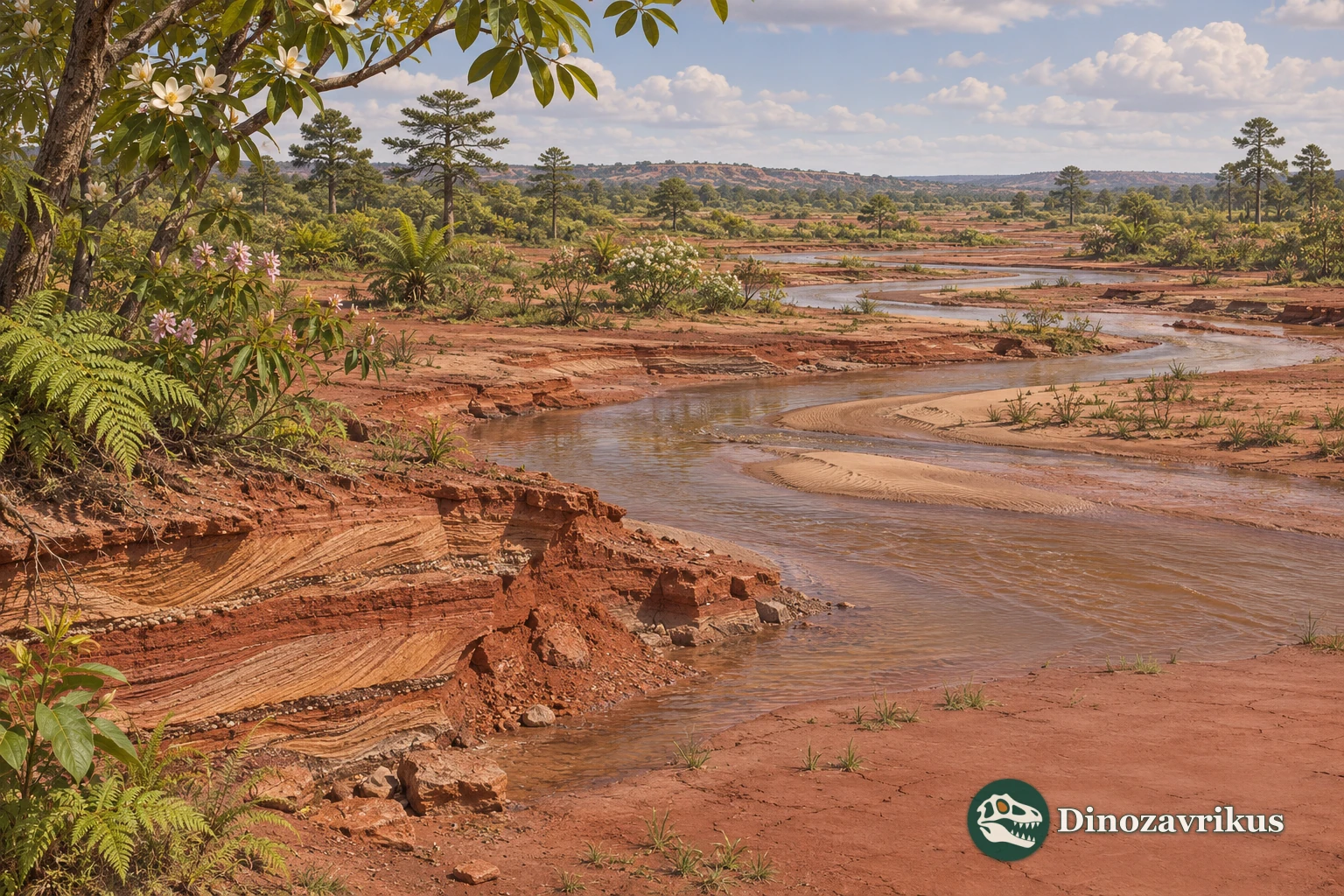
E. K. Lund found RRBP 08630 at Namba 2 in 2008, about 25 km south of Lake Rukwa. Joseph Sertich and Patrick O’Connor described it in 2014. The genus takes its name from the lake and rift basin. The species epithet is Kiswahili for “from the red outcrop”.
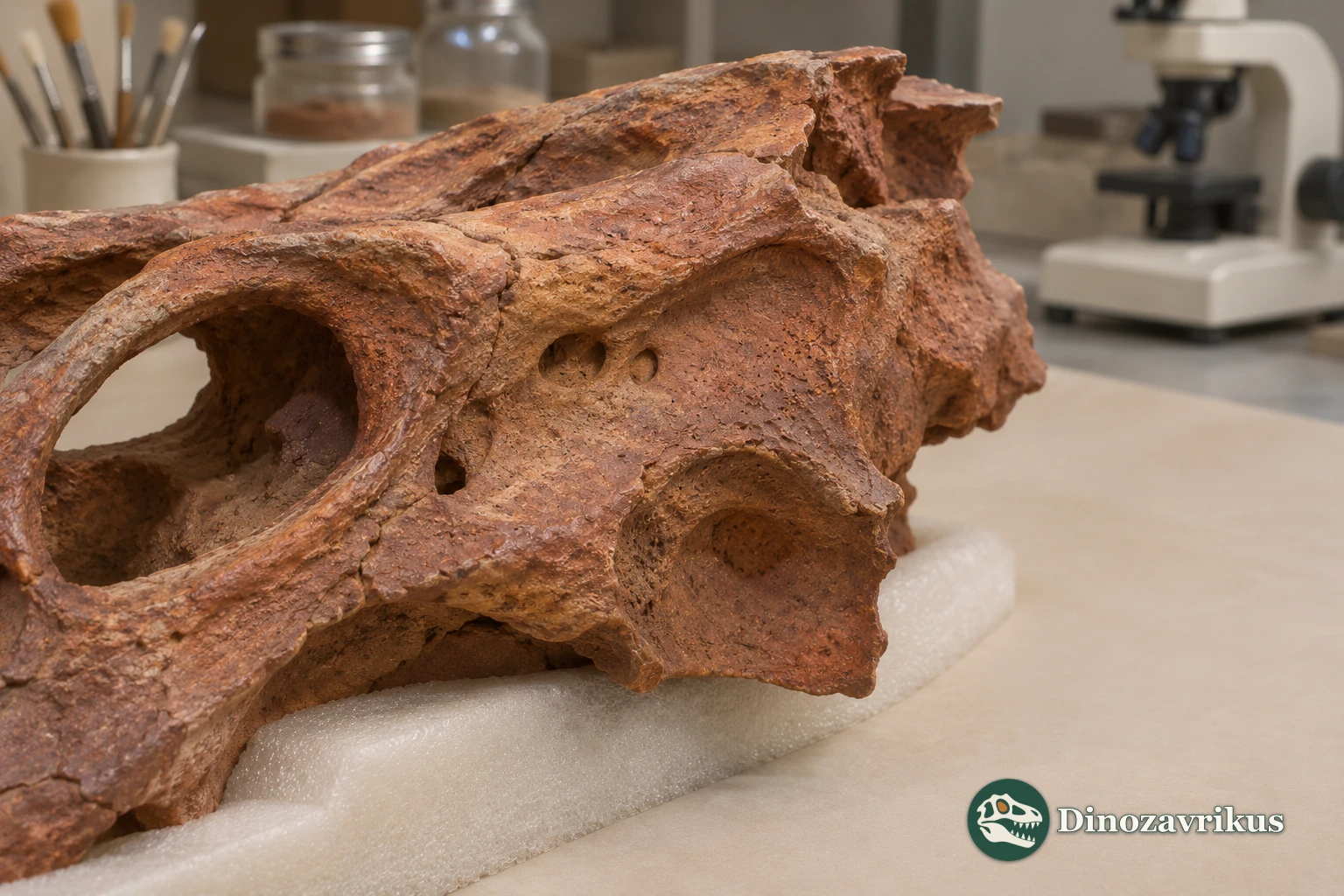
The skull table, the region between the eyes and much of the braincase survive. Their surfaces preserve remarkably fine detail around several small openings. The snout, anterior palate and mandible are missing, so the preserved bone gives only a partial outline of the head.
Nerve exits and a cast of the brain cavity
A broad bridge of bone separates the exit of the ophthalmic division of the trigeminal nerve. A smaller bridge further divides the outlets of its maxillary and mandibular branches. Hamadasuchus has a similar architecture around the nerve exits. Its internal nostrils are wider and sit farther back.
Computed tomography allowed a reconstruction of the cranial cavity, including a long, narrow olfactory tract and a depression along its upper rear contour. The endocast records the space occupied by the brain, membranes and blood vessels. Dense rock around the ear prevented the team from reconstructing the bony labyrinth.
Loose teeth and the age of Namba
Four teeth found at other sites in the formation were provisionally assigned to Rukwasuchus. Some have denticles along their cutting edges. None was found attached to the type skull, so it is uncertain how the teeth fitted together and what prey the animal selected.
The original description followed an Aptian to Cenomanian age for the Galula Formation. Magnetic reversals reported in 2018 support a Late Cretaceous age for the upper Namba Member, within a broad Cenomanian to Campanian interval. The type bed is not precisely dated within that interval.
Frequently asked questions
Who found the skull?
E. K. Lund discovered the type at Namba 2, south of Lake Rukwa, in 2008.
Why was the skull scanned?
The scans record the outline of the brain cavity and traces of some passages for nerves and blood vessels.
Why is the assignment of the teeth provisional?
They were found apart from the skull. Their size and shape are compatible with Rukwasuchus but cannot tie them directly to the type.
What does the species name refer to?
The epithet yajabalijekundu refers to the red outcrops of the Rukwa Rift Basin.