

Saurillodon was a Jurassic lizard from Europe. Portuguese specimens came from the former Guimarota lignite mine near Leiria. A separate short lower jaw from Kirtlington in England was assigned to the same genus, extending the comparison to an older part of the Jurassic.
Quick facts
| Group | Scincomorph lizards in the broad sense |
|---|---|
| Age | Middle and Late Jurassic |
| Region | Europe, Portugal and the United Kingdom |
| Type species | Saurillodon proraformis |
| Scientific name | Saurillodon |
| Diet | No direct evidence |
What can the fossils tell us?
The type species is based on jaws from Guimarota. Jaw BMNH R12650 from Kirtlington is the type of the English species.
Researchers compared the outline of the lower jaw and the arrangement of the teeth to assess similarities with other lizards.
Isolated jaws preserve relatively few of the anatomical characters needed to resolve the genus's exact position.
Jaws from Guimarota
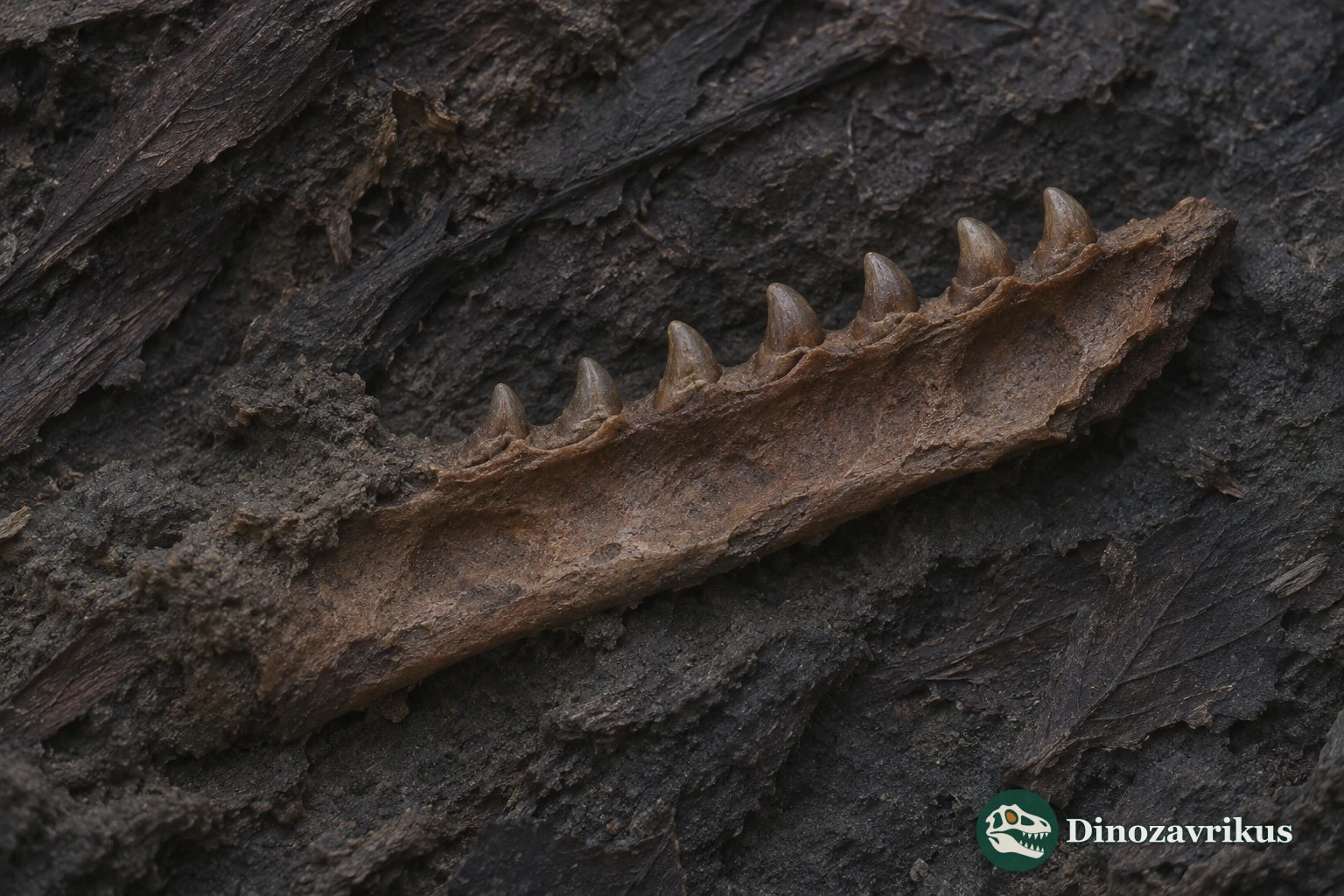
J. Seiffert described the type species as Saurillus proraformis in 1973. Richard Estes transferred it to his new genus, Saurillodon, in 1983. The type of S. proraformis, GUI 7, is a right dentary missing its rear end. Different specimens preserve different parts of the tooth row, so its arrangement is compared alongside the outline of the bone.
An older jaw from England
Susan Evans named Saurillodon marmorensis from the Bathonian Forest Marble Formation at Kirtlington. The type right dentary, BMNH R12650, has seven teeth and positions for two more. This find is Middle Jurassic. The Guimarota lignite that yielded the type species dates to the later Kimmeridgian.
Comparisons with other lizards
The short dentary has been compared with the jaws of several small Mesozoic squamates. Guimarota also yielded Becklesius, another lizard compared with scincomorphs. Jaw characters underpin the broad placement of Saurillodon. Other skull bones associated with matching dentaries would let researchers test that relationship with more characters.
Frequently asked questions
Where was Saurillodon first found?
The material of the type species comes from the Guimarota mine near Leiria, Portugal.
Which is older, the Portuguese or English material?
The named English species comes from the Middle Jurassic, whereas the type species at Guimarota is Late Jurassic.
How many teeth survive on the Kirtlington jaw?
The type jaw preserves seven teeth and positions for two additional teeth.
Do its teeth reveal what it ate?
The preserved rows show the arrangement of the teeth. They contain no direct record of its food.