

Savannasaurus was a titanosaur from the Cretaceous Winton Formation of eastern Australia. A substantial part of one skeleton survived, including vertebrae, ribs and elements of the forelimbs and pelvis. The unusually wide hips are especially informative when comparing it with other Winton sauropods.
Quick facts
| Group | Sauropods, titanosaurs (Titanosauria) |
|---|---|
| Age | Late Cretaceous (Cenomanian to earliest Turonian) |
| Region | Australia (Queensland, near Winton) |
| Diet | Herbivorous sauropod |
| Type species | Savannasaurus elliottorum |
| Holotype | AODF 0660, partial skeleton without a skull |
| Deposits | Winton Formation |
What can the fossils tell us?
Several vertebrae and ribs retained their approximate order within the rock. Their arrangement helps associate bones that separated before fossilisation.
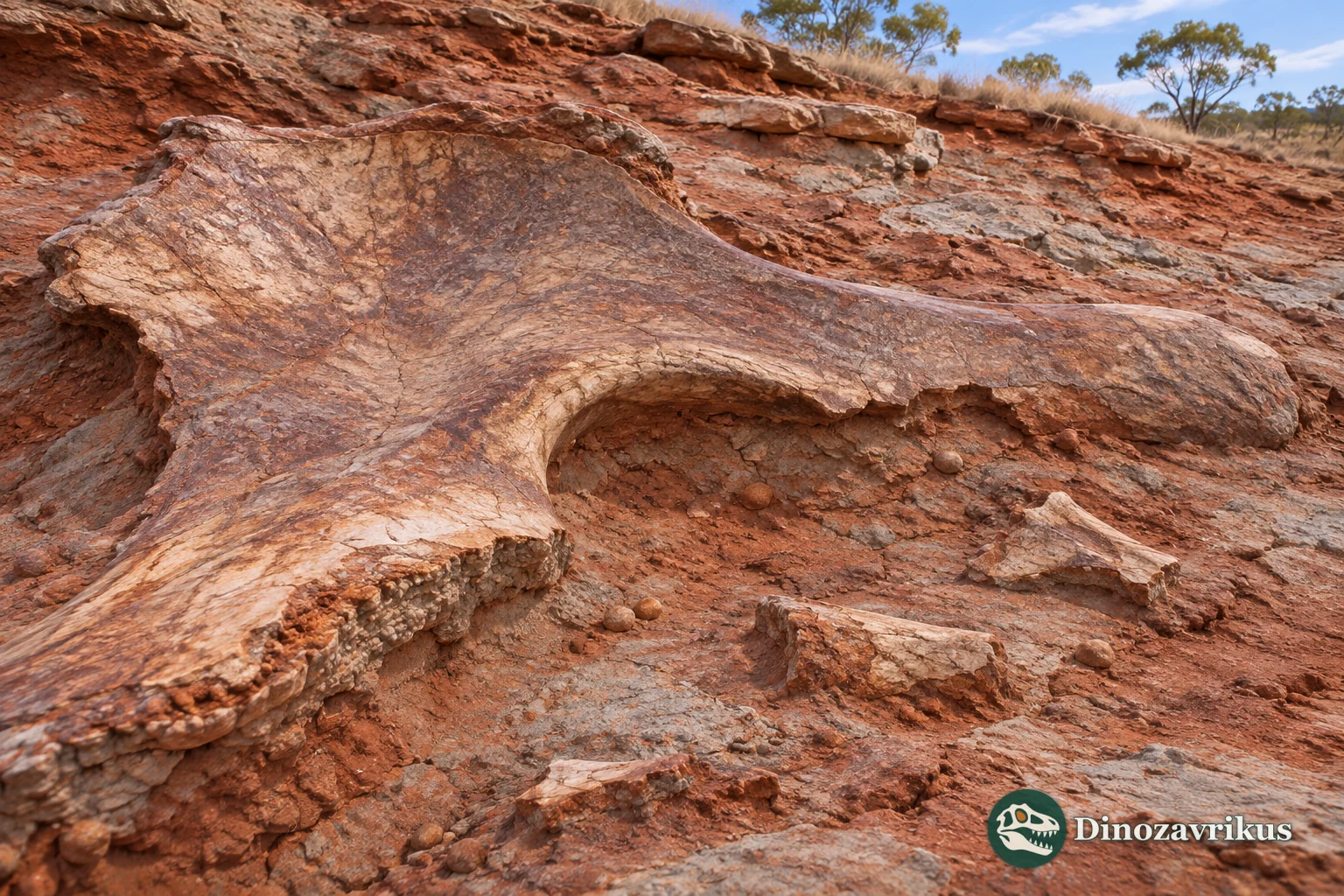
The left and right bones from the lower pelvis survived together. They record the width of that part of the body and leave the posture of a moving animal to reconstruction.
The end of the fourth metacarpal has an hourglass outline. It provides a specific feature to check when an isolated bone lacks the rest of its skeleton.
The bones from Belmont Station
David Elliott found the bones in 2005 at Belmont Station, north-east of Winton. Staff from the Queensland Museum and Australian Age of Dinosaurs Museum excavated rock containing the fossils. Preparation took close to a decade because the bones were enclosed in a hard siltstone concretion.
Stephen Poropat and colleagues named Savannasaurus elliottorum in 2016. The genus name refers to the modern landscape of the discovery. The species name honours the Elliott family. The Australian Age of Dinosaurs Museum near Winton holds the type skeleton, AODF 0660.
Broad hips and unusual joints
The pelvis survives alongside sacral and tail vertebrae, part of the shoulder girdle and bones of the front feet. The left and right pubes and ischia remained connected. Their position led researchers to estimate a hip width of at least one metre. This measurement describes the pelvis. It does not directly establish whole-body mass.
The front tail vertebrae have shallow depressions along their sides. Some anterior joint faces combine a concavity at the top with a convex profile below. The fourth metacarpal narrows at the centre of its lower end. Such details help identify species when comparisons must use incomplete skeletons or isolated bones.
Other sauropods in the Winton Formation
The same formation has also yielded Wintonotitan. A 2024 study tentatively assigned another specimen, AODF 2854, to Savannasaurus. If confirmed, it would place several different titanosauriforms at a single Winton fossil locality, including forms previously known from separate skeletons.
The broad diet was herbivorous, inferred from its membership of the sauropods. The type skeleton preserves neither the skull nor teeth, so it does not identify particular plants or show how Savannasaurus gathered its food.
Frequently asked questions
Where was Savannasaurus found?
The type skeleton was found at Belmont Station, near Winton in Queensland, Australia.
Why is the dinosaur called Savannasaurus?
The genus name refers to the modern savanna near the discovery site. Evidence for the Cretaceous landscape comes from the rocks and fossils.
What do the hip bones show?
The paired bones allowed researchers to estimate a hip width of at least one metre. A mass estimate would require additional measurements and assumptions.
Has a skull been found?
No skull is securely attributed to Savannasaurus. The type is a partial skeleton of the rest of the body.