

Scalamagnus tropicensis was a short-necked polycotylid plesiosaur from the Early Turonian of what is now Utah. The nearly complete type skeleton is disarticulated but preserves far more than a skull alone. First described as Dolichorhynchops tropicensis in 2012, the species received its own genus in a 2024 phylogenetic reassessment. Its estimated length is about 3.2 m, while gastrolith function and the animal's exact behaviour remain uncertain.
Quick facts
| Type species | Scalamagnus tropicensis |
|---|---|
| Group | Polycotylid plesiosaur |
| Age | Early Turonian, Late Cretaceous |
| Formation | Tropic Shale |
| Locality | Kane County, Utah, USA; Glen Canyon area |
| Holotype | MNA V10046 / GLCA 23189 |
| Known material | Nearly complete but disarticulated skeleton, including skull and postcranial bones |
| Length | About 3.2 m, reconstructed from the type skeleton |
Evidence guide
MNA V10046, also catalogued as GLCA 23189, is the holotype. It preserves the skull, vertebrae, ribs, girdle elements, and limb bones, but the bones are not all articulated in life position.
The species was described as Dolichorhynchops tropicensis in 2012. Clark, O'Keefe, and Slack established Scalamagnus for it in 2024 based on a phylogenetic reassessment; the type specimen and species epithet remained the same.
The length estimate comes from arranging a nearly complete but disarticulated skeleton. It is not a direct measurement of a living or fully articulated individual.
The 2012 description recorded 289 gastroliths and a shark tooth in association with the type locality. Their presence does not by itself establish the stones' function, the plesiosaur's diet, or a shark attack.
From Dolichorhynchops to Scalamagnus
Rebecca Schmeisser McKean described the species as Dolichorhynchops tropicensis in 2012. The holotype is MNA V10046, also registered as GLCA 23189, and a second specimen, MNA V9431 / GLCA 23761, consists of separate postcranial material. These are distinct individuals, not one combined skeleton. The fossils came from the Tropic Shale in Kane County, southern Utah.
In 2024, Robert Clark, F. Robin O'Keefe, and Sarah Slack reassessed short-necked plesiosaurs using a phylogenetic analysis. They concluded that the species did not fit Dolichorhynchops as they defined that genus and established Scalamagnus. The new combination changed the genus name, not the type specimen or species epithet. It is a classification result, not a new fossil discovery or evidence that Scalamagnus was a direct ancestor of another genus.
A nearly complete skeleton with missing connections
MNA V10046 preserves the skull, vertebrae from several regions of the spine, ribs, portions of the shoulder and pelvic girdles, and limb elements. It is nearly complete in the sense that many body regions are represented, but the bones were disarticulated before burial and do not preserve one continuous pose. The second specimen, MNA V9431, adds separate postcranial bones but is less complete.
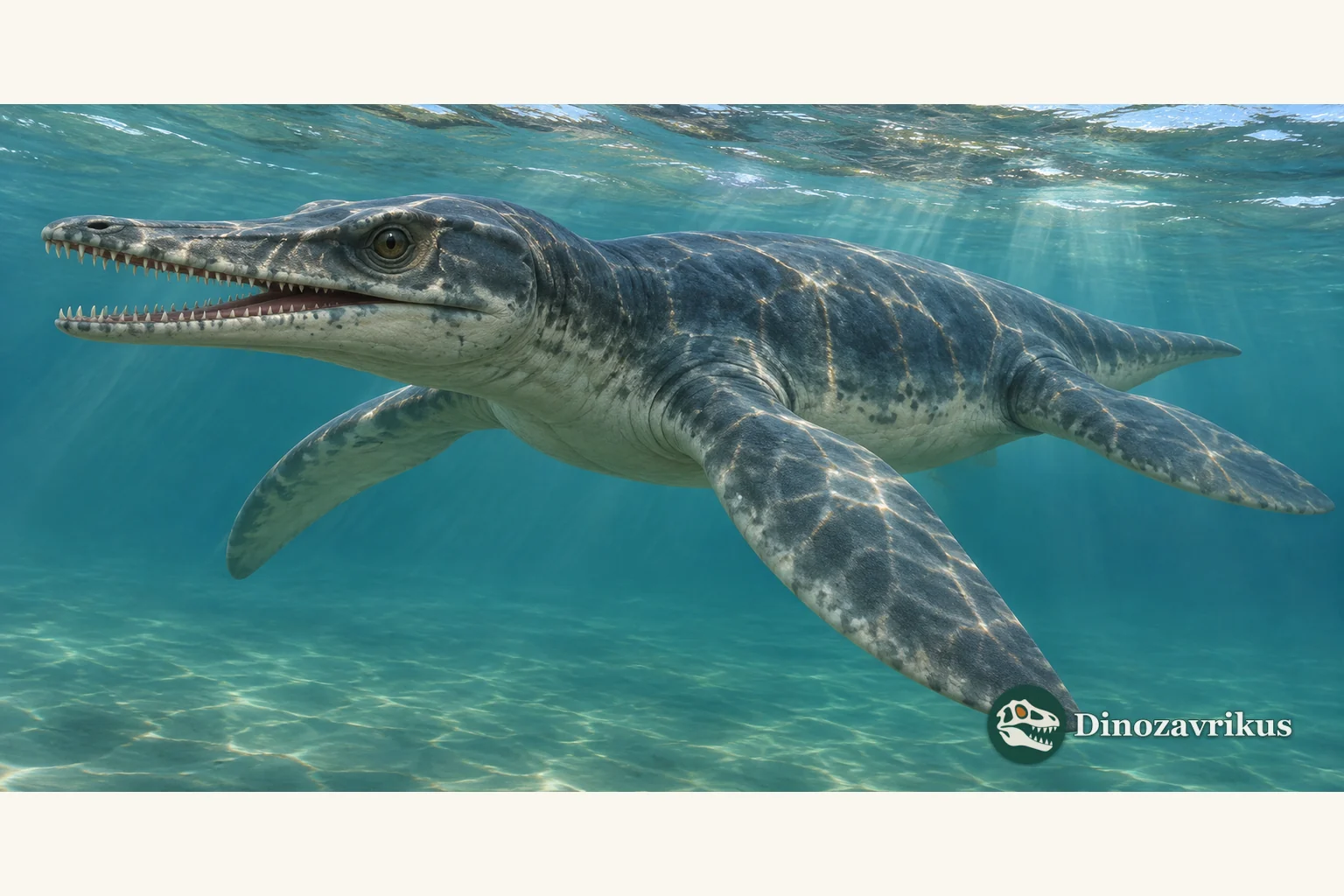
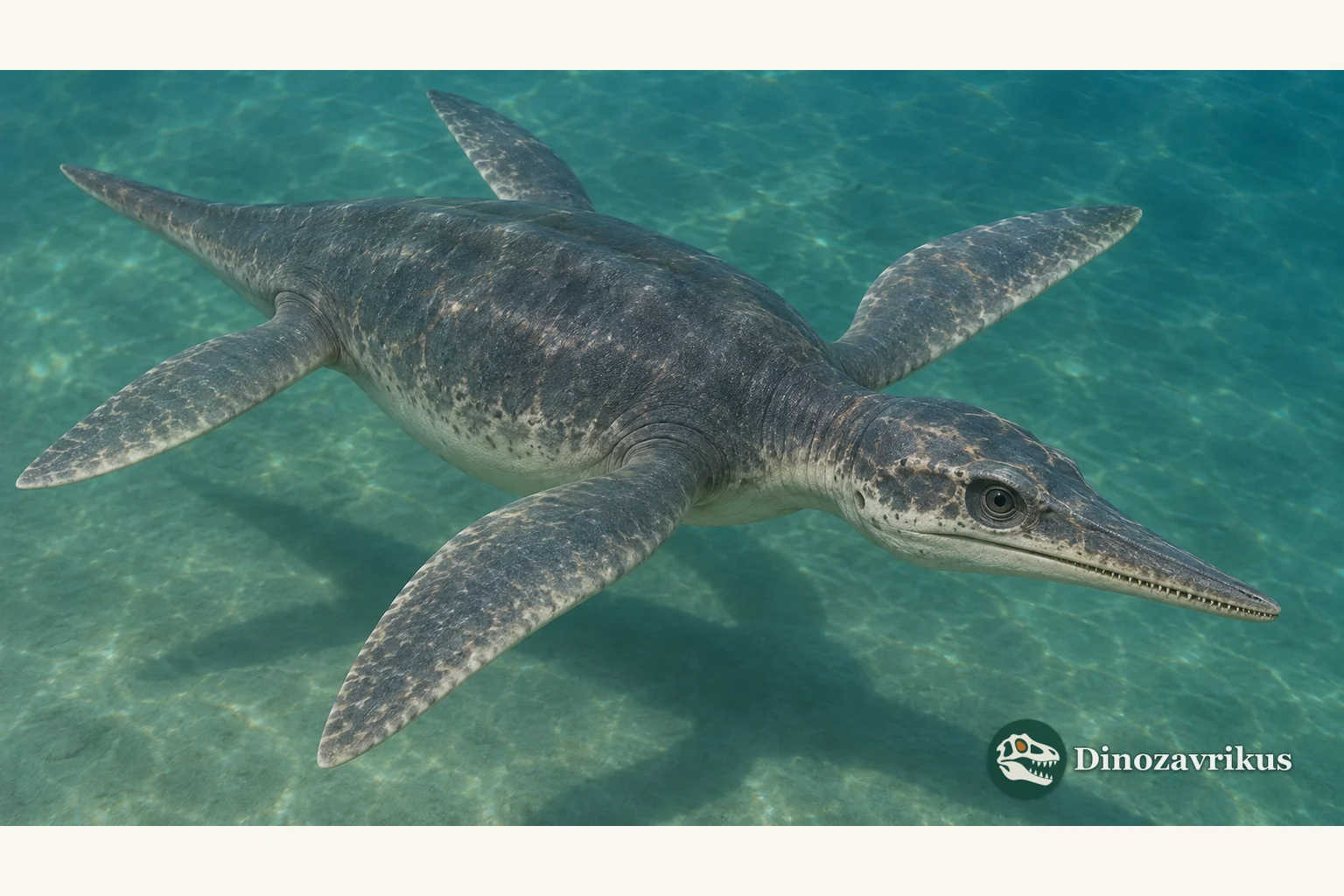
The short neck, elongated snout, and four paddle-shaped limbs are consistent with a polycotylid plesiosaur. Those skeletal features support a broad body plan; the exact soft-tissue outline, colour, and swimming motion are artistic reconstruction. The comparison with Martinectes and Trinacromerum helps place Scalamagnus among other short-necked plesiosaurs without implying that one genus descended directly from another.
Length and maturity
The type's total length has been estimated at about 3.2 m. Because the skeleton is disarticulated, researchers must reconstruct the positions and spacing of separate bones. The estimate is more informative than a skull-only guess, but it is not a direct measurement of the living animal.
The 2012 description treated the type as probably an early adult. The 2024 paper discussed it as adult based on a combination of features. The wording differs between studies, illustrating that maturity estimates can be uncertain; body size alone does not establish an individual's exact age. Mass, growth rate, lifespan, and sexual dimorphism remain unknown.
Gastroliths and a nearby shark tooth
The original description reported 289 gastroliths associated with the type find, along with a shark tooth. Gastroliths are stones interpreted as having been swallowed during life, but their precise role in Scalamagnus has not been demonstrated. Their presence alone does not show whether they aided digestion, affected buoyancy, or had another function.
The shark tooth documents a shark in the same depositional context; it is not by itself evidence of an attack or scavenging. Bones and other objects may come together through transport and sedimentation after death. The skeleton's disarticulation records a taphonomic history, but no specific injury or disease has been established as a pathology of this individual.
The Early Turonian sea of Utah
The Tropic Shale formed in a marine basin connected to the Western Interior Seaway. The Early Turonian age for the type locality is constrained by ammonites and traceable bentonite layers. This dates the enclosing strata; the bones themselves were not directly radiometrically dated.
Scalamagnus lived among a broader marine fauna, but its precise prey, hunting strategy, swimming speed, and social behaviour are not established. The fossil record documents bones and their geological context. The reconstructed scenes on this page use comparative plesiosaur anatomy to picture a plausible animal, not a witnessed hunt or an exact portrait of MNA V10046.
Frequently asked questions
What was Scalamagnus originally called?
It was described in 2012 as Dolichorhynchops tropicensis. A 2024 phylogenetic reassessment established the genus Scalamagnus, while the species epithet and holotype remained the same.
Where was the fossil found?
The type comes from the Tropic Shale in Kane County, Utah, in the Glen Canyon area. The enclosing strata are Early Turonian.
How large was Scalamagnus?
Its length is estimated at about 3.2 m from a nearly complete but disarticulated skeleton. It is a reconstruction, not a direct measurement of a living animal.
Do the gastroliths prove what it ate?
No. The 2012 description recorded 289 gastroliths and a shark tooth near the type, but their association does not establish diet, stone function, or an attack.