

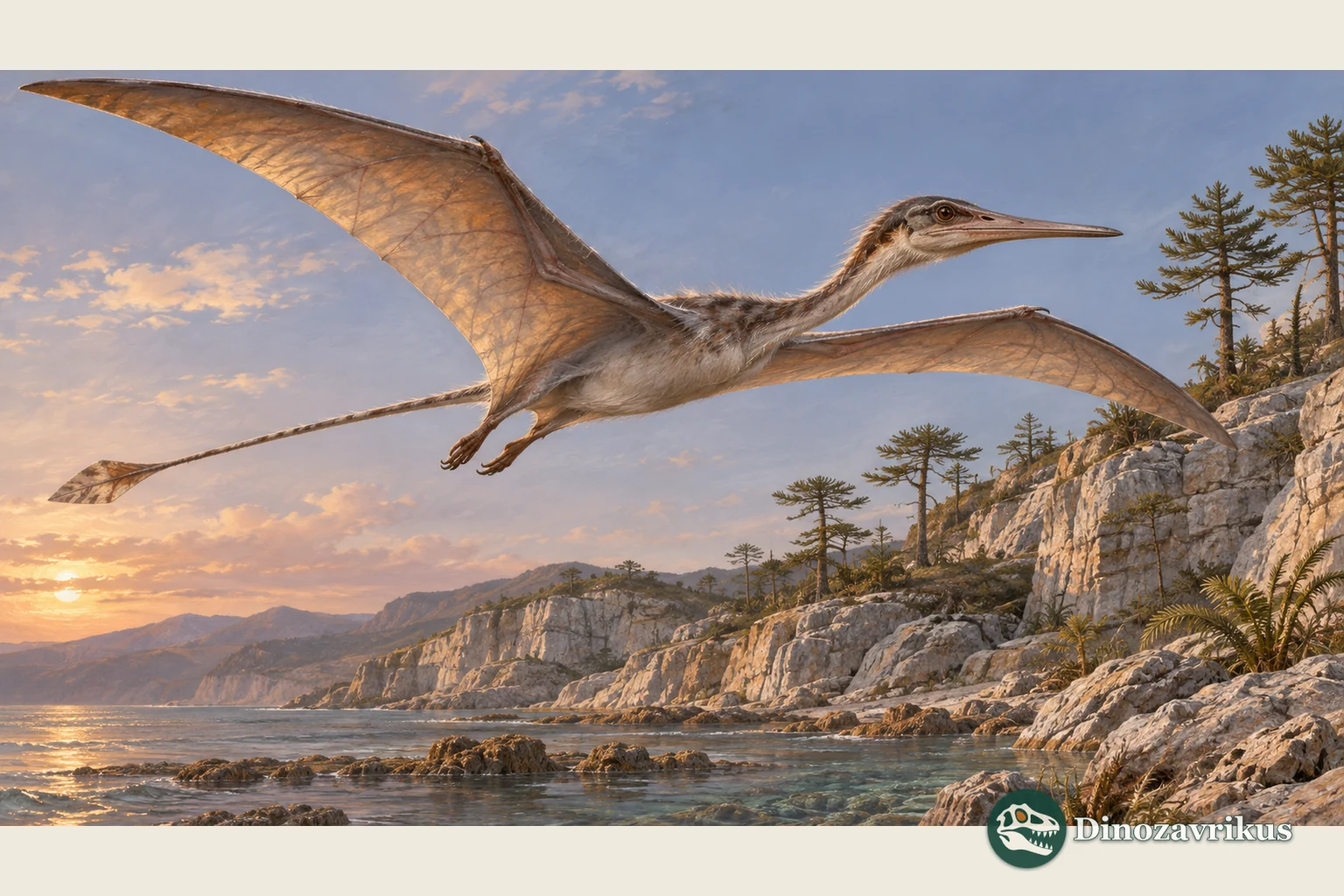
Seazzadactylus venieri is known from a single partial skeleton recovered near Seazza Brook in northeastern Italy. Its bones are associated but mostly out of articulation. Both jaws retain extensive tooth rows, including distinctive crowns with several cusps. The cover is a comparative life reconstruction rather than a photograph or a record of the animal's actual colour.
Quick facts
| Named species | Seazzadactylus venieri, Dalla Vecchia, 2019 |
|---|---|
| Holotype | MFSN 21545, associated but disarticulated partial skeleton |
| Locality | Seazza Brook near Preone, northeastern Italy |
| Rock unit | Dolomia di Forni Formation |
| Geological age | Norian, Late Triassic |
| Distinctive evidence | Extensive tooth rows with multicusped crowns |
| Known specimens | One described skeleton |
| Growth | Still growing, but not an early juvenile |
What can the fossils tell us?
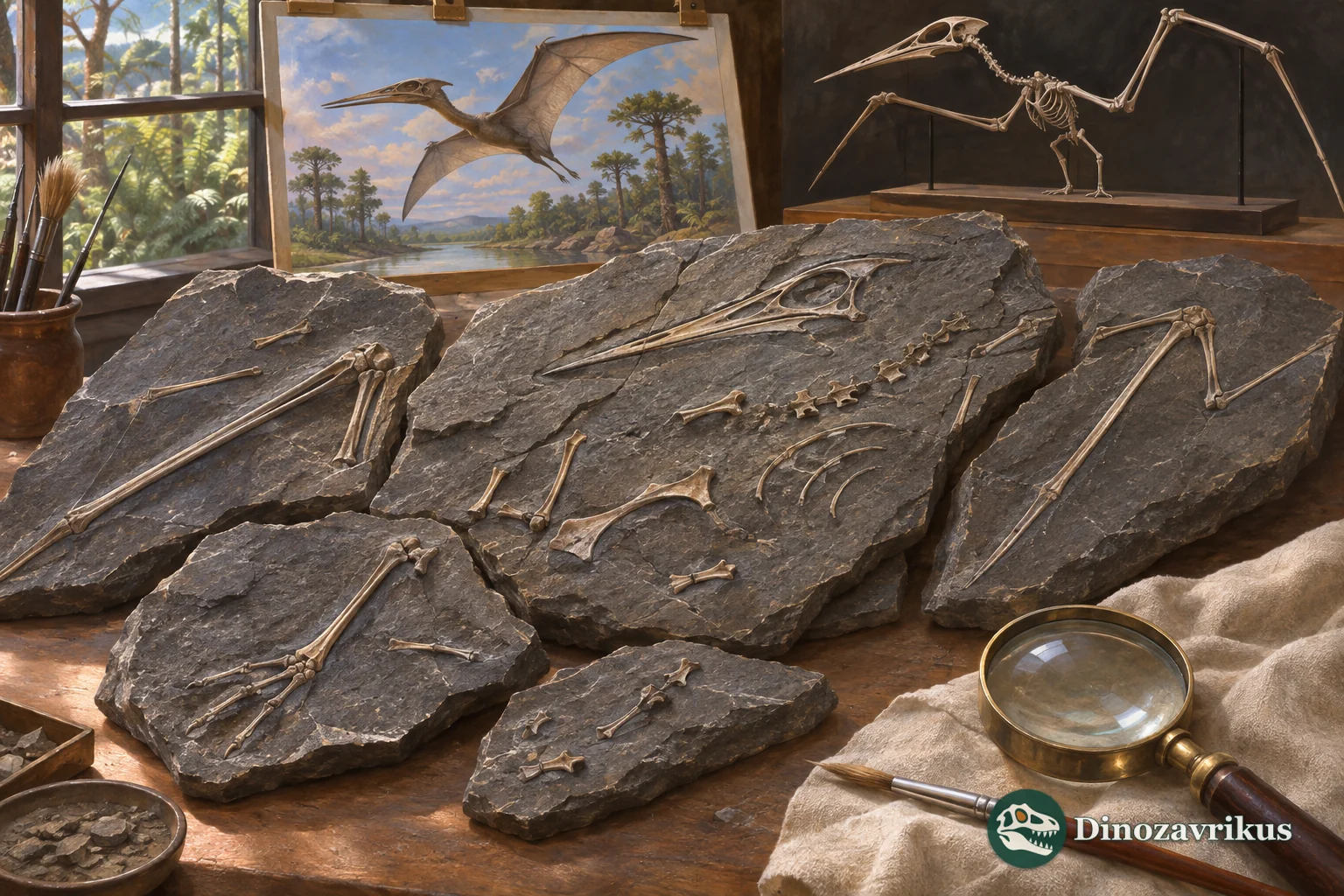
The specimen contains skull, jaw, spinal and limb material. Its pieces belong to one find, although the slab was broken and parts are missing.
Upper and lower jaws preserve many positions, including six- and seven-cusped crowns. Tooth shape alone does not identify a specific prey animal.
The fossil was collected from a loose boulder. Rock type and local geology indicate the lower Dolomia di Forni, whose fossiliferous portion is Norian.
A combination of unfused sacral areas and a formed tibiotarsus suggests the individual was still growing, without being a young juvenile.
A fossil rescued from a brook
Umberto Venier recovered the broken dark dolostone slab from the bed of Seazza Brook and brought it to the Friulian natural history museum in Udine. The fossil was studied over many years before Fabio Marco Dalla Vecchia formally named it in 2019. The genus refers to the brook and the species honours Venier. The museum number is MFSN 21545.
The boulder was loose, so its exact original bed cannot be traced. Its lithology and local geology indicate the lower part of the Dolomia di Forni Formation. Conodont dating places the fossil-bearing part of that formation in the later middle to late Norian. This dates a rock interval, not the day the individual died.
What the slab preserves
MFSN 21545 includes parts of the skull and both lower-jaw rami, hyoid elements, vertebrae, shoulder and wing bones, plus pelvic and hind-limb material. The bones are associated but mostly separated. Some slab pieces were lost before preparation; restored parts of the museum display are not additional fossil bones.
The mixture of fused and unfused bones led Dalla Vecchia to regard the animal as still growing but not a young juvenile. Growth stage matters when comparing the shape and proportions of closely related specimens.
Teeth, anatomy and relationships
The nearly complete maxillary and mandibular tooth rows are especially informative. Several posterior crowns bear multiple cusps, including six- and seven-cusped examples. The pattern differs from that of other Triassic pterosaurs. Features of the jugal, palate, scapula and small pteroid bone supply independent anatomical distinctions.
Austriadraco offers a nearby Late Triassic comparison with multicusped teeth, but the skull and tooth details differ. Austriadactylus shows another early toothed pterosaur combination. Similarity in a phylogenetic analysis does not make one taxon the other's direct ancestor.
Life beyond the fossil
The preserved teeth reveal a feeding apparatus, but there are no stomach contents or direct traces of a particular meal. The surrounding rock constrains the geological setting; the illustrated perch and flight are choices about a possible living animal. Colour, precise wing membrane and habitual behaviour remain unknown.
Frequently asked questions
Where was Seazzadactylus found?
Its only known skeleton was recovered from a loose boulder in Seazza Brook near Preone in northeastern Italy.
How many specimens are known?
The 2019 description names one associated but disarticulated partial skeleton, MFSN 21545.
What makes its teeth distinctive?
The extensive upper and lower tooth rows include crowns with several cusps, including six- and seven-cusped teeth.
Was the fossil a young juvenile?
The bone-fusion pattern suggests it was still growing, but it was not considered an early juvenile.