

Seeleyosaurus guilelmiimperatoris was an Early Jurassic plesiosaur from the Posidonia Shale near Holzmaden, Germany. Its nearly complete holotype preserves much of the skeleton, though the skull is distorted and some bones are displaced. A second individual is known mainly from a cast after the original was largely destroyed during the Second World War. The fossils support a detailed anatomical account, but not every feature in an underwater reconstruction.
Quick facts
| Type species | Seeleyosaurus guilelmiimperatoris |
|---|---|
| Group | Early plesiosaur; assigned to Microcleididae in a 2025 study |
| Age | Early Toarcian, Early Jurassic |
| Formation | Posidonia Shale |
| Locality | Near Holzmaden, Baden-Württemberg, Germany |
| Holotype | MB.R.1992, nearly complete but partly disarticulated skeleton |
| Second specimen | SMNS 12039; original largely destroyed, surviving cast |
| Reconstructed length | About 2.9 m for the holotype; about 3.4 m for the second specimen |
Evidence guide
Bernhard Hauff found the nearly complete skeleton near Holzmaden in 1893. Its skull is displaced and deformed, and parts of the skeleton are disarticulated. The published length of about 2.9 m is reconstructed from the fossil.
Dames described the fossil as Plesiosaurus guilelmi imperatoris in 1895. It was later assigned to other genera; White reinstated Seeleyosaurus in 1940. A 2025 redescription recognizes the genus and assigns it to Microcleididae.
SMNS 12039 was nearly destroyed during the Second World War; a cast remains. Its published reconstructed length is about 3.4 m. Both known individuals were assessed as skeletally mature, so size difference alone does not explain their proportions.
Fibrous remains have been described near the trailing edge of a forelimb and around the tail tip. They were interpreted as phosphatized connective tissue. They do not reveal the exact shape of a tail fin or the animal’s complete soft tissues.
Discovery and museum history
Bernhard Hauff found and prepared holotype MB.R.1992 near Holzmaden in early 1893. Berlin’s Museum für Naturkunde acquired it in May 1894 with support from Wilhelm II. In 1895, Wilhelm Dames named the species Plesiosaurus guilelmi imperatoris in honour of the emperor. These records trace the history of a particular museum specimen; they do not mean the skeleton was recovered perfectly articulated.
The second referred specimen, SMNS 12039, was also nearly complete before it was largely destroyed during the Second World War. A cast preserves a record for study, but the cast must not be counted as a second intact original skeleton. Its reconstructed length has been given as roughly 3.4 m, compared with about 2.9 m for MB.R.1992.
A changing name and revised classification
After its original description, the species appeared under other genus names, including Plesiosaurus and Simolestes. Alan White reinstated Seeleyosaurus in 1940. These combinations refer to changing taxonomic interpretations of the same named species, not successive growth stages or different animals.
A 2025 anatomical redescription recognizes Seeleyosaurus as a distinct genus and places it in Microcleididae, an early-diverging plesiosaur family. Phylogenetic placement is inferred from anatomical character comparisons and can change when new data or taxa are added. It does not establish direct ancestry. The distinct species Plesiopterys wildi is not treated as a juvenile Seeleyosaurus. Compare the regional record with Hauffiosaurus, a different Early Jurassic plesiosaur, or the later Kimmerosaurus.
What the skeletons preserve
MB.R.1992 is nearly complete in the sense that many body regions are represented. The bones are partly disarticulated, and the skull is displaced and distorted. The specimen therefore offers substantial anatomical information without preserving a continuous, undisturbed body outline. Its reconstructed length of about 2.9 m depends on the arrangement and spacing of the fossil elements.
The vertebrae include tall neural spines with a constricted base, a feature described in the 2025 study. Localized fibrous remains were also reported along the trailing edge of a forelimb and near the tail tip. The authors interpreted these as phosphatized connective tissue. The preservation is important, but it does not show the exact shape or flexibility of a complete tail fin.
Size, maturity and the Posidonia Shale
Published reconstructed lengths are approximately 2.9 m for the holotype and 3.4 m for the second specimen. Both individuals were assessed as osteologically mature. A difference between two reconstructed lengths does not by itself establish sexual dimorphism, a growth stage, or a separate species. No reliable body mass or growth rate is known from this small sample.
The fossils come from the Early Toarcian Posidonia Shale near Holzmaden. Their age is assigned through stratigraphic context and associated fossils, rather than by direct radiometric dating of the bones. The shale preserves exceptionally informative marine fossils, but post-burial deformation and displacement remain visible in the Seeleyosaurus material.
What cannot be read from the fossils
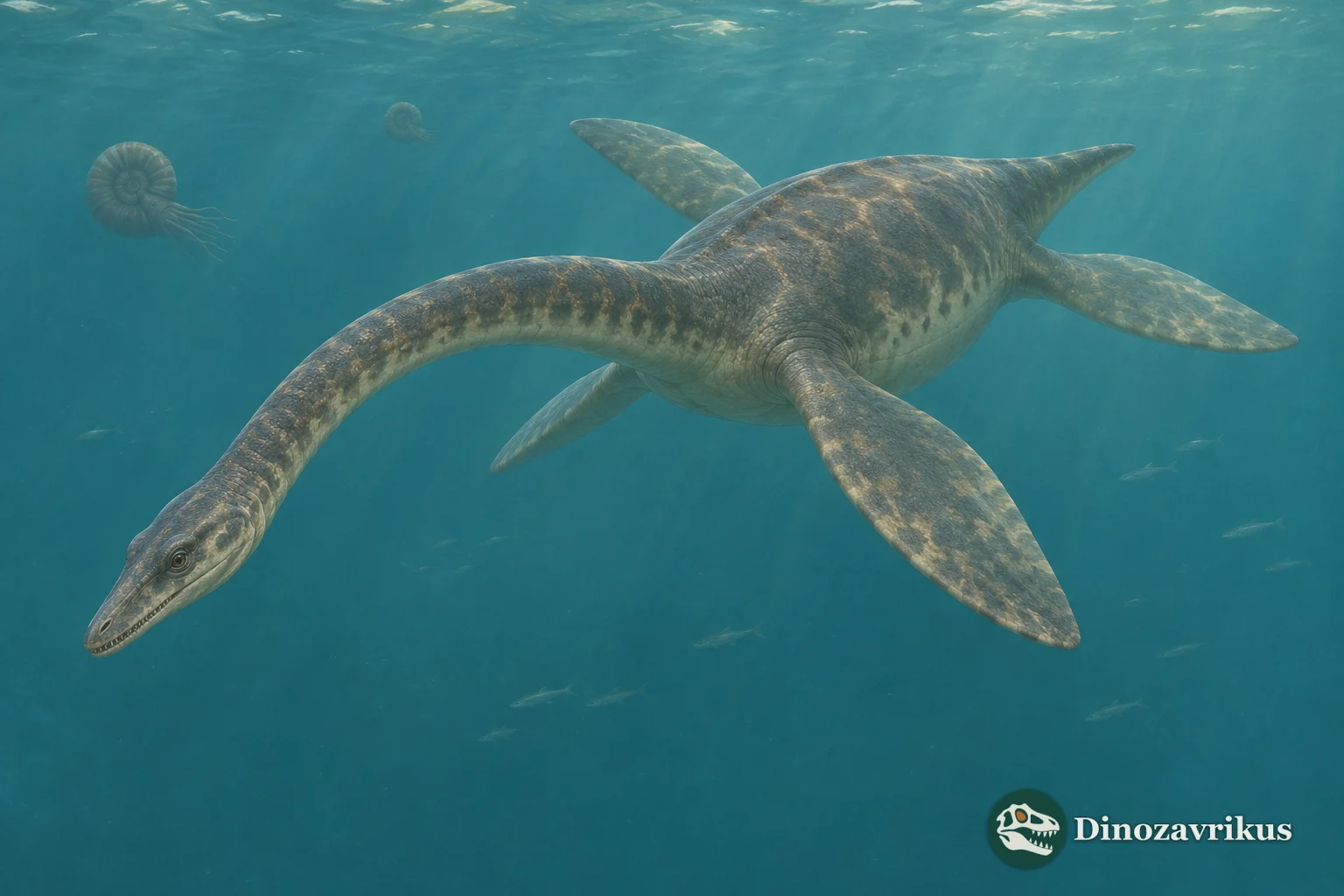
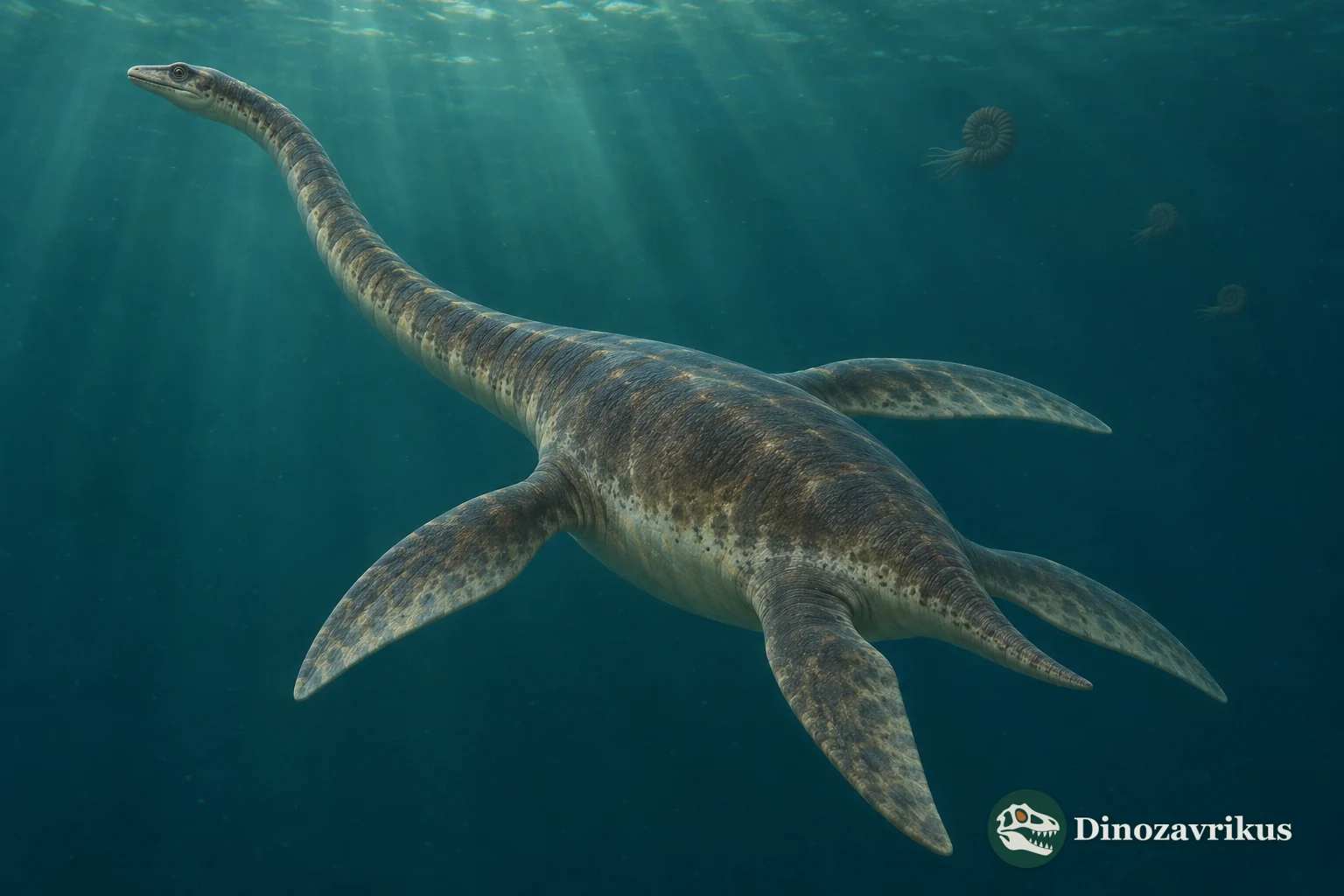
The skeletons do not determine skin colour, a precise swimming motion, speed, social behaviour or reproductive biology. Teeth and skull damage also limit species-specific conclusions about prey. Palaeoart can combine the known limb and vertebral anatomy with comparisons to related plesiosaurs, but the depicted soft tissues and posture remain reconstruction.
The central evidence is concrete: a nearly complete holotype, a cast of a second individual, and localized soft-tissue traces. Those fossils make Seeleyosaurus informative, while also setting clear limits on what is known about its body in life.
Frequently asked questions
Where was Seeleyosaurus found?
The holotype was found near Holzmaden in the Early Jurassic Posidonia Shale of Baden-Württemberg, Germany.
Who found the holotype?
Fossil preparator Bernhard Hauff found and prepared MB.R.1992 in early 1893. The Berlin Museum für Naturkunde acquired it the following year.
How long was Seeleyosaurus?
Published reconstructions estimate about 2.9 m for the holotype and about 3.4 m for a second individual represented by a cast. These are reconstructions, not direct measurements of living animals.
Was Plesiopterys a juvenile Seeleyosaurus?
No. The 2025 redescription treats Plesiopterys wildi as a separate valid species rather than a juvenile Seeleyosaurus.