

Shachemys was an adocid turtle from Cretaceous Asia. Its plastron, the lower half of the shell, had two unusually large bones at the front. The way those bones met the rest of the plastron suggests that its front edge could move.
Quick facts
| Group | Turtles, adocids |
|---|---|
| Age | Early and Late Cretaceous |
| Region | Asia: Kazakhstan, Tajikistan, Uzbekistan and Laos |
| Type species | Shachemys baibolatica |
| Holotype | IZANK R3922, partial left hypoplastron |
| Scientific name | Shachemys |
| Diet | No direct evidence |
What can the fossils tell us?
IZANK R3922 preserves part of a left hypoplastron, a bone in the rear half of the underside. It anchors the name of the type species.
The two enlarged front bones show contacts consistent with a hinge. The fossils do not preserve how far the flap could move.
Joined shell fragments support the presence of at most one midline neural bone. They overturned an earlier reconstruction with six.
From the Aral region to Laos
V. V. Kuznetsov described the type species, Shachemys baibolatica, in 1976. Its holotype is a piece of the left hypoplastron from the Bostobe Formation at Shakh-Shakh in the northeastern Aral region of Kazakhstan. More complete evidence for the shape of the shell comes from material at Baibishe and Kansai.
A 2007 revision recognised three species. S. ancestralis occurs in the upper Turonian beds of Dzharakuduk, Uzbekistan. The smaller S. laosiana comes from older Aptian–Albian deposits in Laos. Material from Japan and Thailand was assigned to the genus without a secure species identification.
Bones along the middle of the shell
An early reconstruction of a Kansai shell showed six neural bones in a row down the back. Later material preserved contacts between plates that could be checked directly. It indicated that the turtle had at most one neural bone. In addition, the tiny pits dotting the shell surface are openings of canals through the bone.
The authors estimated a maximum shell length of about 70 centimetres for S. baibolatica from the nuchal plate IZANK R3927. They gave a length of about 20 centimetres for S. laosiana. Those figures describe different species and specimens.
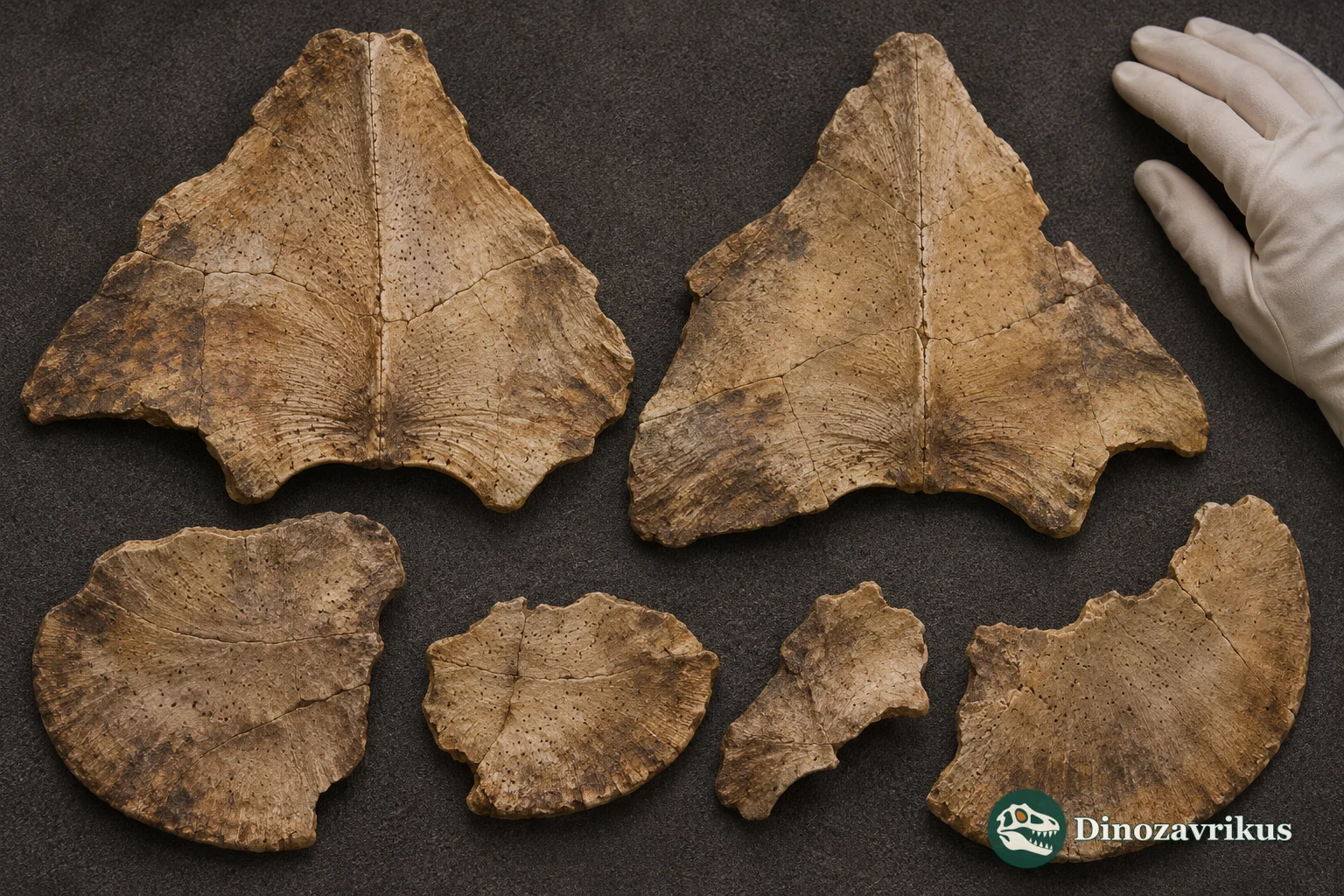
A hinge at the front
The large triangular epiplastra at the front of the plastron joined adjacent plates along margins interpreted as a hinge. The bones do not reveal how tightly the turtle could close its shell. Compare Hutchemys, another Cretaceous turtle whose plastron helps diagnose the genus. In that softshell turtle, researchers looked at the extent of bony callosities.
Frequently asked questions
Where was the Shachemys holotype found?
It comes from the Bostobe Formation at Shakh-Shakh in northeastern Aral Kazakhstan.
How many species were recognised in the 2007 revision?
Three. The type species is Shachemys baibolatica. The other two are S. ancestralis and S. laosiana.
What part of the shell could move?
The hinge has been inferred at the front of the plastron, where the paired epiplastra met neighbouring bones.
How was the 70-centimetre shell length estimated?
It was reconstructed from a nuchal plate at the front of a large specimen’s shell.