

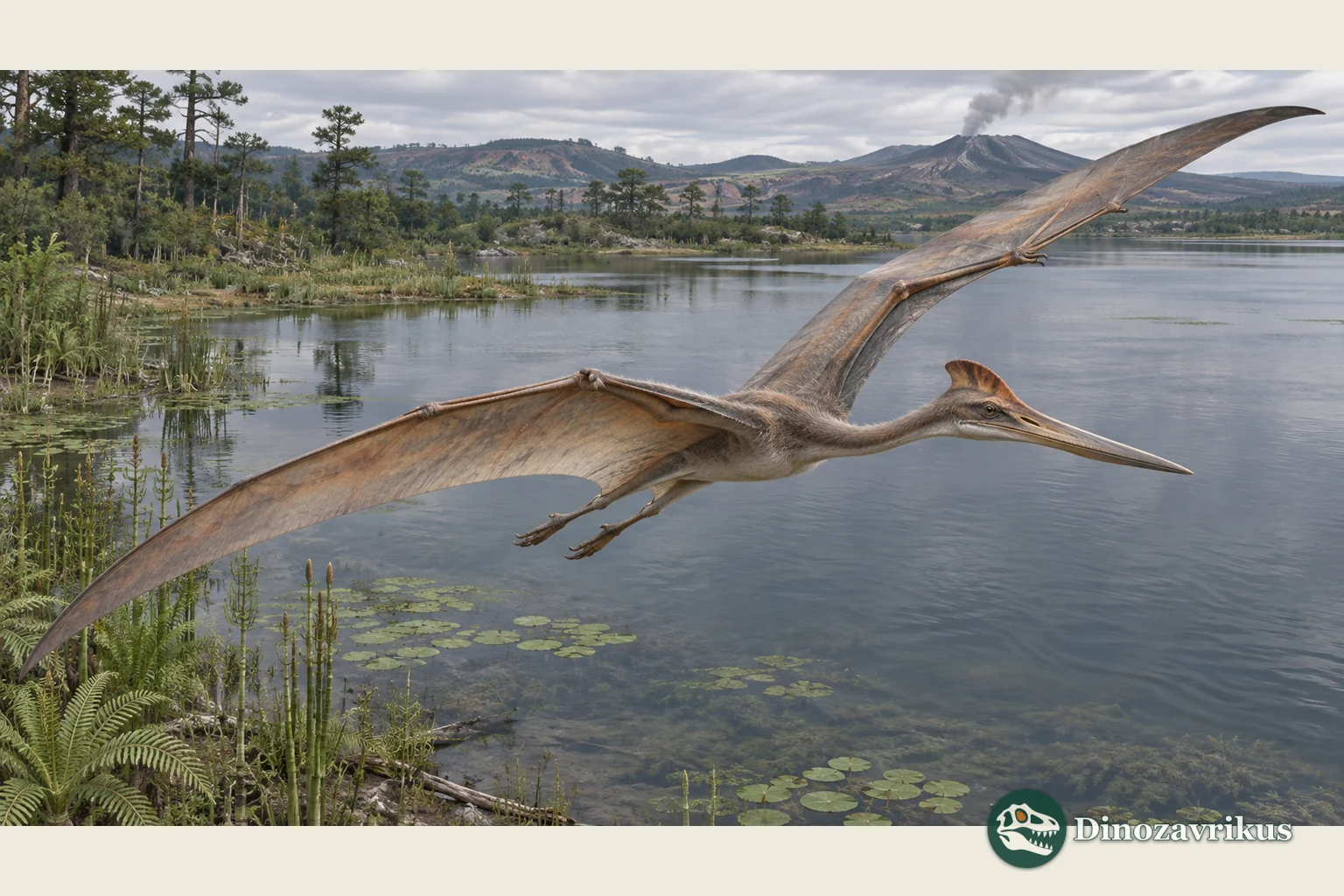
Shenzhoupterus chaoyangensis is known from an articulated skull and nearly complete skeleton in the Early Cretaceous Jiufotang Formation of Liaoning, China. Its toothless jaws and unusually large opening in front of the eye helped identify a distinct branch of azhdarchoid pterosaurs. The cover is a life reconstruction: the fossil does not preserve its colour or a moment of lakeshore behaviour.
Quick facts
| Named species | Shenzhoupterus chaoyangensis, Lü and colleagues, 2008 |
|---|---|
| Holotype | HGM 41HIII-305A, articulated skull and nearly complete skeleton |
| Locality | Chaoyang area, Liaoning, China |
| Rock unit | Jiufotang Formation |
| Geological age | Aptian, Early Cretaceous |
| Group | Chaoyangopteridae within Azhdarchoidea |
| Wingspan | About 1.4 m, published estimate for the described skeleton |
| Jaws | Toothless, with a large nasoantorbital opening |
What can the fossils tell us?
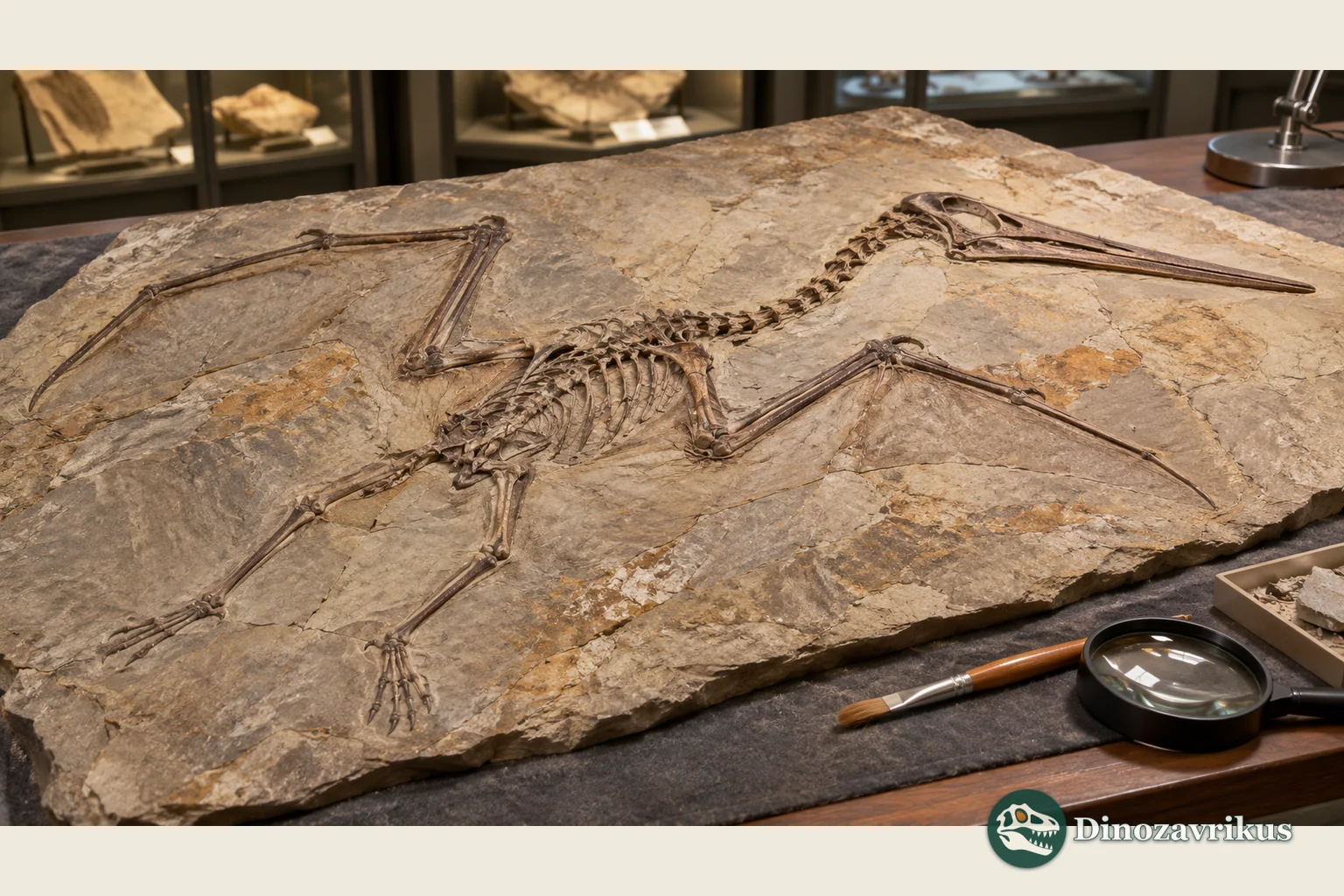
The holotype includes an articulated skull and substantial postcranial skeleton. It permits comparisons across the same individual, not a record of skin colour or behaviour.
The nasoantorbital fenestra extends high above the braincase. These cranial features help distinguish chaoyangopterids but do not reveal a particular food item.
The original authors estimated this wingspan from the described skeleton. It should not be treated as the maximum size of all adults.
The 2008 analysis grouped Shenzhoupterus with Chaoyangopterus and other forms. Later studies revised the family's membership and reassigned a second proposed Shenzhoupterus species.
A named skeleton from Liaoning
Junchang Lü, David Unwin, Li Xu and Xingliao Zhang named Shenzhoupterus chaoyangensis in 2008. The genus combines Shenzhou, a historical name for China, with a wing-related ending, and the species name points to Chaoyang. Holotype HGM 41HIII-305A preserves the skull and a largely articulated skeleton of one individual. The original description estimated its wingspan at about 1.4 m, a value for that specimen rather than a fixed size for the entire genus.
The fossil came from the Jiufotang Formation in western Liaoning. Its Aptian lake and wetland deposits belong to the Jehol assemblage. This geological setting tells us where the body was buried, while its exact living range and cause of death remain unknown.
A skull that helped identify a family
The jaw margins lack teeth. A large nasoantorbital opening occupies much of the side of the skull and reaches unusually high above the main part of the braincase. The skull's proportions and the postcranial skeleton gave the original authors several lines of comparison, rather than a single toothless character.
The study placed the animal near Chaoyangopterus, Jidapterus and other early azhdarchoids in the newly named Chaoyangopteridae. Membership and character interpretation have been reconsidered in later analyses. Their similarity is evidence of relationship, not a direct ancestor sequence.
The second-species question
A different Chinese skeleton was named Shenzhoupterus sanyainus in 2023. A later study that year transferred it to Meilifeilong sanyainus. The larger skeleton and its size should therefore not be silently folded into the type species S. chaoyangensis. Some authors have also questioned how distinctive the original genus is relative to other chaoyangopterids, while the 2023 comparative study continued to treat it separately.
The museum illustration below is a generic explanatory view of articulated preservation. It is not a photograph or exact rendering of HGM 41HIII-305A.
Size, food and reconstructed life
An articulated wing-bearing skeleton supports the published estimate of approximately 1.4 m in wingspan. It does not establish a population-wide adult maximum. Toothlessness narrows the anatomical description, but no stomach contents, prey remains or feeding traces identify what this individual ate.
The lakes in the artworks follow the depositional context of Jiufotang. Wing position, body covering and colour in a living scene are inferred or chosen, and a lakeshore pose does not demonstrate fish-catching behaviour.
Frequently asked questions
Where was Shenzhoupterus found?
Its articulated skeleton came from the Early Cretaceous Jiufotang Formation in Liaoning, northeastern China.
Did it have teeth?
No. The described jaws are toothless and the skull has a notably large opening in front of the eye.
How large was it?
The original description estimated about 1.4 m in wingspan for its known skeleton, not a maximum adult size for the genus.
Is Shenzhoupterus sanyainus still a second species?
It was named in 2023, but a later study that year reassigned it to Meilifeilong sanyainus.