

Simbirskiasaurus birjukovi was an Early Cretaceous ichthyosaur from the Ulyanovsk region of western Russia. Its only securely known specimen is a three-dimensionally preserved partial skull. A bony pillar divides the external narial complex into anterior and posterior openings, a feature clarified after further preparation of the fossil.
Quick facts
| Type species | Simbirskiasaurus birjukovi Ochev & Efimov, 1985 |
|---|---|
| Age | Early Barremian, Early Cretaceous |
| Region | Ulyanovsk area, Volga region, Russia |
| Holotype | YKM 65119, a three-dimensionally preserved partial skull |
| Classification | Platypterygiine ophthalmosaurid in the 2014 redescription |
| Diagnostic feature | A bony pillar divides the external narial complex |
| Unknown | Body size, soft tissues and prey are not established |
Evidence guide
YKM 65119 is preserved in three dimensions, but parts of the snout and skull are missing. Postcranial bones mentioned in the original description were considered lost by later authors.
Further preparation revealed an Aconeceras microconch within the skull. Its biostratigraphic association with the Praeoxyteuthis pugio Zone places the holotype in the Early Barremian, rather than the Hauterivian age originally proposed.
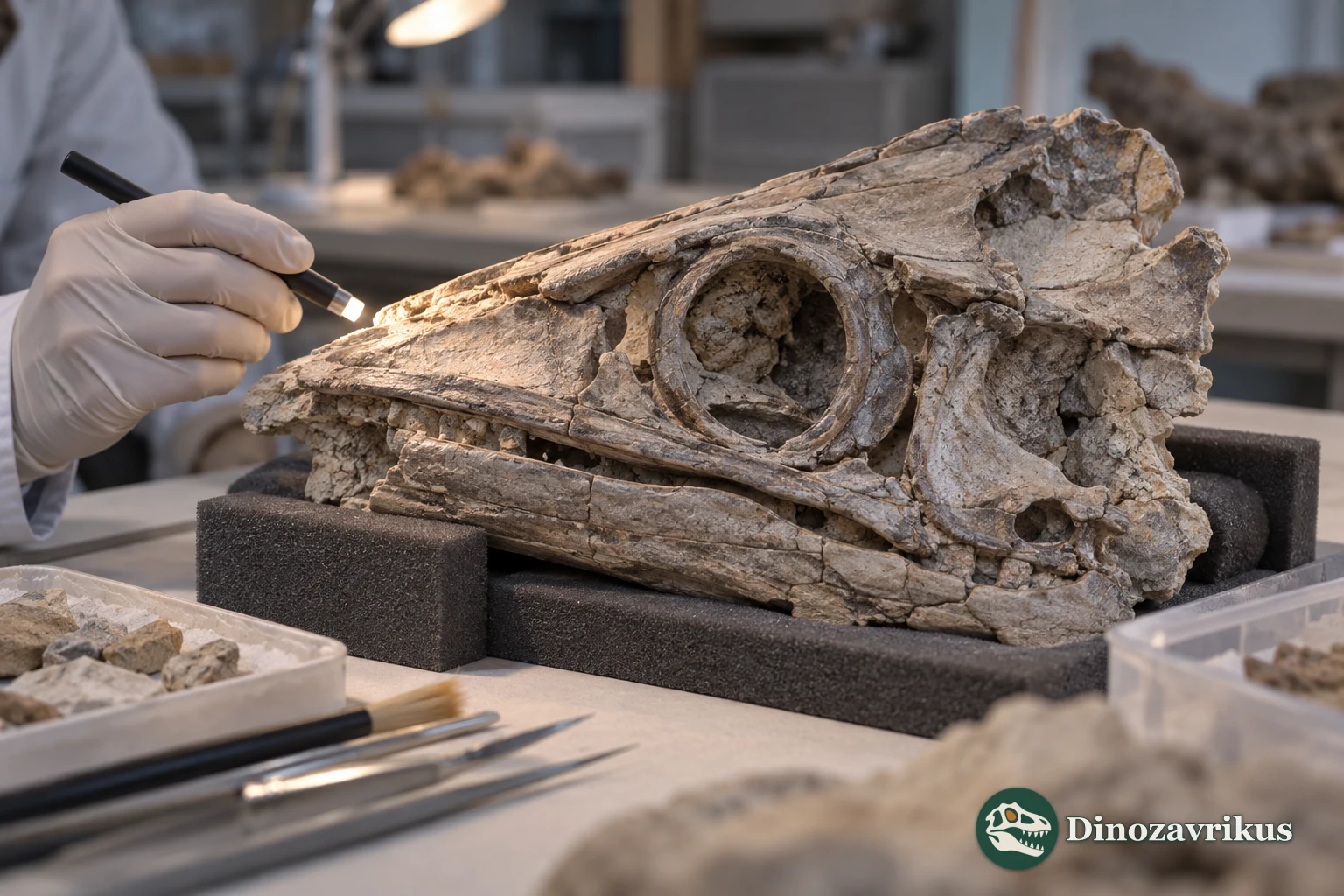
The anterior and large posterior openings are separated by a nasomaxillary pillar. This is a cranial observation; it does not establish a special sense of smell or a particular aquatic behaviour.
After the combination Platypterygius birjukovi and a later referral to Platypterygius sp., the 2014 redescription recognized Simbirskiasaurus as a distinct genus in Ophthalmosauridae and Platypterygiinae.
A Volga ichthyosaur and a changing name
Viktor Ochev and Vladimir Efimov described the genus and type species in 1985. The genus name refers to Simbirsk, the historic name of present-day Ulyanovsk. Its classification later shifted: Maisch and Matzke used the combination Platypterygius birjukovi, while McGowan and Motani referred to the fossil as Platypterygius sp. because they considered the type insufficiently diagnostic.
Valentin Fischer and co-authors re-examined the specimen in 2014. They classified it as an ophthalmosaurid within Platypterygiinae and restored Simbirskiasaurus as a valid genus. Their case relied on a combination of observable skull features after the narial and orbital regions had been prepared, rather than on the early drawings alone.
The holotype is YKM 65119. The 2014 paper corrected a previous citation that gave SGU 104a/22 as its type number. The museum repository associated with the YKM code is not stated clearly in the verified sources, so it should not be assigned to a specific institution without further evidence.
Why the age changed
Ochev and Efimov originally considered the fossil Hauterivian, based on associated shell material and preservation. During later preparation, an ammonite microconch identified as Aconeceras was found within the skull. The 2014 reassessment linked it to the Praeoxyteuthis pugio belemnite zone and assigned the holotype to the Early Barremian.
The precise discovery point is less certain than the age. The original account placed it on the right bank of the Volga about 25 kilometres north of Ulyanovsk. Later authors suggested that a Barremian section between Ulyanovsk and Polivno may be the source, but the specimen cannot be tied to a single measured point along the river.
Other ichthyosaurs from the broader region help compare faunas across time. Leninia is Aptian, while Sveltonectes is known from the Late Barremian. The page on Platypterygius also helps explain the older classification used for Simbirskiasaurus. Regional proximity does not mean that these animals lived together or shared one fossil bed.
A distinctive narial complex
After the surrounding matrix was removed, the supposed cluster of several openings could be interpreted as parts of one complex structure. A nasomaxillary pillar separates the anterior opening from a large posterior opening. The revised interpretation also identified a large narial lamella of the maxilla beneath the lacrimal.
The 2014 authors did not confirm a square-shaped orbit, which the original description had treated as diagnostic. They described additional details of the premaxilla, maxilla and bones around the naris, while parts of the rostrum remained absent. Sacral centra, ribs and neural arches mentioned in the original account could not be located and were considered apparently lost.
Phylogenetic analyses recovered Simbirskiasaurus with Pervushovisaurus and Platypterygius australis in a clade sharing a divided narial aperture. Support for parts of the tree was moderate to low because many ichthyosaurs in the character matrix are incomplete. The analysis compares coded anatomical characters; it does not establish a direct line of descent.
Limits on size and ecology
The partial skull does not supply a reliable total body length. Missing trunk, limbs and tail cannot be measured from YKM 65119, and a close relative is not a substitute for a complete Simbirskiasaurus skeleton. The redescription does not report stomach contents or direct traces of prey, reproduction, growth stages or pathologies for the holotype.
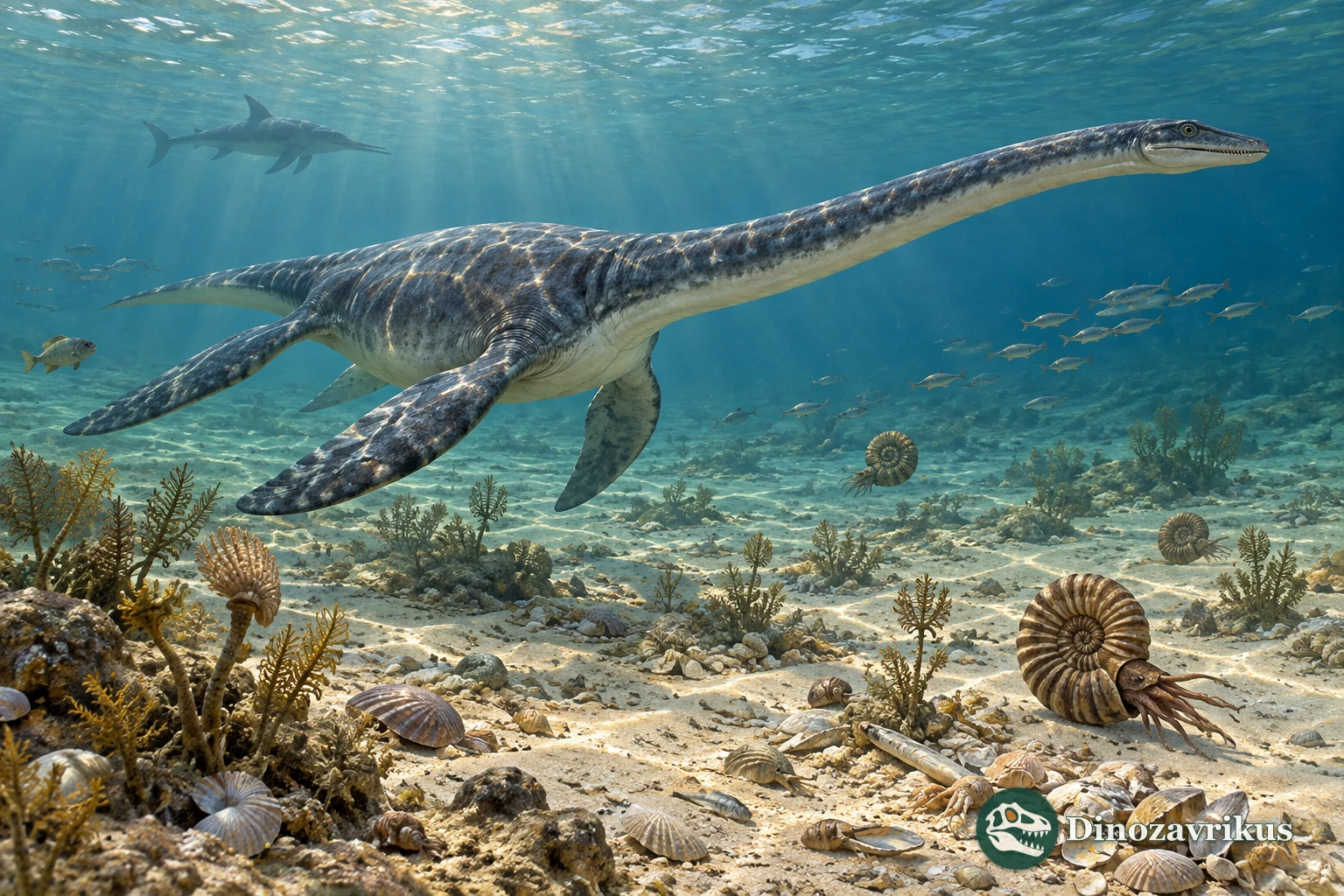
The cover is an artistic reconstruction of a platypterygiine ichthyosaur in a Cretaceous sea. The precise body outline, soft tissues and colour of Simbirskiasaurus remain unknown.
Frequently asked questions
Where was Simbirskiasaurus found?
The holotype came from the Ulyanovsk area of the Volga region. Its exact discovery point is uncertain; the Early Barremian section between Ulyanovsk and Polivno has been suggested as a possible source.
Why was its age revised?
An Aconeceras ammonite found inside the skull was linked to the Praeoxyteuthis pugio Zone, indicating an Early Barremian age rather than the Hauterivian age first proposed.
What is preserved in the holotype?
YKM 65119 is a three-dimensionally preserved partial skull. Postcranial fragments mentioned in the original description were considered lost by the 2014 reassessment.
Is Simbirskiasaurus a valid genus?
The 2014 reassessment recognized it as a valid platypterygiine ophthalmosaurid and restored the genus name after earlier combinations and referrals to Platypterygius.