

Leninia stellans was an Early Cretaceous ichthyosaur named from an articulated but incomplete skull found near Kriushi in Russia's Ulyanovsk Region. Its skull preserves a distinctive star-shaped contact between the frontal and parietal bones. No associated trunk or limbs are known from the holotype, so its full body size and many aspects of its biology remain uncertain.
Quick facts
| Type species | Leninia stellans |
|---|---|
| Age | Lower Aptian, Deshayesites volgensis Zone |
| Locality | Kriushi, Volga River, Ulyanovsk Region, Russia |
| Holotype | YKM 65931, an articulated but incomplete three-dimensionally preserved skull |
| Known material | Skull only; other regional fragments cannot be assigned securely |
| Body size | No reliable total length can be measured from the holotype |
Evidence guide
YKM 65931 is an articulated but incomplete skull preserved in three dimensions. It provides the diagnostic anatomy, but no vertebral column, limbs or tail are preserved with the holotype.
The skull was found inside a limestone nodule on the riverbank near Kriushi. It is assigned to the Deshayesites volgensis Zone; its exact position within the local section remains uncertain.
Elongate medial processes form a star-like outline where the frontal and parietal bones meet. This is an observable feature of the holotype, not evidence for colour or behaviour.
Only 12 of 52 characters could be scored in the original matrix because teeth and postcranial bones are missing. The proposed placement within Ophthalmosaurinae is therefore less secure than the skull description.
A skull found in a limestone nodule
The holotype, YKM 65931, came from a large limestone nodule lying on the bank of the Volga about two kilometres south-east of Kriushi village, in the Sengiley District of Ulyanovsk Region. The skull was not recovered in place within an undisturbed bed. Field observations suggested that the nodule resembled material from an upper nodule horizon, but that correlation was tentative. The published age is therefore given more broadly as the Lower Aptian Deshayesites volgensis ammonite Zone.
Valentin Fischer, Mikhail Arkhangelsky, Grigory Uspensky, Igor Stenshin and Pascal Godefroit described the genus and species in 2014. The name Leninia refers to the historical setting of the museum that houses the skull in Ulyanovsk; stellans means star-like and refers to the unusual suture between two skull bones. The specimen is held by the I. A. Goncharov Ulyanovsk Regional Museum of Local Lore.
Other fragmentary ichthyosaur remains from Aptian localities in the wider region have been compared with Leninia. They include partial skulls and a braincase, but the original authors did not assign them confidently to the genus. Geographic proximity and similar age alone are not enough to make that identification.
What the skull preserves
YKM 65931 is three-dimensionally preserved and partly articulated. Although incomplete, it retains enough of the skull to document the positions of several bones. The original diagnosis includes a posterior process of the maxilla that reaches about halfway along the orbit, an anterior process of the prefrontal that covers the nasal, and distinctive contacts among bones of the skull roof.
The most memorable feature is the frontal–parietal suture. Elongate forked processes form a star-shaped outline, which inspired the species name. The diagnosis rests on a combination of characters, since a single feature may occur in more than one ichthyosaur lineage.
No teeth are preserved in the holotype. The shallow maxillary dental groove near the nostril led the authors to suggest that teeth in this part of the jaw may have been reduced in height. That is an inference from the jaw, not direct evidence that Leninia was toothless.
Size, vision and evolutionary placement
The skull does not preserve the trunk or limbs needed for a reliable total-length estimate. The original description called Leninia moderately large, but a precise body length should not be treated as a measurement of YKM 65931. A fuller skeleton would be needed to test body proportions.
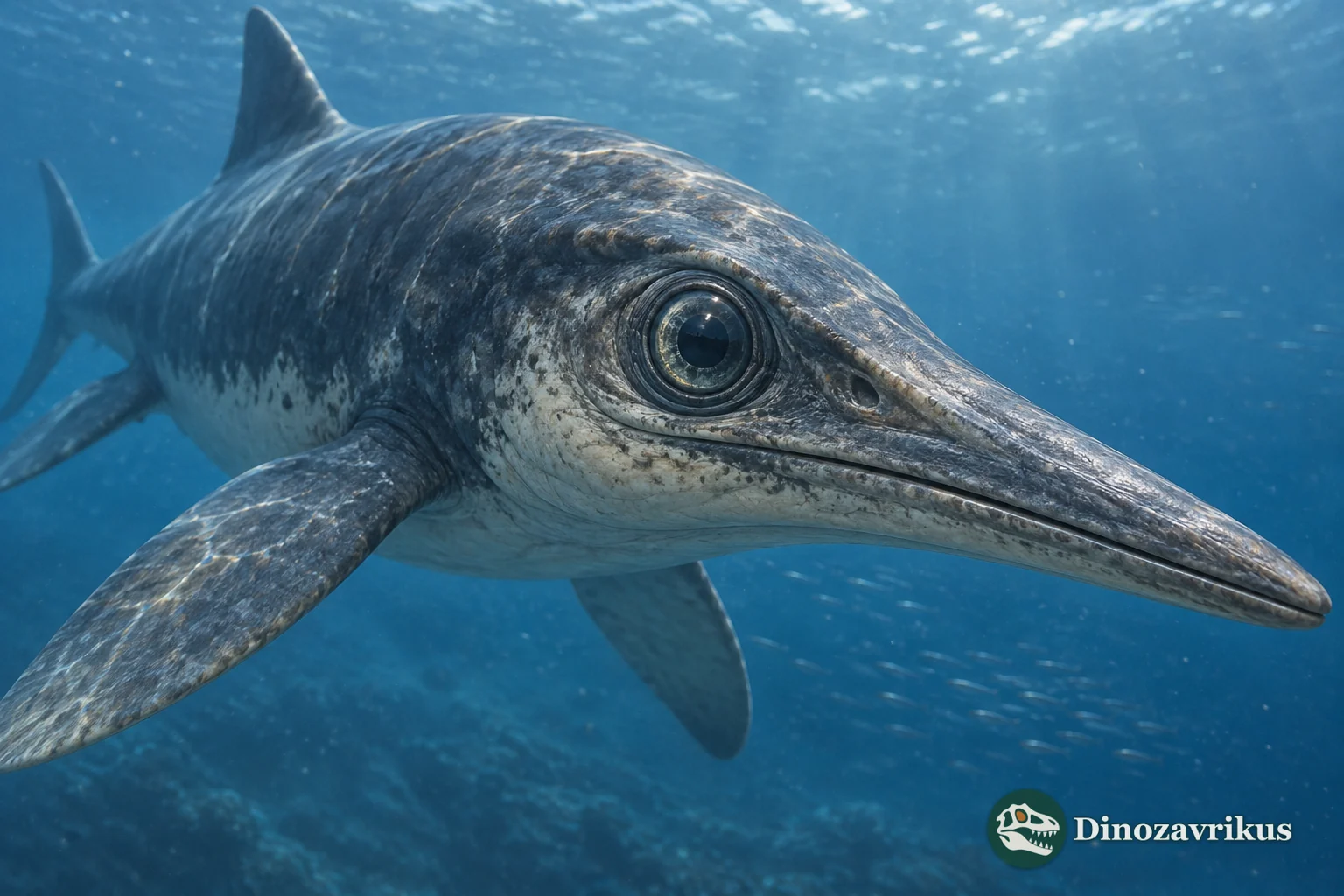
The orbit and its sclerotic ring can be compared with those of other ichthyosaurs when researchers study visual anatomy. Eye size alone does not establish a particular diving depth, hunting strategy or swimming speed. No stomach contents, bite marks, pathologies or growth series have been described for Leninia.
The original phylogenetic analysis placed Leninia among ophthalmosaurines, but only 12 of 52 characters could be coded because teeth and postcranial skeleton are absent. Its broad placement is a testable hypothesis with limited anatomical coverage, not a settled account of every relationship. Comparisons with Mollesaurus and Jabalisaurus are useful, but they do not imply direct ancestor–descendant relationships.
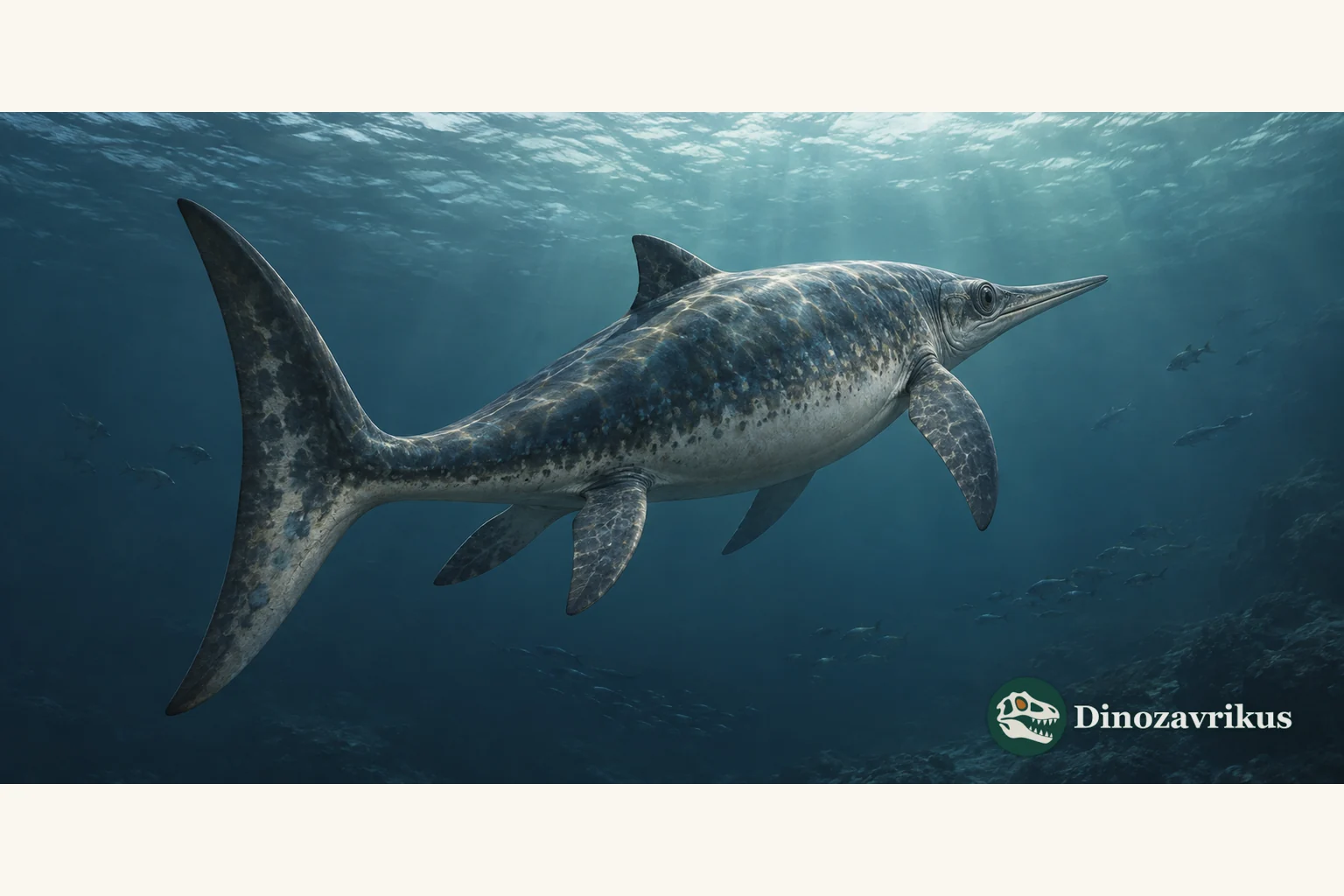
The Lower Aptian rocks record a marine setting. They do not preserve a narrative of how Leninia hunted or behaved. Images of the animal's body and colour remain artistic reconstructions unless more complete remains provide direct evidence.
Frequently asked questions
Where was Leninia found?
The holotype was found inside a limestone nodule on the Volga bank near Kriushi in Ulyanovsk Region, Russia. It is assigned to the Lower Aptian.
What does the name Leninia stellans mean?
Leninia refers to the historical setting of the Ulyanovsk museum that houses the type skull. The species name stellans means star-like and refers to the skull suture.
Is a complete Leninia skeleton known?
No. The holotype, YKM 65931, is an incomplete articulated skull. Other regional fragments resemble it but cannot yet be assigned to Leninia securely.
How long was Leninia?
The skull alone does not provide a reliable total body length. The trunk, limbs and tail needed for a defensible estimate are not known from the holotype.