

Jabalisaurus is a genus of Late Jurassic ophthalmosaurid ichthyosaurs. The first known species, Mexican J. meztli, was described in 2021 from an incomplete specimen once assigned to Ophthalmosaurus. In 2026 the genus gained a German species, J. tethyensis, whose type and two referred specimens preserve bones, soft-tissue outlines and even stomach contents. Material from two regions broadens the known distribution, while the limits of the German sample and some features of the Mexican skull remain open to reassessment.
Quick facts
| Family | Ophthalmosauridae; subfamily placement varies among phylogenetic analyses |
|---|---|
| Named species | Jabalisaurus meztli from Mexico and J. tethyensis from Germany |
| Age | Late Jurassic: Kimmeridgian and early Tithonian |
| Mexican holotype | CPC 238, incomplete skull and postcranial material from the La Casita Formation |
| German holotype | SNSB-BSPG 1954 I 608, a very young ichthyosaur from lower Tithonian Bavaria |
| Estimated size | About 2.0–2.9 m proposed for the German species; the upper end depends on assumptions |
Evidence guide
CPC 238 from the Upper Kimmeridgian La Casita Formation was once referred to Ophthalmosaurus cf. icenicus. A re-examination identified a distinctive combination of skull bones. The holotype is incomplete and deformed, leaving some earlier interpretations uncertain.
In 2026, J. tethyensis was named from holotype SNSB-BSPG 1954 I 608 and two specimens referred to it from other sites and horizons. Similar skull proportions, teeth and fin bones support the referral, but the authors noted that no unique feature conclusively unites all three.
Specimen JME-SOS-08369, referred to J. tethyensis, preserves small ganoid-scaled bony fish. This is direct evidence for part of one individual’s diet, not a complete menu for the genus and not evidence from the Mexican holotype.
SMNS 54067 preserves patches of skin on the torso, while the holotype retains an outline of the hindfin. These finds document soft tissues in the German sample, but details should not be transferred automatically to every body region or to J. meztli.
The proposed length for J. tethyensis uses the proportions of one specimen; the upper limit also depends on a growth model. Phylogenetic analyses do not resolve every relationship the same way, and similarity does not show a direct ancestor–descendant link.
From a Mexican fossil to a new genus
The name Jabalisaurus followed a re-examination of specimen CPC 238 from Coahuila, northern Mexico. In 2010 it had been described as Ophthalmosaurus cf. icenicus. A later comparison found a combination of features that did not fit that species, including the contacts among the lacrimal and nasal bones, the shape of the frontal, and a crescent-shaped postorbital. In 2021 Jair Israel Barrientos-Lara and Jesús Alvarado-Ortega named the new genus and species Jabalisaurus meztli.
Holotype CPC 238, previously catalogued as CEP 1876, is incomplete and deformed. It comes from the Late Jurassic La Casita Formation near Gómez Farías in Coahuila. It preserves skull characters and part of the skeleton, but not every body proportion. The 2026 revision notes that head-first burial and later compression may have distorted parts of the skull; some features used in the original diagnosis require careful interpretation.
A German species and its three specimens
In 2026 Erin Maxwell, Jule Neumann and Giovanni Serafini described Jabalisaurus tethyensis from the Bavarian Plattenkalk. Its holotype, SNSB-BSPG 1954 I 608, came from the Geisberg quarry near Apfelthal, close to Mörnsheim. The lower Tithonian slab and counterpart preserve a very young ichthyosaur with visible anatomical detail.
The authors also referred SMNS 54067 from the upper Kimmeridgian Torleite Formation and JME-SOS-08369 from the lower Tithonian near Blumenberg. The three specimens share skull proportions, dentition and some forefin features. But the paper emphasises that no single unique character conclusively unites all three. Referral of the additional specimens is a supported hypothesis that remains open to testing, so the formal diagnosis chiefly rests on the holotype.
Skull, teeth and paddles
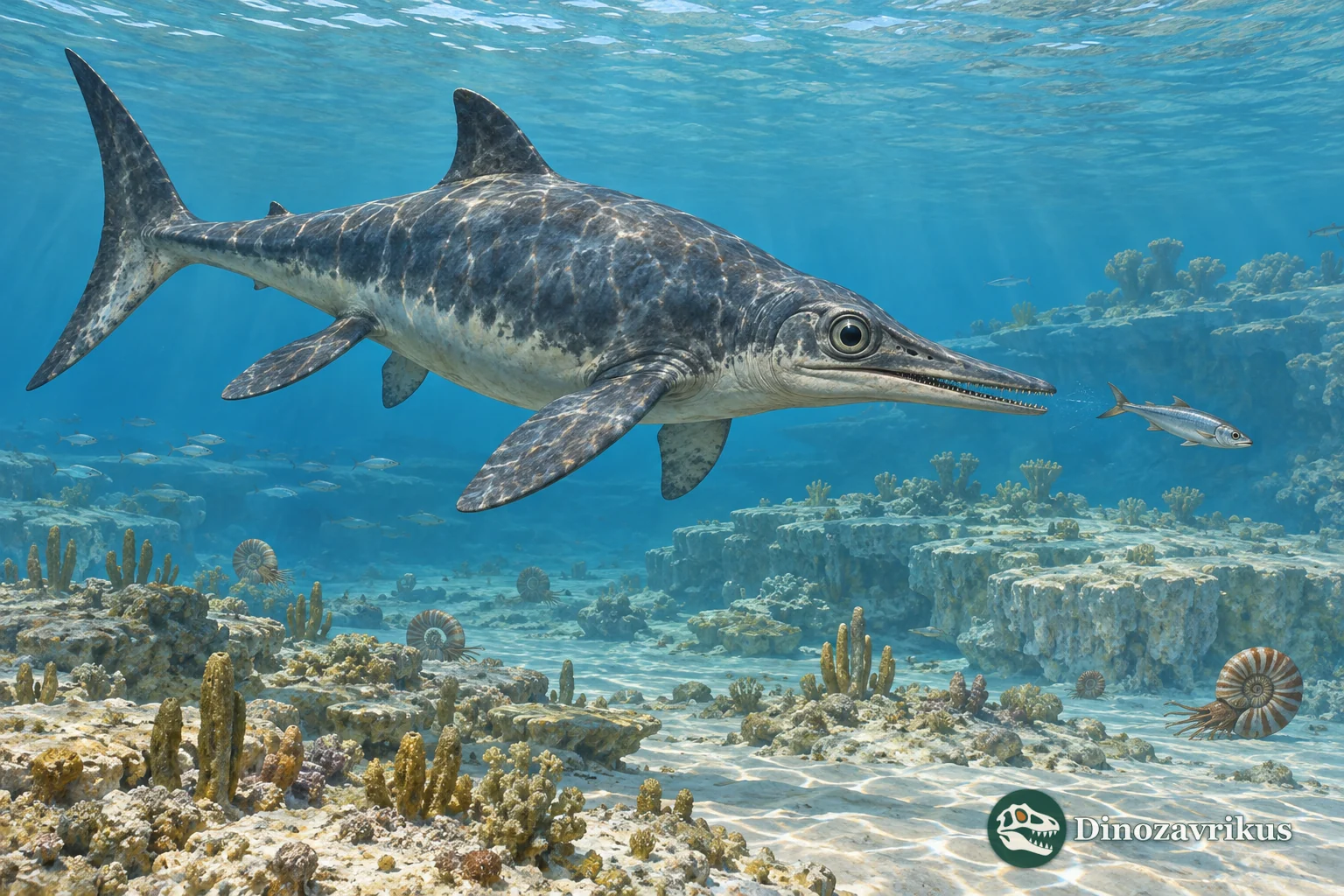
The German species has a high skull with a slender snout and a large orbit. Its external naris is divided into two parts, and the tooth enamel bears fine lengthwise ridges. Tooth shape varies along the jaw: the back teeth are shorter and blunter than those toward the front. These details help compare specimens but do not specify a hunting strategy.
The limbs formed paddles. The humerus has three distal facets for the radius, ulna and preaxial element; the phalanges are tightly packed and polygonal. The German holotype preserves the outline of a short, rounded hindfin. That is direct evidence for this individual, not a pattern that can be applied to all ichthyosaurs; some related animals had longer, more pointed hindfins.
The original Mexican diagnosis included unusual proportions in parts of the skull. The 2026 revision argues that compression and damage may have affected the visible shape of the narial region and skull roof. The species are still distinguished by a combination of features, including how much the splenial contributes to the lower-jaw symphysis. Comparisons with Catutosaurus likewise rely on several skull and limb characters rather than one striking feature.
What the fossils preserve about diet and skin
The clearest direct evidence of food comes from JME-SOS-08369, referred to J. tethyensis: small bony fish with ganoid scales are preserved in the stomach region. This is an uncommon case in which diet is supported by more than tooth shape. It shows what at least one individual had eaten, not that fish were the only or regular food of the genus.
Another German specimen, SMNS 54067, preserves patches of soft tissue on the front of the back. The material was examined in natural and ultraviolet light, and the authors describe smooth skin. It does not reveal colour, nor does it mean soft tissue is preserved across the whole body. Comparable stomach contents or skin are not currently known from the Mexican J. meztli holotype.
Size and relationships
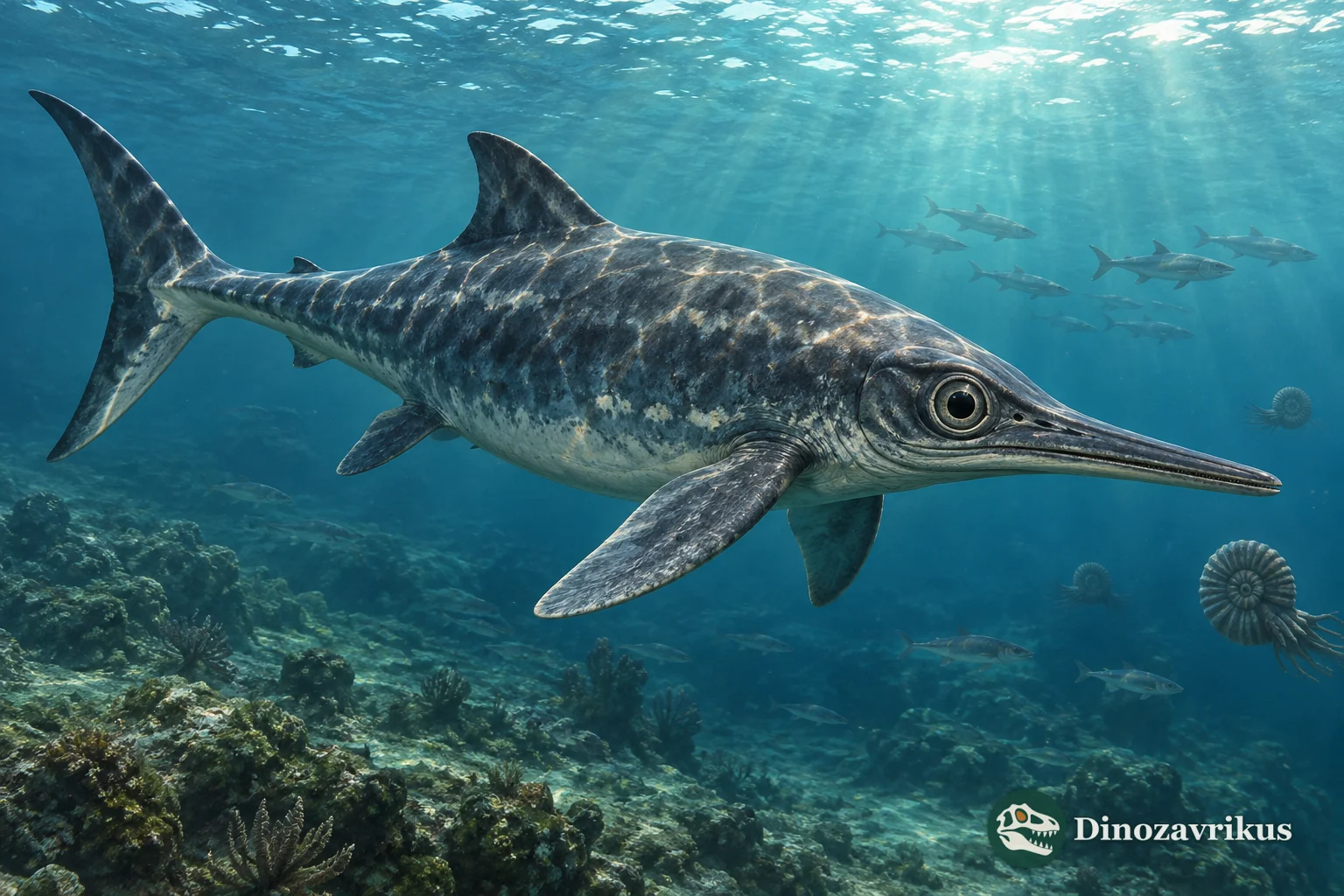
A length of roughly 2–3 m has been proposed for J. tethyensis. The upper estimate is derived from skull length and proportions of another specimen, then depends on how young the holotype was. Because the holotype is a very young juvenile, transferring age-related proportions to an adult is sensitive to assumptions. It is not a direct measurement of an adult skeleton.
Some phylogenetic analyses place Jabalisaurus among ophthalmosaurines, but methods do not resolve every relationship in the same way. The German species shows that members of the genus lived on both sides of the north-western Tethys during the Late Jurassic. It does not show that the German species descended from the Mexican one or establish a particular migration route.
The German specimens span nearby Late Jurassic intervals, while the Mexican species comes from Upper Kimmeridgian deposits. Their similarities and differences help researchers study ichthyosaur diversity around the Tethys, though the sample remains small. For comparison with another Bavarian ichthyosaur, see Aegirosaurus; several fossils now divided among different genera were once assigned to it.
Frequently asked questions
How many Jabalisaurus species are known?
Two species are described: Mexican J. meztli and Bavarian J. tethyensis. The latter was named in 2026 after fossils once assigned to Aegirosaurus were revised.
Where was Jabalisaurus found?
J. meztli comes from the La Casita Formation in Coahuila, Mexico. German J. tethyensis is known from Bavarian Plattenkalk sites near Mörnsheim, Painten and Eichstätt.
What did Jabalisaurus eat?
Small bony fish are preserved in the stomach region of one specimen referred to J. tethyensis. This is direct evidence for one individual, while the diet of the whole genus remains uncertain.
How long was Jabalisaurus?
A length of about 2.0–2.9 m was calculated for the German species. The upper end depends on assumptions about proportions and age; no complete adult skeleton confirms it.