

Sinomacrops bondei was named from a crushed Jurassic skeleton in Hebei, China. A short broad face, relatively long lower legs and scattered soft-tissue impressions make the specimen unusually informative for an anurognathid. The animal flying on the cover is an interpretation; neither its exact colours nor the flight scene were fossilized.
Quick facts
| Named species | Sinomacrops bondei, Wei and colleagues, 2021 |
|---|---|
| Holotype | JPM-2012-001, flattened skeleton and impressions |
| Repository | Jinzhou Museum of Paleontology, China |
| Locality | Mutoudeng, Qinglong County, Hebei Province |
| Rock unit | Daohugou Beds of the Tiaojishan Formation |
| Age | Callovian–Oxfordian, approximately 164–158 million years ago |
| Diagnostic features | Closely spaced first three upper-jaw sockets; lower leg about twice femur length |
| Growth stage | Interpreted as subadult from bone fusion |
What can the fossils tell us?
The holotype preserves a crushed skull, trunk and limbs, plus impressions left by some lost bones. It can document one individual's proportions, not the size range of the species.
The first three upper-jaw alveoli lie close together. The fossil supports comparisons within Anurognathidae, but contains no identified meal.
The measured right tibiotarsus is 2.66 cm versus a 1.36 cm femur. Their ratio helps diagnose this specimen but does not establish a particular hunting style.
Impressions by the skull, neck and hindlimbs support a wing membrane reaching the lower leg and an extensive interleg membrane. Colour and their complete margins remain unknown.
The Mutoudeng specimen
Xuefang Wei and coauthors described Sinomacrops bondei in 2021 from JPM-2012-001, housed at the Jinzhou Museum of Paleontology. The name combines a reference to China with the broad face and large eyes characteristic of anurognathids; the species honours palaeontologist Niels Bonde. The specimen came from Mutoudeng in Qinglong County, within the Daohugou Beds of the Tiaojishan Formation. The describing study assigns those rocks a Callovian–Oxfordian age of roughly 164–158 million years.
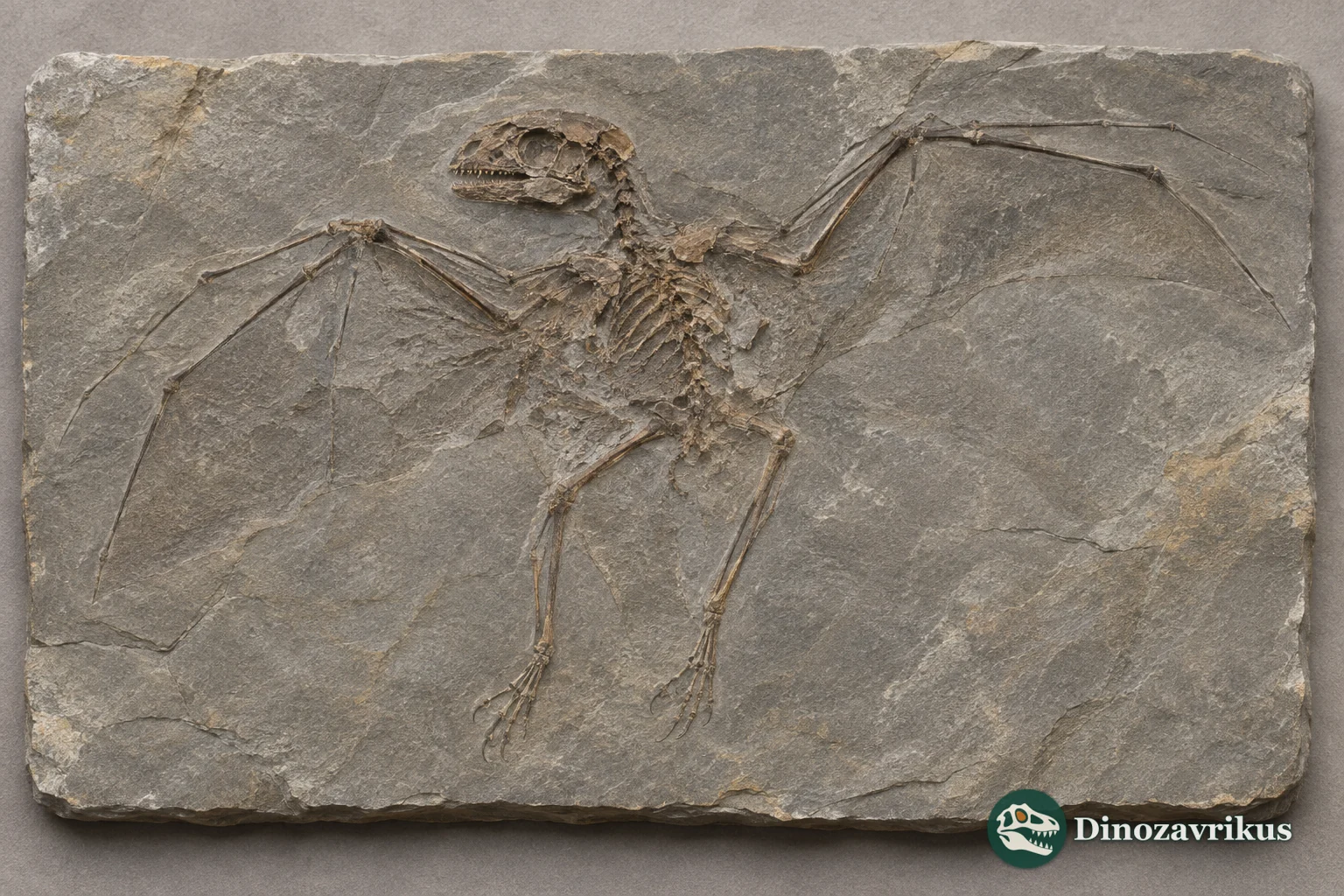
The skull is exposed from the side; most of the rest of the skeleton faces the viewer from below. Fragile bone has broken away in places, leaving impressions in the rock. Limited-resolution CT scans helped identify boundaries of some wing elements where surface preparation alone was inconclusive. A missing bone must therefore be distinguished from a structure that was never present.
A short face and unusually long shins
The right upper jaw shows closely packed first three tooth sockets. A partly displaced sclerotic eye ring lies near the short broad skull. Several small cranial bones are difficult to separate because the fossil was flattened. The authors used the tooth-socket arrangement and the relative lengths of the leg bones to diagnose the species, rather than relying on the impression of a large-eyed face alone.
The paper records a right humerus of 2.36 cm, femur of 1.36 cm and tibiotarsus of 2.66 cm. Those values describe this holotype, not an average adult. Incomplete skull fusion, alongside pelvic evidence, led the authors to interpret it as a subadult. The study's phylogenetic analysis recovered Batrachognathus as its closest sampled relative. That is a hypothesis of relationship, not a claim that either named genus was the other's ancestor. Jeholopterus provides a separate anurognathid comparison for soft tissues.
Skin and membrane impressions
Soft-tissue traces extend from the top of the skull towards the neck. A patch beside the left lower leg suggested to the describers that the wing membrane reached distally along the leg. Another patch beside the right hindlimb supports an extensive interleg membrane, but its relationship with the tail remains unresolved. The paper also notes a tail impression longer than the hindlimb; its complete bony series is not available for direct measurement.
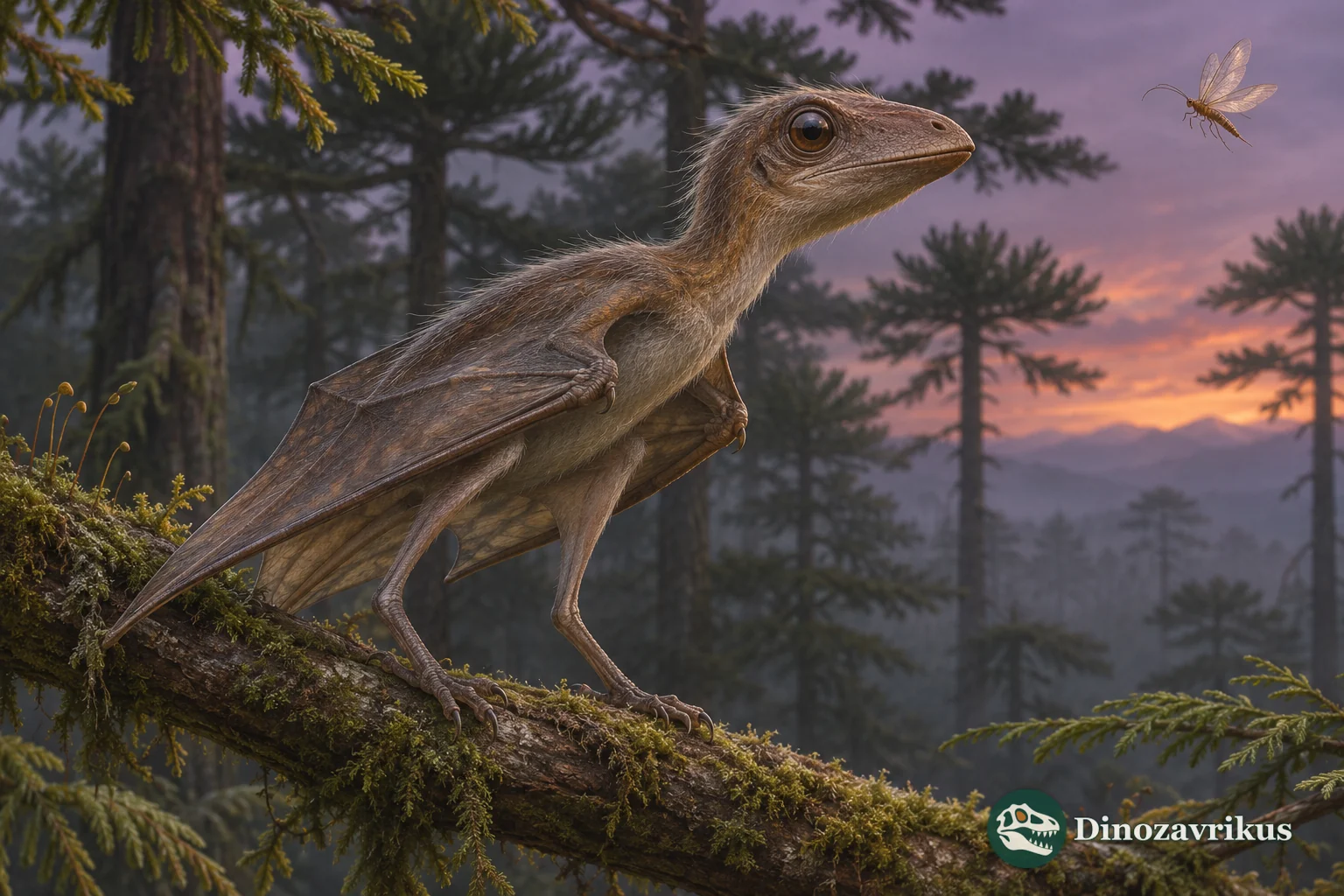
These observations constrain parts of a restoration, but leave the living animal's pigments, complete membrane outline and individual behaviour unknown. Sordes preserves different soft-tissue information and should not supply a ready-made colour or wing shape for this specimen. An insect-catching diet is a common inference for small anurognathids with simple teeth; no stomach contents or captured prey were reported for Sinomacrops.
What the pictures add
The fossil-slab image is an interpretive model of flattened skeletal preservation, not a photograph or exact replica of JPM-2012-001. The woodland image imagines a resting animal near an insect. The known bones and tissue patches support a pterosaur with wings, but they do not document that perch, encounter or time of day.
Frequently asked questions
Where was Sinomacrops found?
Its holotype came from the Daohugou Beds of the Tiaojishan Formation at Mutoudeng, Hebei Province, China.
What distinguishes its skeleton?
The first three upper-jaw tooth sockets are closely spaced, and its measured lower leg is about twice as long as the femur.
Are its wing membranes known?
Only patches of soft tissue survive. They suggest that the wing membrane reached the lower leg, without preserving every margin.
Was the holotype fully grown?
The describing authors considered it subadult based on skeletal fusion. Its eventual adult size is not directly known.