

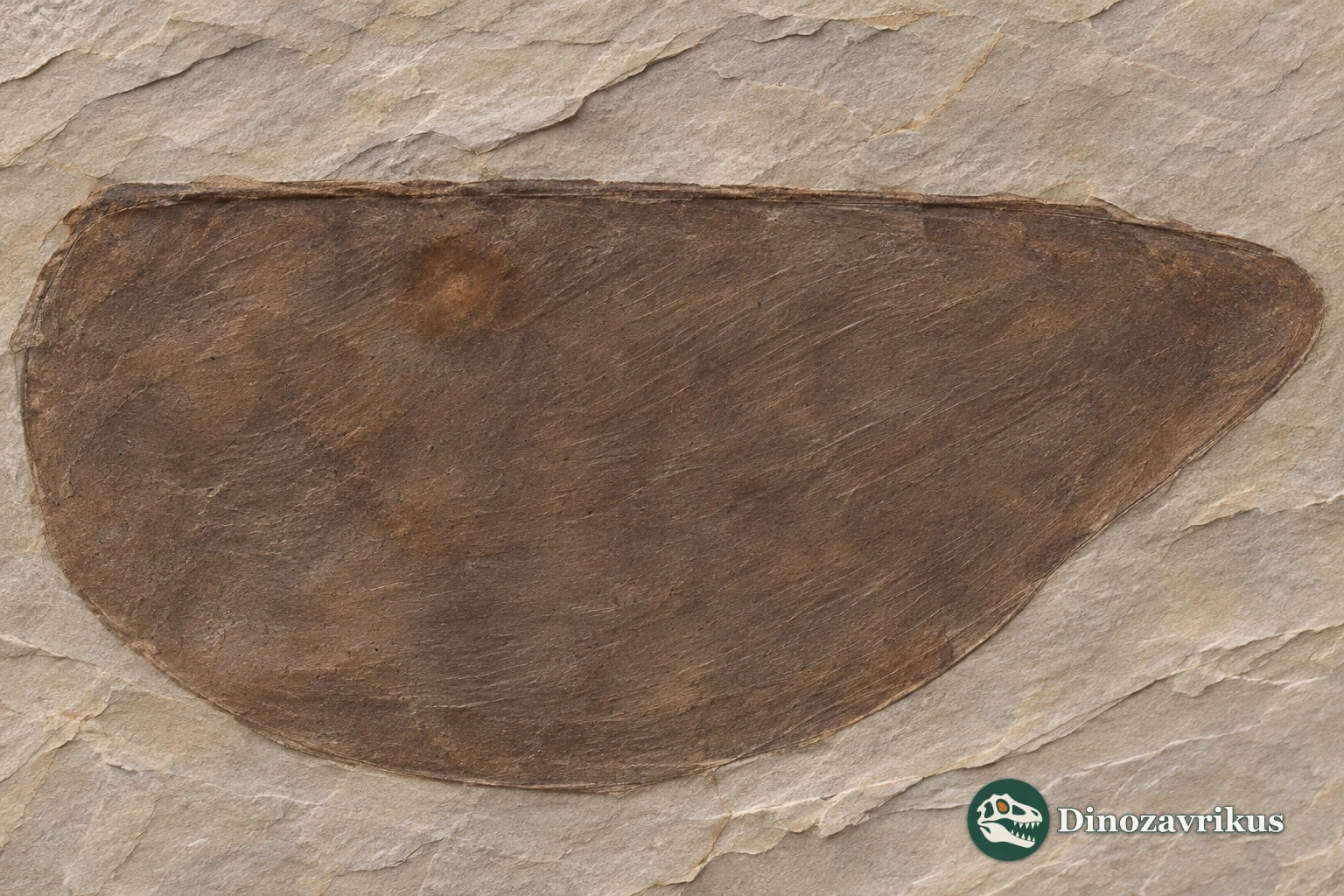
The early Cambrian arthropod Sinskolutella sheltered its body inside two valves. Some Siberian specimens preserve a rounded patch a little above mid-height on the valve. Palaeontologist Lyudmila Melnikova interpreted it as the attachment scar of an adductor, the muscle that pulled the valves together.
Quick facts
| Group | Bradoriids |
|---|---|
| Age | Early Cambrian |
| Genus established | Lyudmila Melnikova, 1998 |
| Type species | Sinskolutella ordinata |
| Siberian shell length | 6.5–10 mm |
| Localities | Sakha and South Australia |
What can the fossils tell us?
The shape and position of the patch support its interpretation as the attachment of a closing muscle.
Electron microscopy revealed different sizes of round pore with a radial pattern around the opening. Their function is unknown.
The valves are similarly shaped and convex. Their outline slants towards the lower rear edge. Short tips can project from the dorsal corners.
The Algal Lens on the Lena River
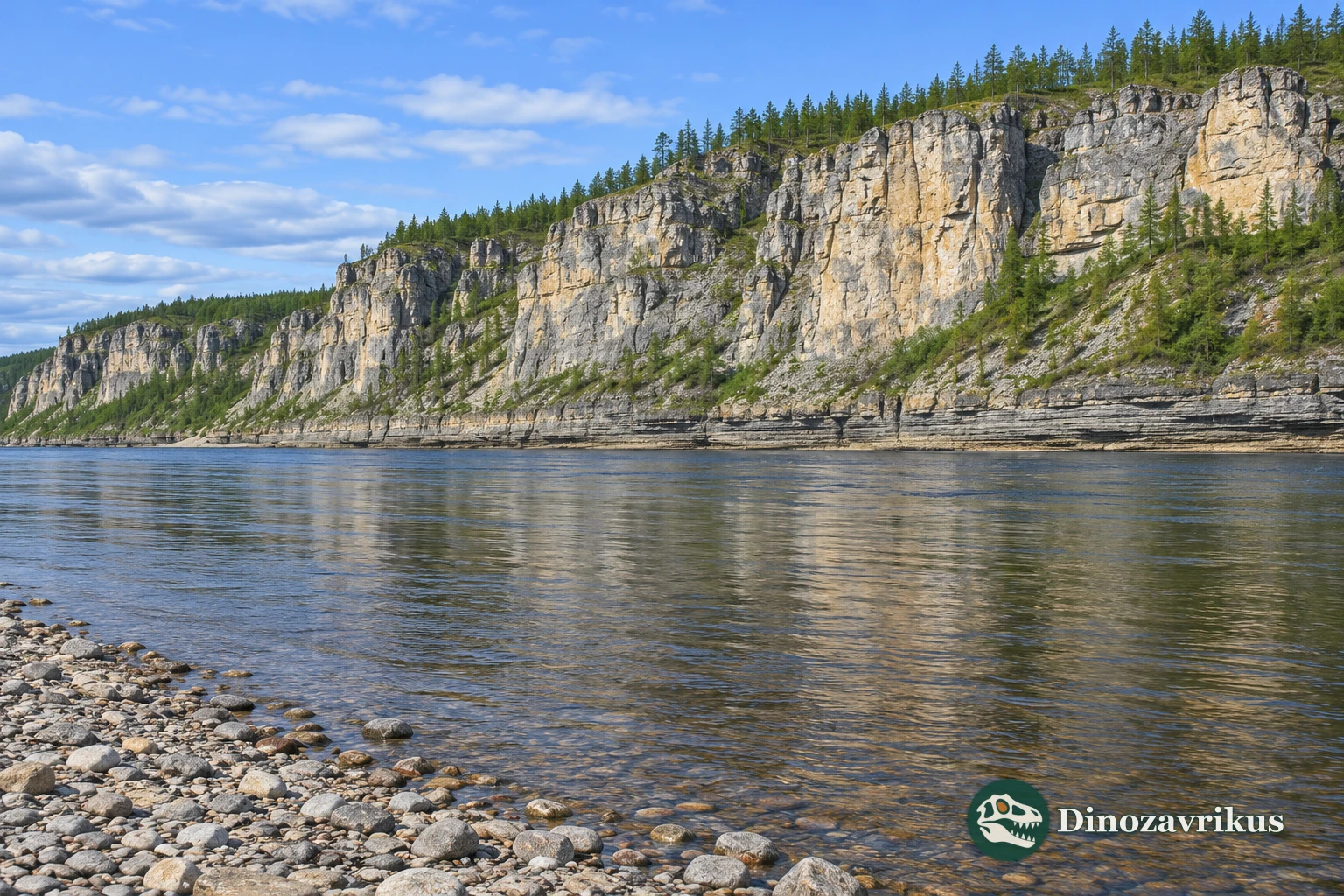
The fossils come from the right bank of the Lena River opposite Sinsk. The valves are scattered across bedding surfaces in a layer informally called the Algal Lens, near the base of the Sinsk Formation. Associated fossils place the layer in the Botomian, a regional Early Cambrian stage.
Some shells are crumpled like thin paper. This is consistent with weak original mineralisation, although a recently moulted animal might also have had a soft shell. Attempts to free the fossils from the rock broke them into pieces, so Melnikova studied them on the slabs. The Borissiak Paleontological Institute holds the collection as PIN 4349.
A muscle attachment and rimmed pores
About 15 of roughly 200 S. ordinata specimens showed a patch in the front half of the valve. Melnikova interpreted it as a muscle attachment. The muscle itself is absent. A possible adductor scar has also been described on a specimen of the bradoriid Liangshanella.
The valves have circular pores of several sizes, each bounded by a raised rim with radial details. Chemical analysis detected calcium and phosphorus. Phosphorus may have entered the fossil after burial, so its presence does not establish the original shell composition.
Records from Siberia and South Australia
The species ordinata was first described under Bradoria in 1983 and was later placed in Matthoria. Melnikova introduced Sinskolutella in 1998. Its distinctive traits include a straight dorsal edge, slanting valves and surface details.
The Flinders Ranges of South Australia yielded another early Cambrian species, S. cuspidata. The Siberian species shares some shell and muscle-scar features with later leperditicopids. That resemblance has suggested a possible relationship that remains to be tested.
Frequently asked questions
Where has Sinskolutella been found?
The type species comes from the Sinsk Formation of Sakha, Siberia. Another species was named from the Flinders Ranges in South Australia.
How large are the Siberian shells?
The shells of the type species in the studied material measure 6.5–10 mm long.
What does the round mark mean?
It is interpreted as the attachment scar of a muscle that pulled the valves closed.
What did the pores do?
The pores and their rims are preserved in the rock. Their biological function remains unknown.