

Spirocerus was an extinct bovid of Pleistocene Eurasia. It is often called a spiral-horned antelope, but that familiar label does not settle its exact place within Bovidae. A 2019 analysis placed it nearer bovines than antelopines. The cover proposes a living appearance; coat color and the full horn sheaths are not preserved.
Its best-known fossils are cranial pieces with twisted horn cores. More complete Chinese samples also include teeth and jaws, allowing researchers to test distinctions once made from isolated horns.
Quick facts
| Group | Bovidae; a 2019 analysis placed it nearer Bovinae than Antilopinae |
|---|---|
| Type species | S. kiakhtensis, based on a name first proposed by M. V. Pavlova |
| Other species | S. wongi and S. peii in the 2019 revision |
| Time | Pleistocene; localities and species differ in age |
| Range | Northern China, Central Asia and Transbaikalia |
| Evidence | Skull fragments with horn cores, jaws, teeth and some limb bones |
| Measured horn core | About 283 mm in one S. wongi skull, excluding the missing sheath |
What can the fossils tell us?
Bony cores preserve their longitudinal keels and degree of twist. The number of turns varies and may also change with age or sex, so it is not a diagnosis by itself.
At Shanshenmiaozui, a partial S. wongi skull (IVPP V 28650) and several jaws extend the anatomical sample. A single tooth cannot reconstruct the whole animal.
A 2019 character analysis grouped the three species closer to Bovinae than Antilopinae. That inference depends on the compared taxa and traits.
Naming three fossil species
M. V. Pavlova originally named the Transbaikalian form kiakhtensis under another genus. Marcellin Boule and Pierre Teilhard de Chardin established Spirocerus in 1928 and included that species. Fossils from northern China were later named S. wongi and S. peii. These names apply to separate samples, not three growth stages of one animal.
A 1981 revision identified the S. kiakhtensis type as a braincase fragment with horn cores, Kyakhta regional museum specimen 2249. Some earlier authors had combined Chinese material with that species; the revision argued for three distinguishable forms. A 2019 study again accepted S. kiakhtensis, S. wongi and S. peii.
What the horn cores measure
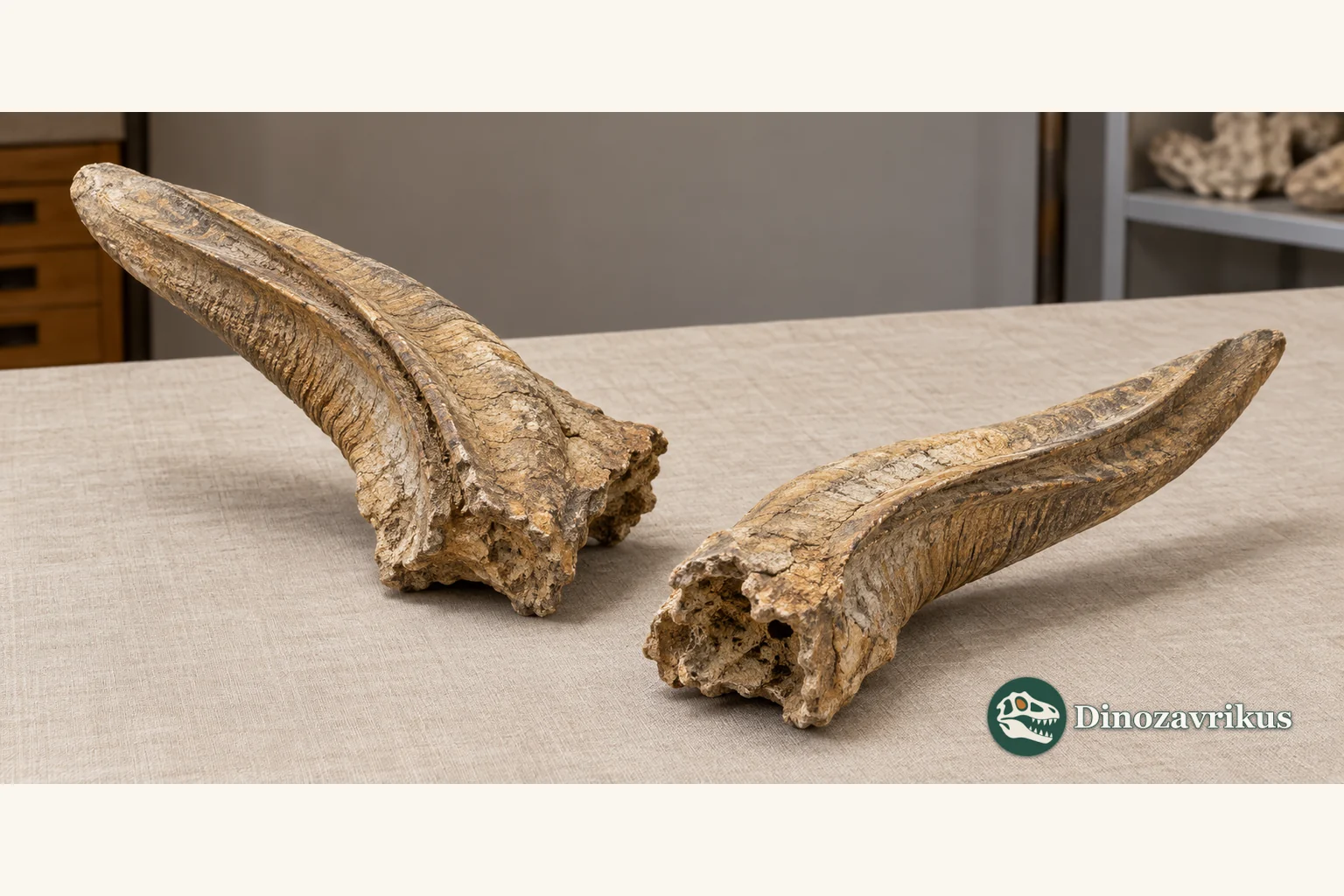
The bony horn cores carry longitudinal keels and twist along their length. Comparisons consider the direction and degree of torsion, keel development, cross section and the angle between the two cores. The 1981 authors warned that the number of turns alone could vary with age and perhaps sex.
An Early Pleistocene skull from Shanshenmiaozui in the Nihewan Basin, IVPP V 28650, preserves two S. wongi horn cores. One is about 283 mm long and the pair diverges by roughly 50 degrees. Those are measurements of one skull, not a genus average or the length of the lost keratin sheaths. CT images revealed internal canals and changes in cross section along the core.
Deposits and evolutionary proposals
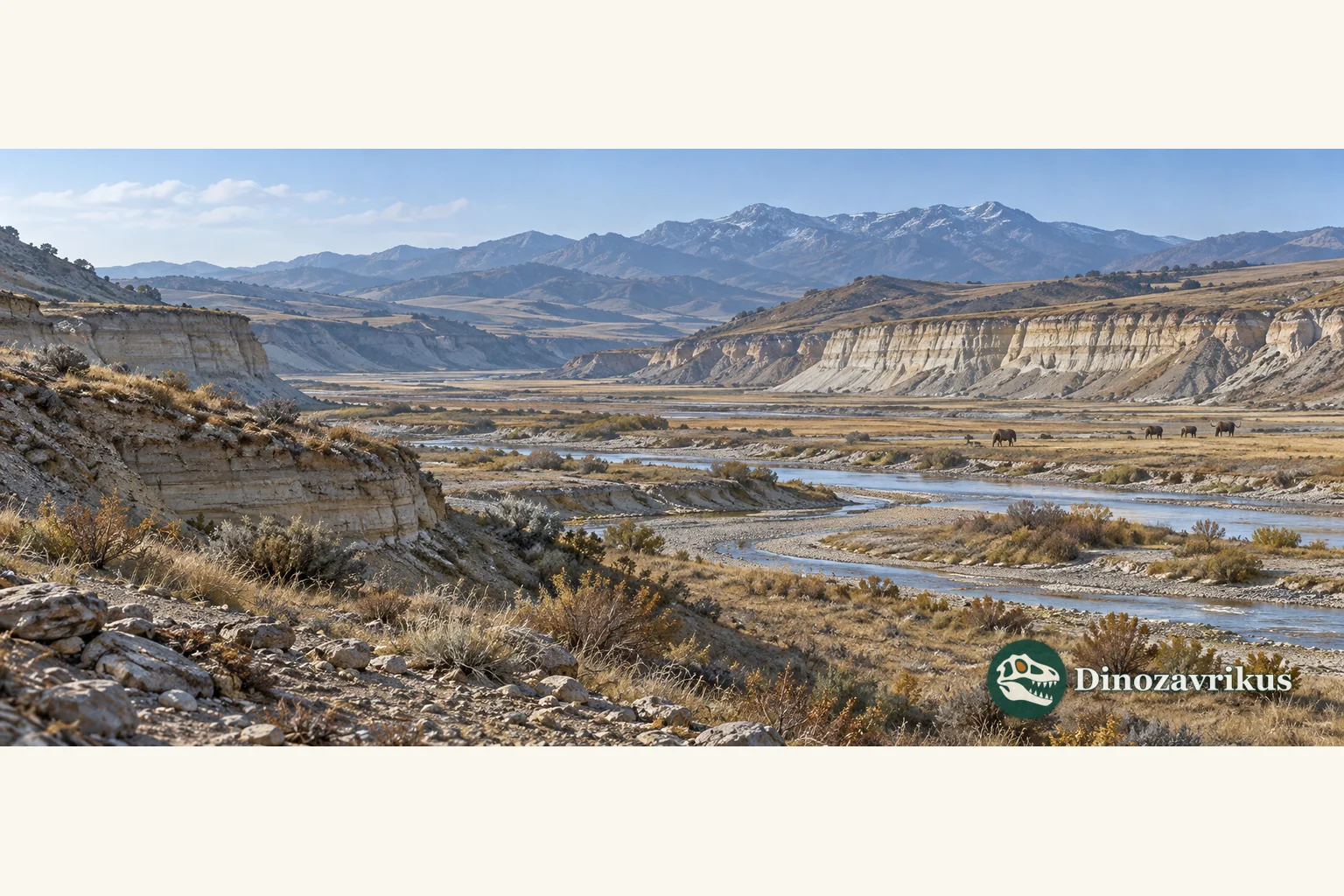
The Nihewan samples belong to the Early Quaternary. A study of material from Shuichongkou compared Chinese and Central Asian horns and teeth, then proposed a history of dispersal and divergence. That is an evolutionary scenario inferred from separated fossils, not a documented parent-to-offspring chain.
A character analysis published in 2019 placed Spirocerus closer to Bovinae than Antilopinae. Gazellospira offers a useful comparison among twisted-horn bovids, but a similar horn silhouette alone does not establish direct ancestry.
Limits of a life reconstruction
Teeth and bovid relationships support plant feeding, but the sampled fossils do not identify a specific list of plants. Horn cores reveal cranial form, not herd size, fighting behavior or coat color. There is no complete skeleton for every species; a horn length cannot yield a precise body mass. The life scene illustrates one plausible broad bovid form without claiming to portray a measured individual.
Frequently asked questions
Why is Spirocerus called spiral-horned?
Its bony horn cores twist along their axis and carry longitudinal keels. The degree of twisting varies among fossils.
How many species have been recognized?
A 2019 revision accepted S. kiakhtensis, S. wongi and S. peii, although earlier authors combined some material differently.
Is the complete horn length known?
No. A core in one S. wongi skull measures about 283 mm; its outer keratin sheath has not survived.
Was it related to living cattle?
It belonged to Bovidae. One phylogenetic analysis placed it nearer Bovinae than Antilopinae, though its precise position is inferred rather than directly observed.