

The genus Squaliodalatias was first described from Eocene teeth found in south-western France. Another species later turned up in Cretaceous deposits on Hornby Island, Canada. Teeth from the early Paleocene of Austria and Denmark show that the genus occurs on both sides of the Cretaceous–Palaeogene boundary.
Quick facts
| Group | Kitefin sharks |
|---|---|
| Material | Isolated teeth |
| Type species | From Lutetian deposits in France |
| Cretaceous record | Campanian of Hornby Island, Canada |
| Danian tooth height | 2.2 mm at Waidach |
What can the fossils tell us?
The Hornby Island specimens have a strongly divided root. They differ from both the Eocene type species and the Austrian tooth.
The Austrian specimen preserves an inclined cusp and surfaces for interlocking with adjacent teeth. It was identified to genus without assigning it to either named species.
Several Late Miocene fragments preserve the form of the crown. Eroded and incomplete roots limit the species identification.
From Eocene France back to Cretaceous Canada
In 2006 Sylvain Adnet, Henri Cappetta and Jozef Reynders established the genus for Squaliodalatias weltoni, from Lutetian beds in the Landes region. The inner side of its root bears a protuberance or bulge whose shape varies according to the tooth’s position in the jaw. A similar bulge in another specimen is therefore only one part of the comparison.
The Campanian species S. savoiei from Hornby Island has a more strongly divided root. The teeth were recovered with an assemblage of other marine sharks whose composition suggests a deep-water setting. The Canadian occurrence is substantially older than the first known fossils of the Eocene type species.
An early Paleocene tooth from Austria
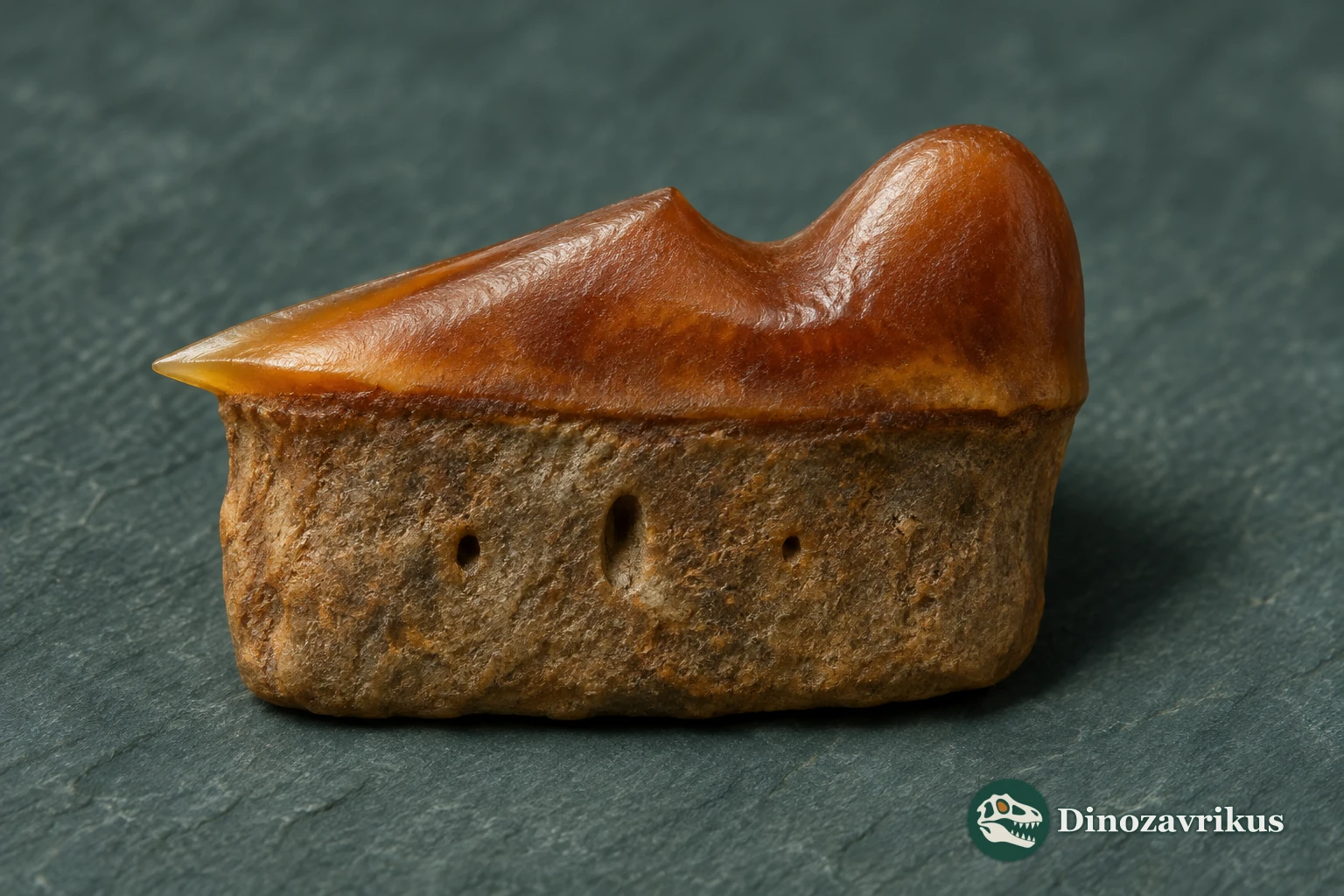
The Waidach section near Salzburg yielded an incomplete lower tooth, NHMW/2023/0125/0001, measuring 2.2 millimetres high and 1.5 millimetres wide. The main cusp inclines sharply towards the corner of the jaw. On the outer face a broad strip of enameloid extends down the root and is interrupted by a large opening. The sides of the root preserve the surfaces where the tooth could interlock with its neighbours.
The tooth came from horizon 9 of the Olching Formation, above the Cretaceous–Palaeogene boundary. Protoxynotus, from a different dogfish shark lineage, is known from older beds in the same section. Those fossils document changes across the sequence and came from different times.
A tooth assigned to the genus from Danian beds at Stevns in Denmark has a more upright cusp and smooth edges. The Austrian tooth bears weak serrations on one edge and two projections on the inner face of the root. Neither Paleocene specimen was assigned to either of the named species.
Younger finds in Slovakia and Spain
Early Miocene deposits at Cerová in Slovakia yielded a single damaged lower tooth 1.6 millimetres high, identified to genus. Late Miocene fragments from the Alcoy Basin of eastern Spain were compared with the French type species. The Spanish specimens are worn or broken, so that identification remains tentative.
The teeth show how elements of the lower row might have supported each other. Body length, colour and whether the shark produced light remain unknown.
Frequently asked questions
Which is the type species?
The type species was described in 2006 from Eocene teeth found in the Landes region of south-western France.
Was Squaliodalatias present in the Cretaceous?
Yes. The species described from Hornby Island comes from Campanian beds, older than the end-Cretaceous boundary.
Do the Austrian and Danish finds represent a named species?
Both were assigned to the genus. Differences in cusp angle, edges and root structure did not support assigning them to either named species.
What is known from the Miocene?
There is an Early Miocene lower tooth from Slovakia and Late Miocene material from Spain, the latter tentatively compared with the type species.