

Stegops was a Carboniferous temnospondyl amphibian. Short bony spikes projected from the rear of its skull and from the lower jaw. Some specimens from Linton, Ohio, show extra spikes that are absent in other skulls from the same deposit.
Quick facts
| Group | Temnospondyls, dissorophoids |
|---|---|
| Age | Late Carboniferous, Middle Pennsylvanian |
| Region | North America, United States (Ohio) |
| Type species | Stegops divaricata |
| Scientific name | Stegops |
| Diet | Exact prey is unknown |
What can the fossils tell us?
The specimens compared by researchers have spikes on the tabular and quadratojugal of the skull and on the angular of the lower jaw.
The ornament recalls that of some Permian temnospondyls. Comparisons of dozens of other features place Stegops among dissorophoids.
Only some specimens have spikes on two additional bones. The cause of this variation and the function of the spikes remain unresolved.
A skull and its counterpart
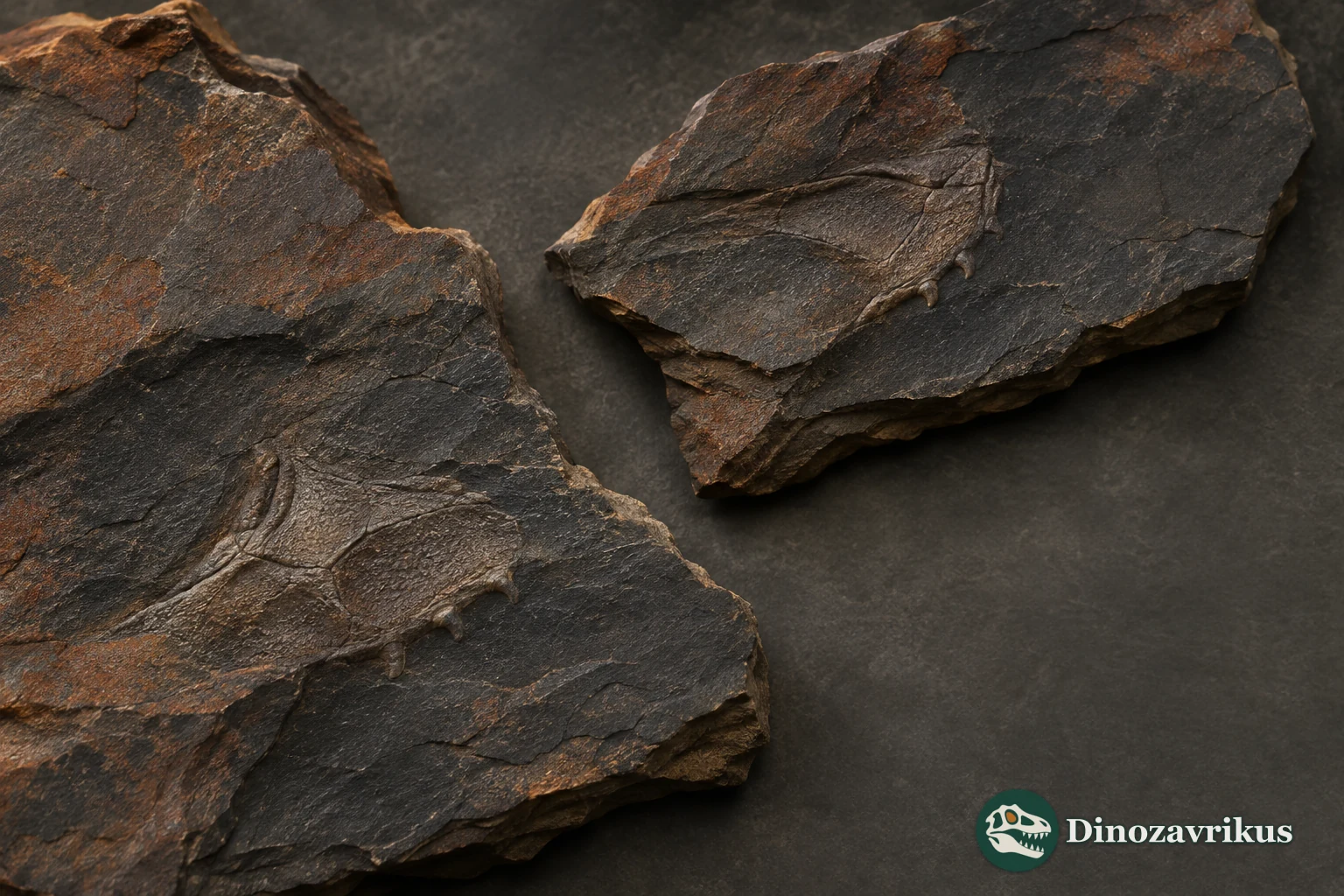
Edward Drinker Cope described the species in 1885 as Ceraterpeton divaricatum. William Gurley collected the skull at Linton in eastern Ohio. The holotype, UR 16, is held at the Field Museum, and its counterpart, AMNH 2559, is at the American Museum of Natural History. The counterpart is the matching surface of the split block that held the fossil. Roy Moodie later established the genus Stegops for this species.
Where the spikes grew
The tabular bears a spike at the back of the skull roof. The quadratojugal carries another near the cheek, and the angular bears one on the lower jaw. Andrew Milner and Rainer Schoch found that further spikes occurred on the squamosal and supratemporal in only some individuals. The bones document variation in the species, but on their own do not identify the sex of the individuals.
How its affinities were reassessed
The bony spikes led earlier researchers to link Stegops to the Permian zatrachydids. Milner and Schoch compared 52 characters across 15 temnospondyls. Their analysis put Stegops inside the dissorophoid group and the zatrachydids outside it. The exact position of Stegops shifted among equally plausible trees. The similarities in the spikes were therefore interpreted as the result of independent evolution.
Another temnospondyl from Linton
The same coal beds preserve Platyrhinops, a small dissorophoid with two-pointed marginal teeth. The two genera can be identified from different parts of their skulls. In Stegops the projections are conspicuous along the back and sides, whereas the dentition and palate are especially informative in Platyrhinops.
Frequently asked questions
Where was Stegops found?
The skulls come from Middle Pennsylvanian coal beds at Linton, Ohio, in the United States.
Did every Stegops have the same spikes?
The specimens share spikes on three bones. Only some have spikes on two additional bones.
What were the spikes for?
Their function remains uncertain. The fossils establish the shape and position of the spikes and how they varied between individuals.
What group does Stegops belong to?
A comparison of skull characters placed it among dissorophoid temnospondyls. Its exact relationships inside that group remain uncertain.