

Sulcidens was a Paleogene ray with broad teeth arranged in a plate. Its crowns were concave and finely textured, with grooves crossing their working surfaces. The limited wear on those surfaces helped prompt the suggestion that the ray fed on small organisms.
Quick facts
| Order | Myliobatiformes |
|---|---|
| Type species | Sulcidens sulcidens |
| Fossils | Isolated teeth and partial dental plates |
| Localities | Angola and Morocco |
| Age | Paleocene and early Eocene |
| Diet | Small prey inferred from teeth |
What can the fossils tell us?
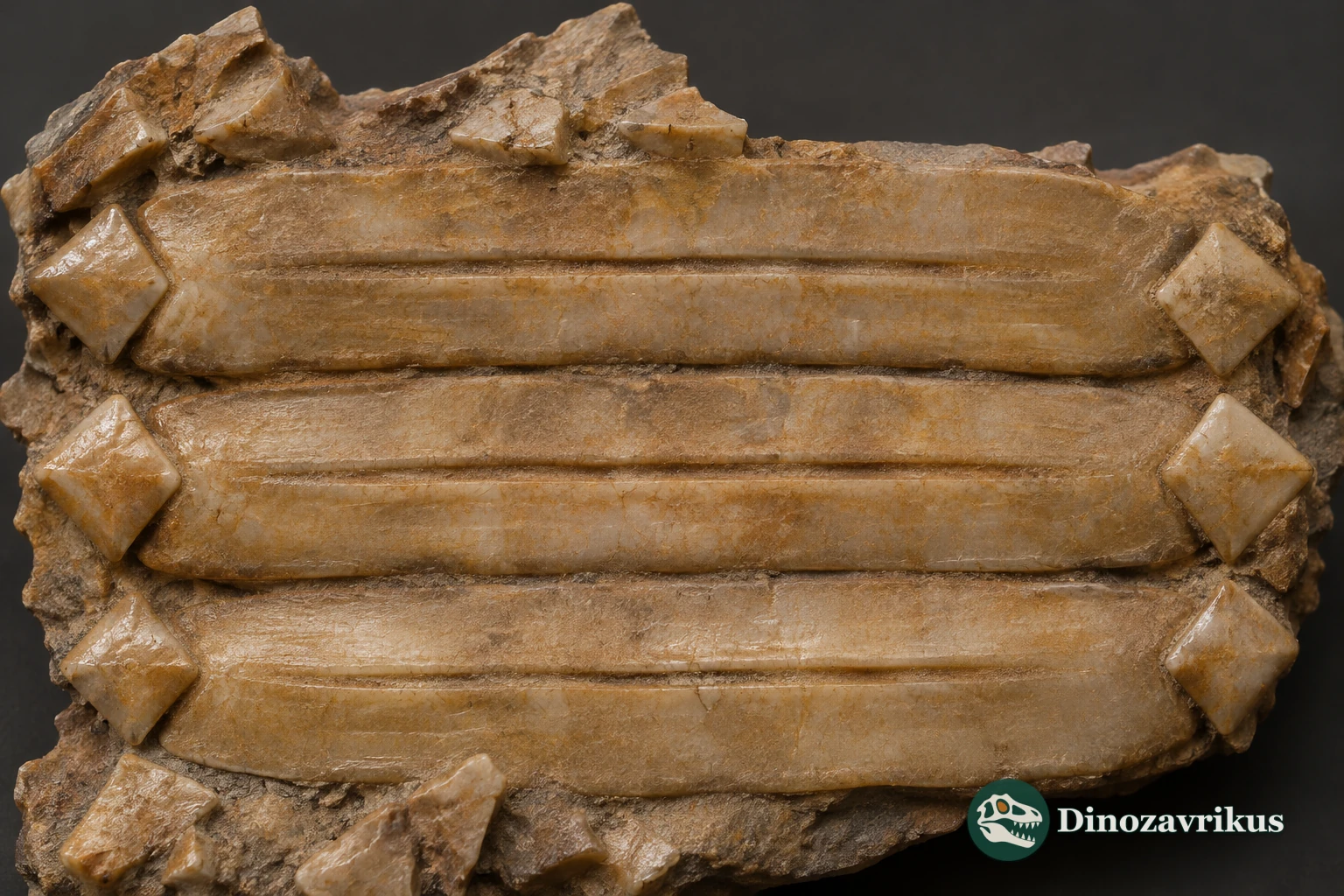
Moroccan specimens preserve alternating arrangements. One row has a broad tooth at the centre, and the next has only lateral teeth.
Little of the surface texture was worn away in life. That is unusual for a ray that routinely crushed hard prey.
The authors inferred possible feeding on small organisms from the teeth. Fossils preserving the ray’s gill apparatus are unknown.
The tooth from Cabinda
Edmond Dartevelle and Edgar Casier named the species Myliobatis sulcidens in 1943. The type is a central tooth from Cabinda, Angola. Its Paleocene age is tentative. Moroccan teeth have a firmer geological context, with specimens reported from several Paleocene levels. Incomplete teeth assigned to the genus also occur low in the Ypresian near Khouribga.
In 2017, Charlie Underwood, Matthew Kolmann and David Ward described three nearly complete articulated dental plates and an isolated central tooth. The material allowed them to establish the genus Sulcidens. The name refers to a groove on the biting surface. The authors left its exact family placement within Myliobatiformes open. A separate analysis by Giuseppe Marramà and colleagues in 2019 also left the genus’s closest relatives unresolved.
Reading an incomplete dental plate
A row with a broad central tooth and one lateral tooth to each side alternates with a row of two lateral pairs. The central teeth in the described sample are seven to ten times wider from side to side than from front to back. Viewed from above, the smaller lateral teeth are roughly diamond-shaped.
The working surface of each crown is concave. A wide groove runs across a central tooth, deepening near the edges where it meets a shorter groove. Below the crown, the root lobes are separated by broad spaces and end in rounded bases. Lateral teeth can look like those of other Paleogene rays, so the preserved arrangement adds information that a loose tooth rarely provides.
What wear reveals about possible prey
The robust teeth of Igdabatis often display heavy wear, consistent with crushing hard food. In Sulcidens, the fine granules on the working surface usually survived intact. The 2017 study interpreted that difference, along with the crown shape, as compatible with a diet of smaller organisms, potentially including plankton.
No known specimen preserves a gill apparatus that could establish how Sulcidens collected such food. Dental similarities to other early rays thought to have eaten plankton may reflect independently acquired feeding traits. The fossils leave open both the precise diet and the way the ray fed.
Frequently asked questions
What does the name Sulcidens refer to?
It refers to a groove on the working surface of the teeth.
Where was the type tooth found?
It came from Cabinda, in present-day Angola.
Why are dental plates especially informative?
They preserve the arrangement of central and side teeth that can be impossible to infer from a loose lateral tooth.
How wide was Sulcidens?
Teeth and partial dental plates do not give a reliable body width.