

Igdabatis is an extinct ray genus in the family Myliobatidae, known from Late Cretaceous teeth. Its fossils have been described in Niger, India and Spain. The teeth preserve differences between middle and lateral jaw positions, but no published skeleton shows the full disc, tail or total body length. A ray-like outline is plausible from family relationships; the species-level body plan remains unknown.
Quick facts
| Group | Myliobatiform ray in the family Myliobatidae |
|---|---|
| Type species | Igdabatis sigmodon, named by Henri Cappetta in 1972 |
| Known material | Isolated middle and lateral teeth; no complete skeleton is known |
| Age | Late Cretaceous, with many records assigned to the Maastrichtian |
| Geography | Niger, India and northeastern Spain |
| Body size | Unknown; tooth measurements do not give a direct body-length estimate |
| Possible feeding | A broad crushing surface is plausible, but specific prey are unknown |
What can the fossils tell us?
Henri Cappetta described I. sigmodon from numerous teeth from Mount Igdaman in Niger. He noted transversely arched middle crowns, some with a sigmoid outline, and roots formed by alternating grooves and plates.
The type tooth of I. sigmodon is about 3.7 times wider than long. Middle teeth of I. indicus vary around two to 3.5 times wider than long; its lateral teeth are smaller and have different outlines. Tooth dimensions describe jaw elements, not the ray’s total size.
I. sigmodon comes from Niger, I. indicus was described from India and later reported in Spain, and I. marmii is known from the lower Maastrichtian of northeastern Spain. Ages assigned to some Indian beds near the Deccan volcanic sequence remain debated.
A ray named for Mount Igdaman
Henri Cappetta established Igdabatis in 1972 in a study of fossil fishes from the Iullemmeden Basin of Niger. The type species is I. sigmodon. Cappetta explained the genus name as a batoid from Mount Igdaman, the source of the material near Tahoua. The fossils came from a bone bed among marls and sandstones, not from an articulated ray skeleton.
The initial description was based on numerous teeth. Cappetta compared their crown curvature, surface ornament and root construction. The fossil record of the genus therefore began with evidence from the mouth. That evidence can reveal dental form and jaw position, but it does not preserve the shape of the pectoral disc, eyes, tail or skin.
A wide middle tooth and smaller side teeth
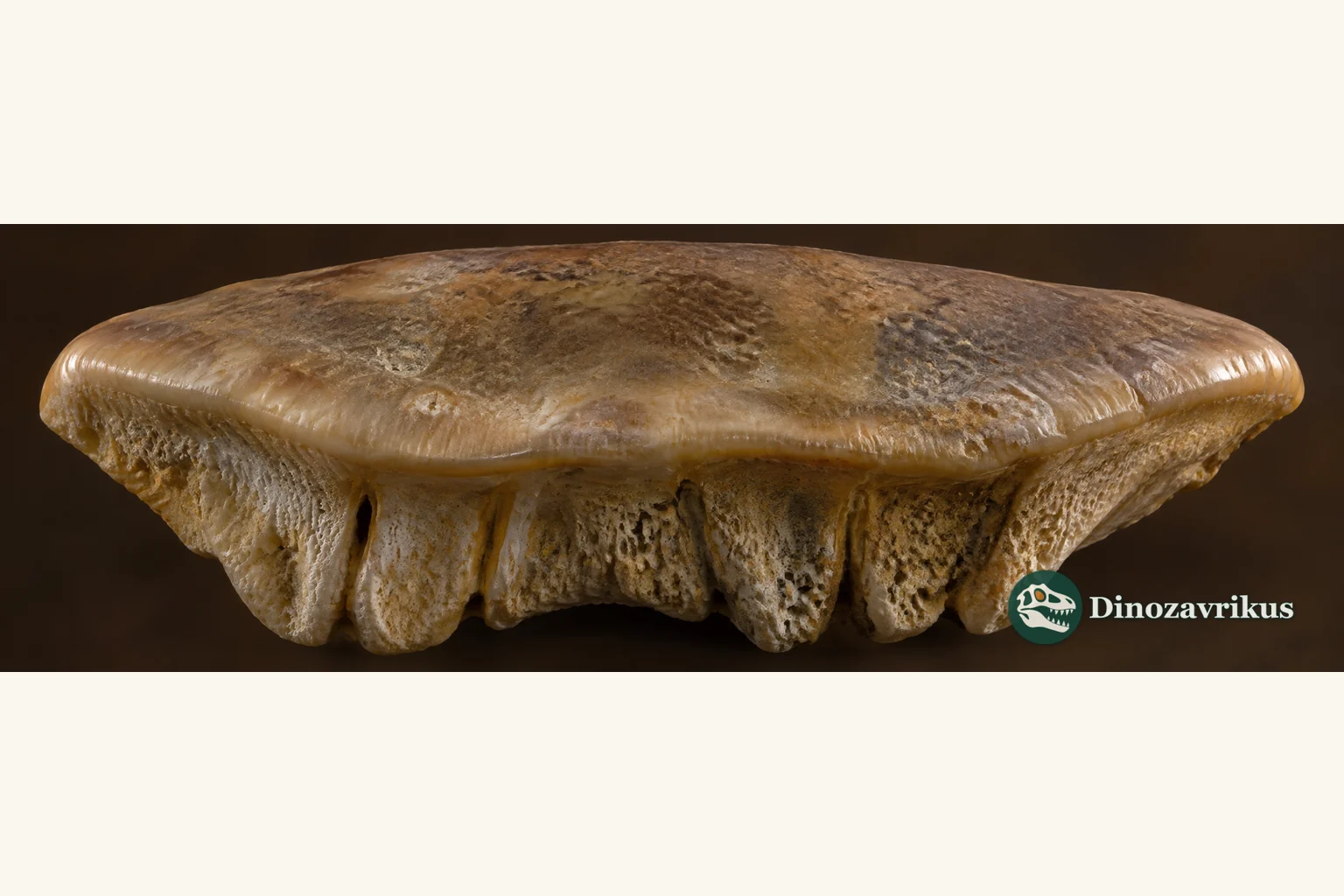
Middle teeth of I. sigmodon are broad across the jaw and curved from front to back. The holotype tooth is about 3.7 times wider than long. Its crown is higher than the root and has a fine honeycomb-like surface; the root alternates grooves and plates of different widths. Some crowns have a conspicuously sigmoid outline, although that curve is not identical in every tooth.
Lateral teeth are different: they are straighter and asymmetrical. This variation is expected along a jaw and is one reason that isolated crowns must be compared by their likely position. The contrast with another Cretaceous ray, Brachyrhizodus, also shows why a tooth outline alone cannot supply a complete head or body reconstruction.
Three named species from Africa, India and Spain
The type species I. sigmodon is from Maastrichtian Niger. Prasad and Cappetta named I. indicus in 1993 from Indian material: six middle and 190 lateral teeth from Marepalli and Asifabad. The holotype is VPL/JU 107. The teeth differ from those of I. sigmodon in crown outline and ornament, allowing the authors to name a second species.
The species I. indicus was later identified in Maastrichtian deposits of the southern Pyrenees. A published sample from Fontllonga and Suterranya contains 202 middle and lateral teeth, plus 51 very small teeth interpreted as likely belonging to young individuals. These are counts of fossil teeth, not counts of rays. A single animal can shed or replace many teeth, and a fossil bed can accumulate remains from multiple animals.
In 2018, Blanco and colleagues described I. marmii from the lower Maastrichtian of northeastern Spain. Their phylogenetic analysis placed the genus within Myliobatidae and the new species in an early position among the taxa they sampled. This is a hypothesis of relationships within a particular analysis, not proof that one named fossil species was the direct ancestor of another.
Age and the limits of the geographic record
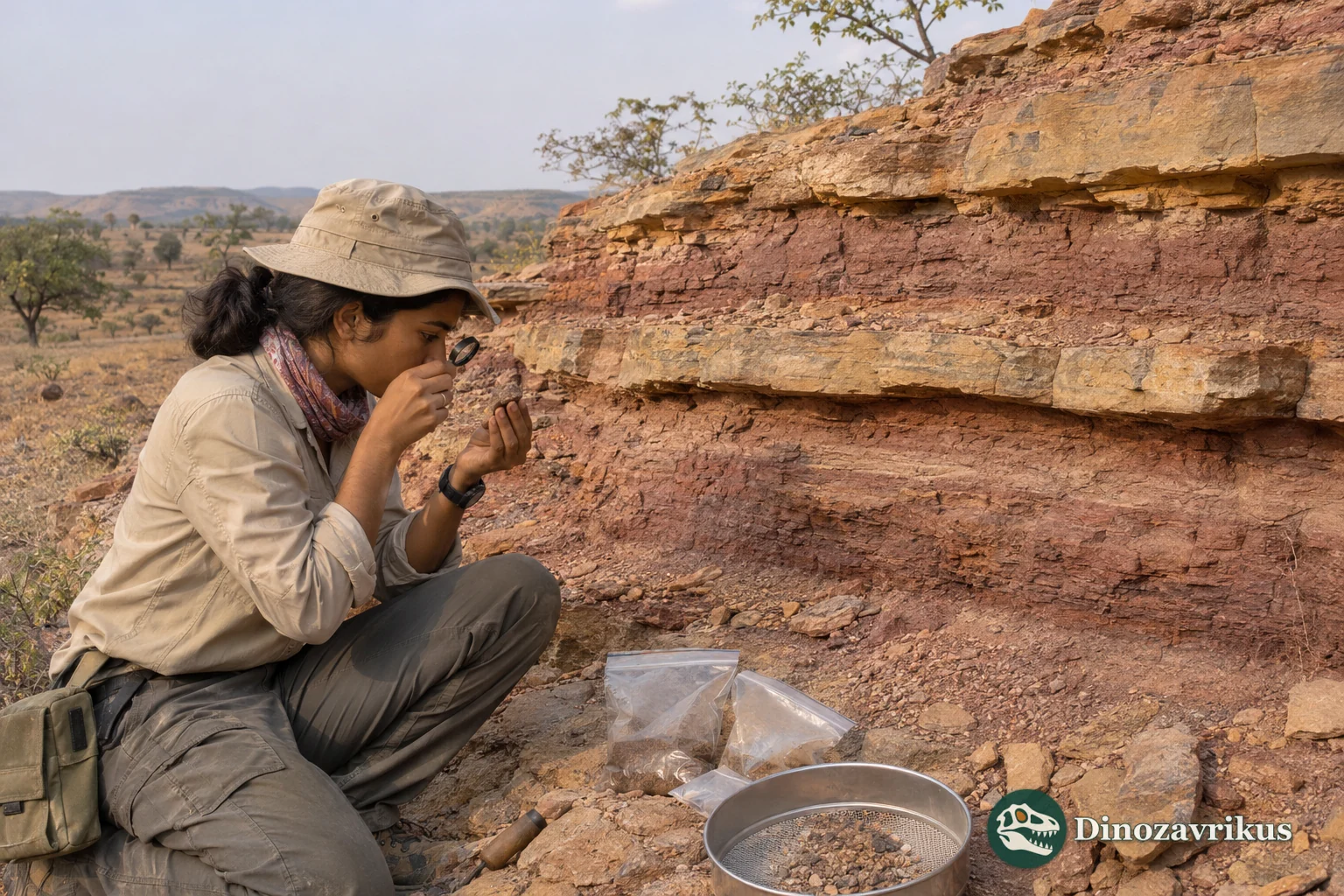
Many records are assigned to the Maastrichtian, the final stage of the Cretaceous. The Niger and Spanish occurrences are tied to the studied formations and their associated fossils. Indian teeth came from beds below and between Deccan lava sequences. The chronology and correlation of those beds are complex, and the age should be assessed for each locality rather than copied from one site to another.
This matters when fossil fish are used to date a bed and the same bed is then used to define the age range of that fish genus. Later work on Deccan-associated deposits discusses uncertainties in those correlations. The Indian material remains important, but its exact relationship to the end-Cretaceous boundary should not be reduced to a single date for every tooth.
What teeth suggest about body and feeding
Broad, transverse teeth could have formed a surface capable of crushing or grinding food. That is a functional hypothesis based on anatomy and comparison with related rays. No stomach contents or unambiguous feeding traces in the cited material identify particular prey. Nor do the fossils establish how often the ray fed in shallow water or whether all species used the same habitat.
Because the genus is classified within Myliobatidae, a broad ray-like body is a reasonable family-level comparison. Yet the fossils discussed here are teeth, not fins or a disc. Total length, disc width, tail proportions and colour are unknown. The cover image is an artistic family-level reconstruction, while the close-up is an explanatory visualization rather than a photograph of a tooth.
Other rays, including the rostrum-bearing Schizorhiza, preserve different parts of the head. Comparing those records helps show how the available fossil elements shape what can be reconstructed for each genus.
Frequently asked questions
Where does the name Igdabatis come from?
Cappetta explained it as a batoid from Mount Igdaman in Niger, where the type material of I. sigmodon was collected.
How many named species of Igdabatis are known?
Three named species are described: I. sigmodon, I. indicus and I. marmii. Some individual teeth can only be identified to the genus or family.
Has a complete Igdabatis skeleton been found?
No. Published material consists chiefly of isolated teeth, so the complete body outline and total length remain unknown.
What did Igdabatis eat?
Its broad teeth may have formed a crushing surface, but no direct stomach or feeding evidence identifies particular prey.